
Flat roofs are everywhere in Mississauga, even on houses that look steeply pitched from the street. Garage decks, rear additions, porch canopies, dormer tie-ins and full low-slope roofs over mid-century homes all rely on membrane systems rather than shingles, and they all fail in ways that shingled roofs do not. If you have noticed a stain spreading across a ceiling, a bubble in your membrane or standing water that never seems to dry, you are already in the market for flat roof repair mississauga homeowners can actually trust. This guide walks through what goes wrong, what the work costs in 2026, how to tell a patch job from a replacement, and what to expect from a competent contractor on site.
Why Flat Roof Repair in Mississauga Is Not the Same as Shingle Work
A sloped roof sheds water by gravity. A flat roof, which in practice means anything under roughly a 2:12 slope, holds water and relies on a continuous waterproof membrane to keep it out. That single difference drives everything about flat roof repair mississauga contractors perform. There is no overlap of shingles to fall back on. If a seam opens, a flashing lifts or a drain backs up, water sits on the failure point until it finds a way through the deck.
The second difference is diagnosis. On a sloped roof, the leak is usually close to the stain below. On a low-slope roof, water can travel several metres between the entry point and the spot where it drips into your living room. It follows the slope of the deck, runs along a joist, then drops at the first low point or fastener penetration. This is why a proper repair starts with an inspection of the whole roof surface rather than a quick patch over the wet spot on the ceiling.
The third difference is season. Mississauga swings from humid, high-UV summers to freeze-thaw winters where surface temperatures on a dark membrane can move forty degrees in a single day. That cycling expands and contracts the membrane, works fasteners loose and stresses every seam and termination bar. Most flat roof failures in the GTA are not dramatic. They are the slow result of thousands of expansion cycles acting on a detail that was never quite right to begin with.
The Housing Character of Mississauga and What It Means for Your Roof
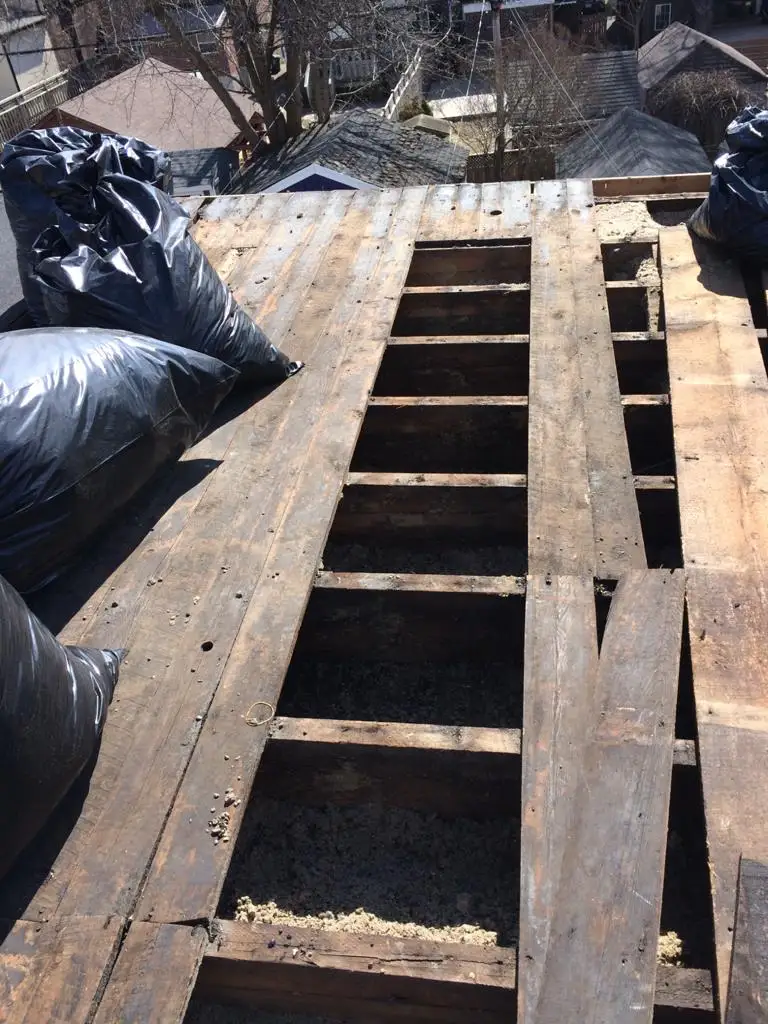
Mississauga is not one housing stock, it is several layered on top of each other, and the roof problems track the era of construction. Older neighbourhoods carry postwar bungalows and side-splits, many with flat or nearly flat additions built onto the back in the 1970s and 1980s. Those additions frequently use built-up tar and gravel or early modified bitumen, and by 2026 a good number of them are on their second or third membrane. The decks under them are often plank rather than plywood, which changes how a contractor fastens a new system and how much board replacement a quote should allow for.
Then there are the large subdivision builds from the 1990s and 2000s, where the flat sections are usually small: a garage roof, a bay window canopy, or the transition where a two-storey wall meets a lower roof. These are almost always torch-applied modified bitumen or, more recently, single-ply. They are small enough that homeowners ignore them for decades, and they leak at wall flashings more often than anywhere else, because the counterflashing was tucked into a mortar joint that has since eroded.
Finally, the estate lots and custom builds scattered through the city often feature genuinely large flat roof areas, sometimes with roof decks, parapets and internal drains. These are effectively commercial systems sitting on a residential building, and they need commercial-grade detailing. A contractor comfortable with a 200 square foot garage roof is not automatically the right choice for a 2,000 square foot parapet roof with two internal drains and a mechanical curb.
Knowing which category your home falls into tells you a great deal before anyone climbs a ladder. It predicts the likely membrane, the likely deck type, and the likely failure points, which in turn tells you whether a quote is realistic or optimistic. Any contractor quoting flat roof repair mississauga work should be able to tell you which era your assembly belongs to within a few minutes of getting on the roof.
The Most Common Flat Roof Problems on Mississauga Homes
Across residential low-slope work in the western GTA, the same handful of issues account for the large majority of service calls. If you are booking flat roof repair mississauga service for the first time, it helps to recognise the symptoms before the estimator arrives.
- Seam and lap failure. Where two sheets of membrane overlap, the bond eventually fatigues. On torch-down roofs, an underheated seam from the original install can hold for years and then open without warning. This is the single most common source of residential flat roof leaks.
- Flashing and termination failure. Anywhere the membrane stops, it has to be sealed: at walls, curbs, skylights, vents, parapets and edge metal. Sealant beads dry out and crack, counterflashing pulls loose, and mortar joints erode. Most leaks that appear near a wall are flashing problems, not field membrane problems.
- Ponding water. Ontario practice is that water should clear a roof within roughly 48 hours. Water that sits longer accelerates membrane breakdown, grows algae and adds weight. Ponding is usually a slope or drainage problem rather than a membrane problem, and patching over it does not address the cause.
- Blisters and ridging. Trapped moisture or air under the membrane expands in summer heat and lifts the sheet. Small, intact blisters can be monitored. Blisters that have split open are a direct route for water into the assembly.
- Punctures and mechanical damage. Foot traffic from HVAC servicing, dropped tools, satellite dish anchors and branch impact all puncture membranes. Single-ply systems are more vulnerable to this than multi-ply built-up assemblies.
- Drain and scupper blockage. Maple keys, seed pods and general debris are a genuine problem in mature Mississauga neighbourhoods with established tree canopy. A blocked drain turns a functioning roof into a shallow pond within one storm.
- Wet insulation and saturated deck. By the time this appears, repair options narrow considerably. Wet insulation does not dry out under a sealed membrane. It has to be cut out and replaced, and the cost of doing so is what turns a modest repair into a section replacement.
The practical takeaway is that most leaks are detail failures rather than whole-system failures. That is good news for your budget, because detail repairs sit at the affordable end of the range, and the majority of flat roof repair mississauga calls resolve without touching the field of the roof at all.
What Flat Roof Repair in Mississauga Costs in 2026
Pricing for flat roof repair in Mississauga depends on access, roof height, membrane type, the number of penetrations and whether the deck below is still sound. The figures below reflect typical 2026 residential pricing across Mississauga and the wider GTA, including materials, labour and disposal. They assume normal ladder or scaffold access and no asbestos-containing material in older built-up assemblies, which occasionally turns up in pre-1985 roofs and requires separate abatement handling.
| Repair type | Typical 2026 cost range | Time on site | What it addresses |
|---|---|---|---|
| Leak diagnosis and inspection report | $150 to $400, often credited to the repair | 1 to 2 hours | Locating the actual entry point, moisture scan, written findings |
| Small seam or puncture patch | $400 to $900 | Half day | One localized failure with sound membrane elsewhere |
| Flashing repair at wall, curb or parapet | $650 to $1,800 | Half to full day | Reworked counterflashing, new termination bar, fresh sealant |
| Skylight or vent curb reflash | $700 to $2,000 per unit | Half to full day | Rebuilt curb wrap and membrane tie-in |
| Multiple repairs plus drainage rework | $1,800 to $4,500 | 1 to 2 days | Several detail failures and a slope or drain correction |
| Section replacement with insulation swap | $14 to $22 per square foot | 2 to 4 days | Wet insulation removal, new deck board, new membrane |
| Full residential flat roof replacement | $12 to $20 per square foot | 2 to 5 days | Tear-off to deck, new insulation, new membrane, new metal |
| Emergency after-hours leak stabilization | $450 to $1,200 | 2 to 4 hours | Temporary watertight seal until a permanent repair |
Two things move these numbers more than anything else. The first is access. A second-storey rear addition behind a fenced side yard with no room for a lift costs meaningfully more to work on than a ground-level garage roof of the same size. The second is what is found under the membrane. A repair quoted on the assumption of dry insulation changes character quickly if the crew opens the roof and finds saturated board. A trustworthy quote for flat roof repair mississauga homeowners can rely on will state explicitly what happens to the price if wet material is discovered, rather than leaving that open to interpretation on the day.
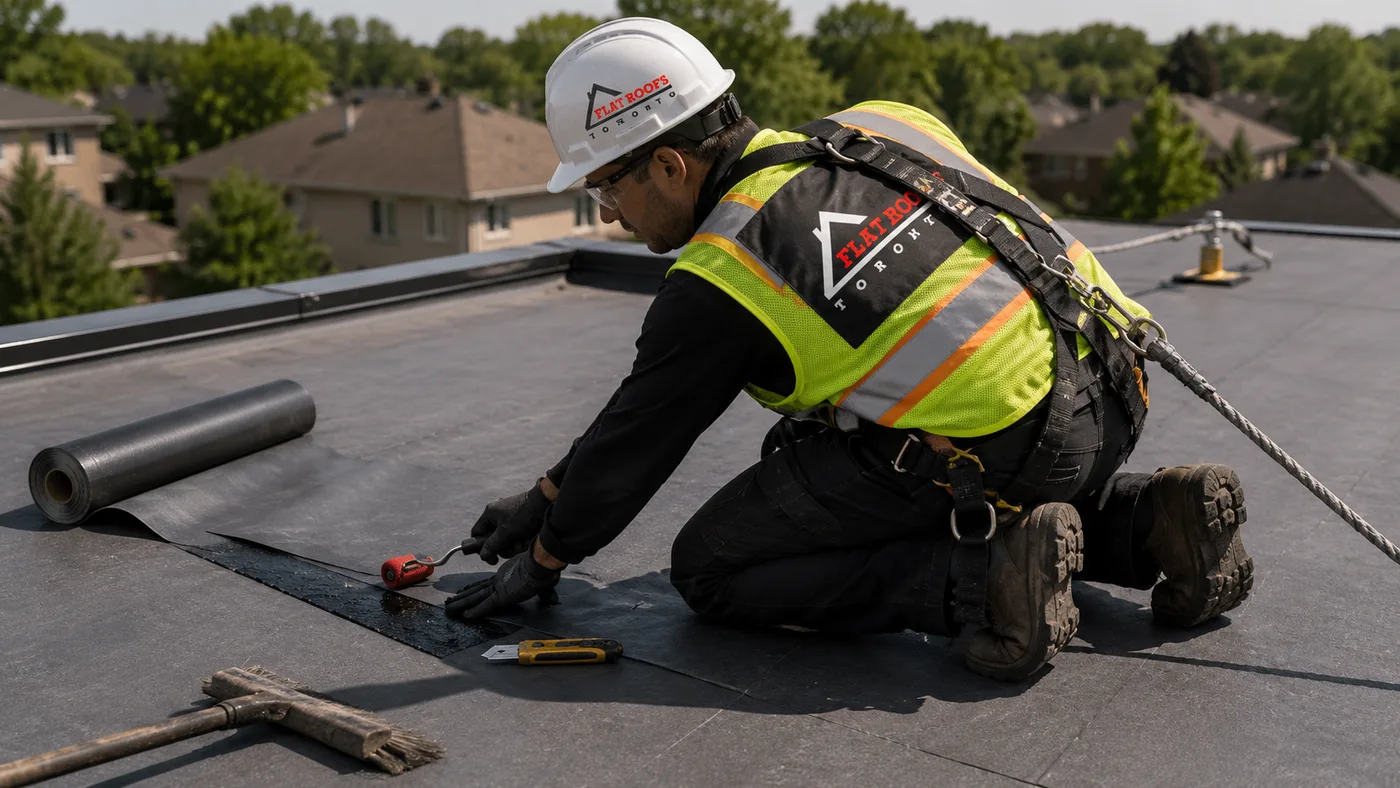
Membrane Types, Expected Life and How Each One Fails
Knowing what is actually on your roof narrows the repair options considerably. Most Mississauga residential low-slope roofs fall into one of five categories, and each has a characteristic way of giving up. The membrane on your roof determines both the method and the price of any flat roof repair in Mississauga.
| Membrane system | Typical service life | Characteristic failure mode | Repairability |
|---|---|---|---|
| Two-ply torch-applied modified bitumen (SBS) | 25 to 30 years | Seam separation, granule loss, cracked flashing | Excellent, patches bond reliably to an existing cap sheet |
| Built-up tar and gravel | 20 to 30 years | Alligatoring, gravel displacement, blistering | Fair, matching materials are harder to source in 2026 |
| TPO single-ply, heat welded | 20 to 30 years | Weld failure at laps, punctures, shrinkage at edges | Good, provided the same TPO family and thickness is used |
| EPDM rubber | 20 to 25 years | Adhesive seam failure, shrinkage pulling at flashings | Good, but weathered EPDM needs cleaning and priming first |
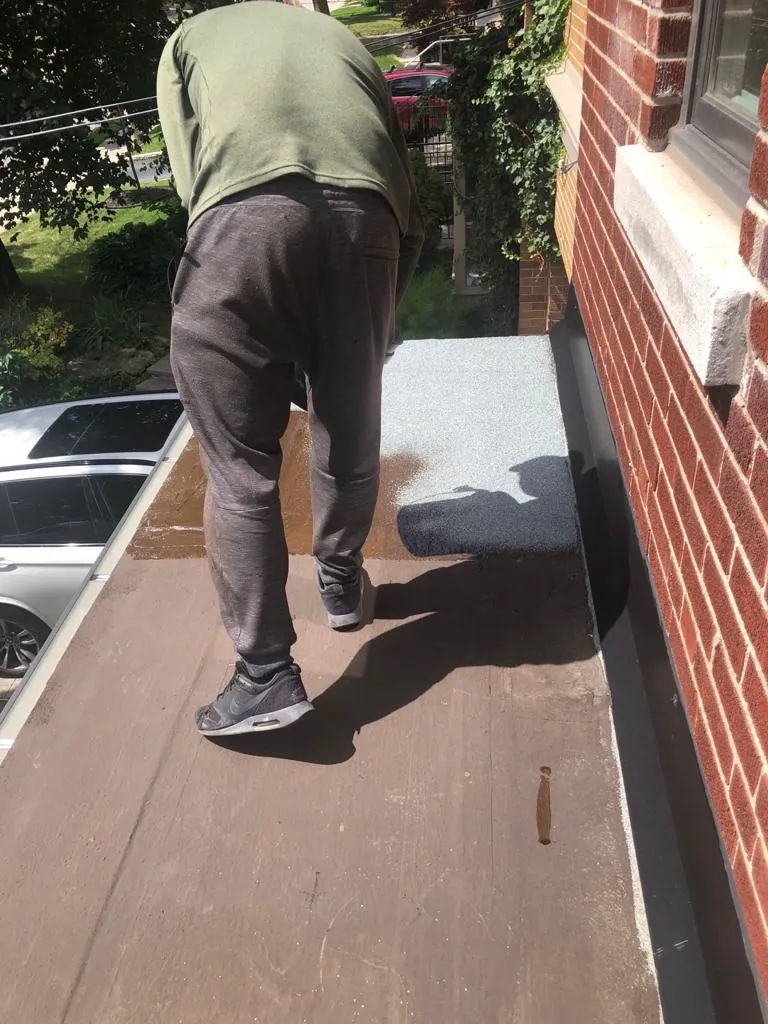
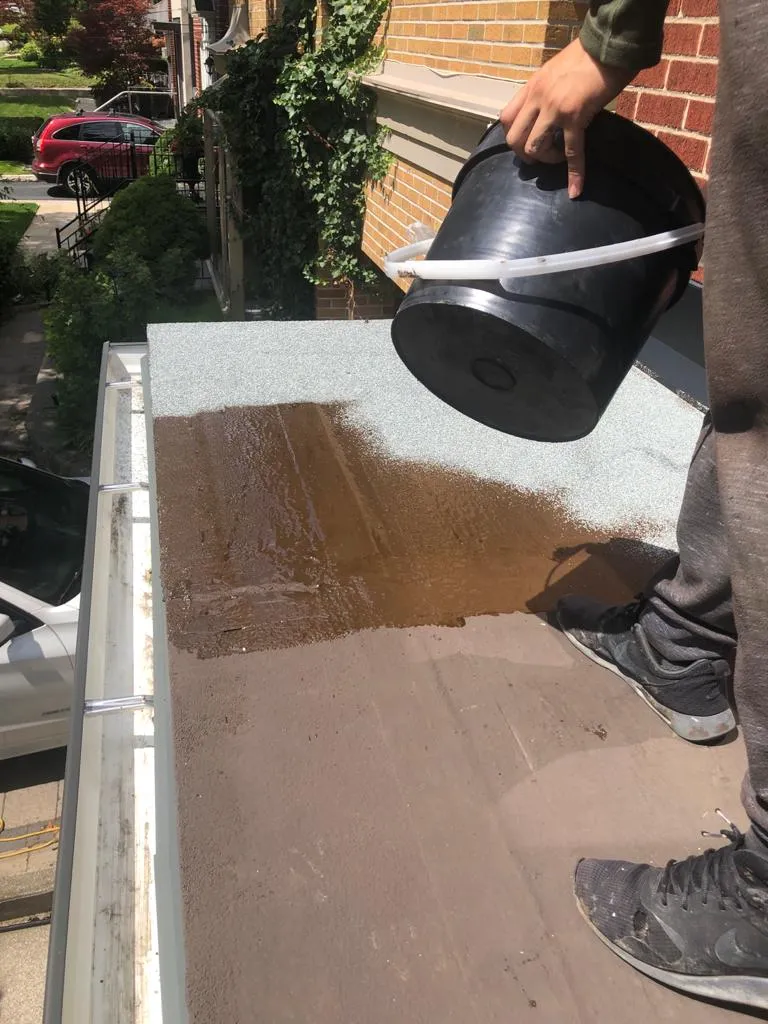
| Liquid applied or rolled asphalt, consumer grade | 5 to 12 years | Cracking, adhesion loss, water tracking under the film | Poor, usually replaced rather than repaired |
The compatibility question matters more than most homeowners expect. You cannot torch modified bitumen onto TPO, and you cannot reliably tape new EPDM to a weathered surface without cleaning and priming it first. A crew that carries only one system and tries to make it work on every roof is a warning sign. Good flat roof repair mississauga work starts with identifying the existing membrane correctly, then either matching it or building a properly engineered transition detail where a match is genuinely impossible.
Repair or Replace: How to Decide Without Guessing
The honest answer is that this is an arithmetic question rather than a philosophical one. Repair makes sense when the membrane still has meaningful service life, the failures are localized, and the insulation below is dry. Replacement makes sense when the membrane is at or past its expected life, when failures are appearing in multiple unrelated locations, or when moisture has already entered the assembly. Most homeowners searching for flat roof repair in Mississauga are somewhere in the middle of that spectrum, which is why a moisture scan is worth paying for before anyone commits to a scope.
A reasonable rule of thumb: if the cost of repairs exceeds roughly 30 percent of a full replacement and the roof is past two thirds of its expected life, replacement is usually the better value over a ten year horizon. If the roof is under fifteen years old with one or two isolated failures, repair is almost always the correct answer and anyone pushing replacement should be asked to justify it in writing.
There are a few clear signals that push toward replacement regardless of age. Widespread ponding that cannot be corrected with a few tapered insulation inserts suggests a structural slope problem. Multiple wet readings on a moisture scan spread across different areas of the roof mean the insulation is compromised in more than one place. Membrane that has gone brittle enough to crack when lifted has no sound bonding surface left for a patch. And if you are already planning to add upgraded insulation or a new skylight, doing that work under a fresh membrane is far cheaper than doing it twice.
It is also worth pricing a partial replacement. Many Mississauga homes have two or three distinct flat sections of different ages and different systems. Replacing the worst section while repairing the others is often the most sensible use of a budget, and a contractor who offers flat roofing services for Mississauga homeowners across both repair and installation can price both routes side by side rather than steering you toward whichever one they prefer to sell.
Emergency Leaks: What to Do in the First Hour
An active leak during a summer thunderstorm is a different problem from a slow ceiling stain. The priority is protecting the interior, not fixing the roof, and there are useful things you can do before anyone arrives. Urgent flat roof repair in Mississauga follows a different sequence from planned work: stabilise first, diagnose properly once the roof is dry.
Move furniture and electronics out of the drip zone and put a container under it. If a ceiling is bulging with trapped water, puncturing the low point of the bulge with a small hole and draining it into a bucket is usually better than letting it hold until the drywall lets go across a much wider area. Shut off power to any circuit near active water. Photograph everything before you clean up, because insurers will ask for it and memory is not evidence.
Do not climb onto a wet low-slope roof to look. Wet membrane, especially TPO and EPDM, is dangerously slick, and standing water hides punctures and soft deck. If the leak is severe enough to need attention before the weather clears, that is a job for a crew with fall protection and the right temporary materials. For active water entry into the building, 24 hour emergency roof repair is the appropriate call rather than waiting for a scheduled inspection slot next week.
One caution about temporary fixes. Tarps and consumer spray sealants applied by a homeowner frequently make the permanent repair more expensive, because the crew has to remove contaminated sealant before new membrane will bond to anything. If you do tarp, weight the edges rather than fastening through the membrane, and tell the contractor exactly what product you used.
Permits, Building Code and Insurance in Mississauga
For straightforward repair and like-for-like re-roofing on a residential building, the City of Mississauga does not generally require a building permit. Permits become relevant when the work changes the structure: replacing or altering roof framing, changing the roof deck substantially, adding a roof access hatch, converting a roof into a walkable deck, or cutting new openings for skylights. If a contractor tells you a permit is required, ask specifically which part of the scope triggers it and confirm with the city’s building department rather than taking it on faith. If a contractor tells you no permit is ever needed for anything, that is equally worth questioning. In practice, the large majority of flat roof repair mississauga jobs proceed without a permit because they restore an existing assembly rather than alter it.
The Ontario Building Code drives several details that separate a compliant repair from a cosmetic one. Roof assemblies need continuous drainage to an approved outlet. Insulation values for a conditioned space below the roof are set by the code’s energy provisions, which matters directly if insulation is being removed and replaced as part of the repair. Flashing at wall junctions has minimum height requirements above the finished roof surface, which is why a proper reflash sometimes involves cutting a new reglet into masonry rather than simply running a bead of caulking along the old line.
On insurance, the general principle in Ontario homeowner policies is that sudden and accidental damage is covered while gradual deterioration and deferred maintenance are not. A membrane torn off in a windstorm is usually a claim. A membrane that failed because it is twenty-eight years old is usually not. Documentation helps in the grey zone: dated inspection reports showing the roof was maintained, photographs from before the event, and a contractor’s written assessment of the cause. Keep the invoices from maintenance visits, because they are the evidence that the roof was not neglected.
What a Professional Repair Visit Actually Looks Like
A repair done properly follows a predictable sequence, and knowing that sequence makes it straightforward to tell competent work from a rushed patch. Every flat roof repair in Mississauga should move through the six stages below, whether the job takes half a day or most of a week.
| Stage | What happens | Typical duration | What you should receive |
|---|---|---|---|
| 1. Assessment | Full roof walk, moisture scan, interior stain mapping, photographs | 1 to 2 hours | Written findings with a photo of each defect |
| 2. Scope and quote | Defined repair list, materials specified by name, exclusions stated | 1 to 3 days to receive | Itemized written quote, not a single lump number |
| 3. Site setup | Access, fall-protection anchors, ground protection, debris containment | About 1 hour | Proof of WSIB coverage and liability insurance |
| 4. Cut back and dry out | Failed membrane removed to sound material, wet insulation cut out | 2 to 6 hours | Photos of the opened assembly before it is closed |
| 5. Rebuild | New insulation or deck board, primer, new membrane plies, new metal | 3 hours to 2 days | Photos of each layer as it is installed |
| 6. Water test and closeout | Flood or hose test where practical, cleanup, magnet sweep for fasteners | 1 to 2 hours | Written warranty terms and completion photographs |
Two items on that list are worth insisting on. The first is photographs of the opened assembly, because once the roof is closed you have no way to verify what was underneath. The second is a written warranty that distinguishes between the workmanship warranty on the repair, typically two to ten years depending on scope, and any remaining manufacturer warranty on the membrane itself. A verbal assurance that the work is guaranteed is not a warranty. You can also get a useful sense of what finished work should look like by reviewing a contractor’s completed project gallery before you commit to anything.
Preventive Maintenance That Reduces Repair Costs
Flat roofs reward attention far more than sloped roofs do, because the failure modes are gradual and visible early if anyone bothers to look. A twice-yearly inspection, ideally in spring after freeze-thaw season and again in autumn before the leaves fall, catches most problems while they are still five hundred dollar repairs rather than five thousand dollar ones. Regular inspection is the cheapest form of flat roof repair mississauga homeowners have available to them.
- Clear drains, scuppers and gutters at least twice a year, and more often where mature maples or birches overhang the roof.
- Inspect every penetration. Vents, stacks, skylight curbs and mechanical curbs are where sealant fails first. Beads should be checked annually and reapplied roughly every four to six years.
- Look for ponding 48 hours after rain. Any water still standing marks a low spot that will fail early and should be corrected with tapered insulation.
- Check the underside. Where there is an accessible attic or ceiling cavity below the roof, a look with a flashlight for staining on the deck sheathing catches leaks well before they reach a finished ceiling.
- Keep traffic off the membrane. If rooftop equipment needs regular servicing, walkway pads are cheap insurance against puncture damage.
- Trim overhanging branches back from the roof edge to reduce both debris load and abrasion during wind.
Homeowners who follow this routine typically spend a few hundred dollars a year and push a full replacement several years further out. Those who ignore the roof until the ceiling stains usually pay for both the repair and the interior drywall and paint work that follows it. When the time does eventually come for a new system, planning it as a planned residential flat roof installation rather than an emergency gives you time to compare membranes, schedule around the weather and gather competing prices.
Frequently Asked Questions About Flat Roof Repair in Mississauga
How much does flat roof repair in Mississauga typically cost?
How long does a flat roof repair take?
Can flat roof repair in Mississauga be done in winter?
Why does my flat roof leak only during heavy rain?
Do I need a permit for flat roof repair in Mississauga?
Is it worth repairing a flat roof that is over 25 years old?
Book Your Flat Roof Repair in Mississauga With an Experienced Low-Slope Crew
Flat Roofs Toronto is a Toronto-based low-slope roofing contractor providing flat roof repair in Mississauga for homeowners and property managers across the city. We work on modified bitumen, TPO, EPDM and built-up systems, we identify the existing membrane before we quote, and we document the assembly with photographs at every stage so you can see exactly what you paid for. Whether you need a single seam repaired, a skylight curb reflashed or an honest second opinion on a quote you already have in hand, we will tell you plainly whether repair or replacement is the better value for your roof.
Call us today at (647) 333-3528 or request a free consultation to book an inspection at a time that suits you.
Flat Roofs Toronto proudly serves Mississauga, Oakville, Brampton, Etobicoke and communities across the Greater Toronto Area with residential and commercial flat roofing.