Flat and low-slope roofs are far more common across Mississauga, Brampton and Caledon than most homeowners realise, and flat roofing Peel Region work follows different rules than the steep asphalt shingle roofs that dominate the same streets. A low-slope surface has no gravity assist. Water sits on it, snow drifts across it, and every seam, drain and flashing detail has to be watertight rather than merely water shedding. That single difference changes the materials, the crew skills, the inspection schedule and the budget. It is also why flat roofing Peel Region quotes vary so widely for what looks, from the ground, like the same job.
This guide covers what homeowners and small building owners across Peel need to know before committing to a flat roofing Peel Region project in 2026: which membranes perform in our freeze and thaw climate, what installed pricing actually looks like this year, when a permit is required, how drainage and insulation decisions quietly determine whether a roof lasts twelve years or thirty, and how to evaluate the contractors bidding on the job. The goal is a practical reference, not a sales pitch.
Why Flat Roofing Peel Region Homes Demand a Different Approach
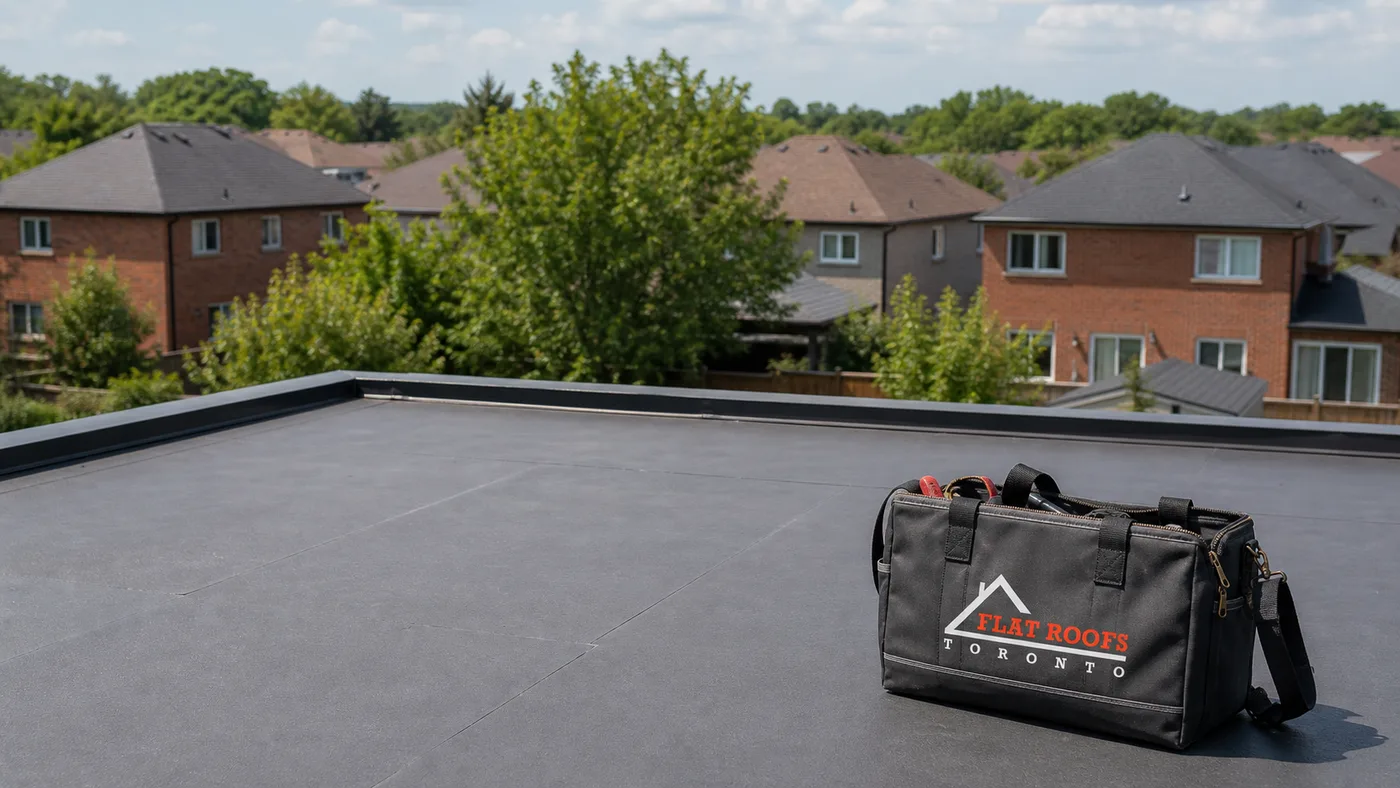
The phrase flat roof is slightly misleading. A properly built low-slope roof is never truly level. The Ontario Building Code and every major membrane manufacturer expect a minimum slope of roughly two per cent, or about one in fifty, so that water moves toward drains or scuppers instead of pooling. Achieving that slope on an existing structure usually means tapered insulation, cricket framing between drains, or shimming the deck. Skipping it is the single most common shortcut in the trade, and it is why so many flat roofing Peel Region repairs trace back to standing water rather than a defective membrane.
Our climate compounds the problem. Southern Ontario cycles through freeze and thaw dozens of times between November and April. Water that ponds in a low spot freezes overnight, expands, then thaws in the afternoon sun. Repeat that cycle for a few winters and even a well made seam begins to open. Add summer surface temperatures that can climb well past forty degrees Celsius on a dark membrane and the material is being pulled through an enormous annual thermal range. Membranes chosen for flat roofing in Peel Region need proven cold-weather flexibility and strong seam technology, not just a low price per square foot.
Wind matters too. Peel has long open corridors, newer subdivisions with limited mature tree cover, and rural exposure north of Brampton where wind speeds pick up noticeably. Uplift pressure is highest at roof corners and perimeters, which is exactly where cheap fastening patterns fail first. A competent flat roofing Peel Region installer increases fastener density at corners and edges rather than using one uniform pattern across the whole field.
The Housing Character of Mississauga, Brampton and Caledon
Peel Region is not one housing stock. It is at least three, and the right flat roofing Peel Region strategy shifts with each of them.
Mississauga
Mississauga blends postwar bungalows and split-levels in its older established areas with dense townhouse and mid-rise development closer to the city centre. The older homes frequently carry a low-slope rear addition, a flat-roofed carport, or a sunroom built decades after the original house. Those additions are where most residential flat roofing Peel Region calls originate, because they were often framed with minimal slope and re-covered several times without a full tear-off. Newer townhouse blocks add another wrinkle: shared or nearly shared roof planes, tight access, and condominium or builder warranty considerations that affect who authorises the work.
Brampton
Brampton is dominated by newer subdivision housing, much of it built from the 1990s onward, alongside an older core with brick homes of an earlier era. Subdivision homes typically have steep shingle roofs, but flat sections appear over garages, porticos, bay projections and second-floor terraces. These small areas are deceptively demanding. They are almost entirely edge and transition detail with very little open field, so the quality of the flashing work matters far more than the membrane brand. Homeowners in Brampton often discover a leak inside a garage ceiling or a bedroom above a porch long before the main roof shows any wear, and those small areas make up a large share of flat roofing Peel Region service calls.
Caledon
Caledon runs to larger estate lots, rural properties, converted or purpose-built outbuildings, and a mix of custom homes where architects have used flat roof sections deliberately for a modern profile. Larger uninterrupted flat areas are more common here, and so are detached structures such as shops and barns. Exposure is greater, snow drifting against tall parapets and adjacent walls is more pronounced, and access for equipment is easier but travel distances are longer. A flat roofing Peel Region project in the region’s northern half often means bigger single-membrane areas and more attention to snow load concentration.
Across all three municipalities, the same underlying truth holds: the flat portion of the roof is usually not the biggest part of the roof, but it causes a disproportionate share of the leaks. If you want a broader look at how we handle flat roofing services across Peel Region and the wider GTA, that is the place to start.
Flat Roofing Materials That Hold Up in Peel Region Weather
There is no single best membrane. There is a best membrane for a given roof size, slope, access, budget and expected service life. The five systems below cover almost every flat roofing Peel Region installation you are likely to be quoted.
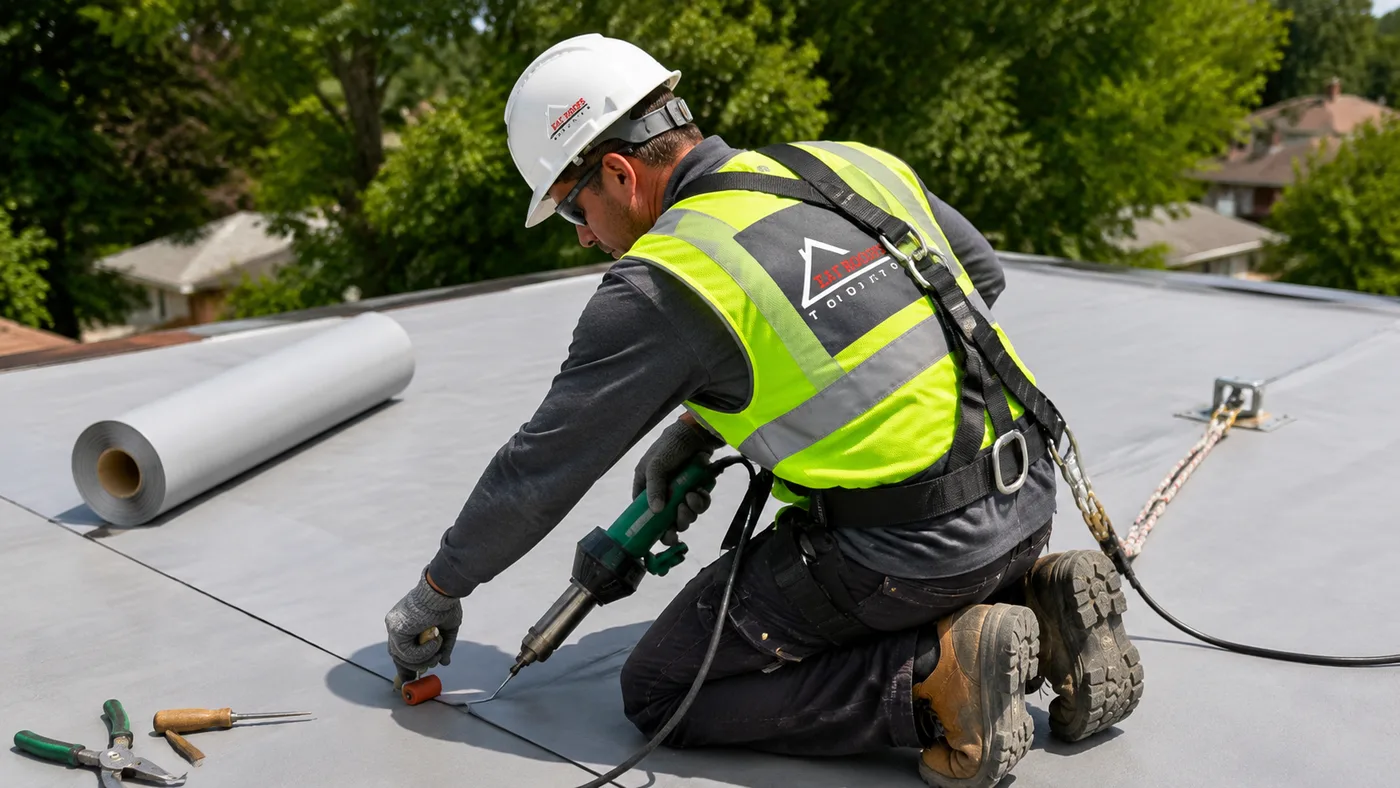
Two-ply modified bitumen (SBS) remains the workhorse for residential low-slope roofs in the GTA. A base sheet is mechanically fastened or adhered, then a granulated cap sheet is torch-applied or self-adhered over it. Two full layers give genuine redundancy, and the material handles our cold well. It is forgiving around the awkward penetrations and parapet transitions typical of older homes.
TPO is a single-ply thermoplastic sheet with hot-air welded seams. The welds are strong and consistent, the white surface reflects summer heat, and installation on large open areas is fast. TPO is an excellent fit for bigger, simpler roof planes and is very common on commercial flat roof installation projects where roof areas are measured in thousands of square feet.
EPDM is a synthetic rubber membrane, usually black, valued for elasticity and long field performance. Its weakness is seams, which are adhesive or tape based rather than welded, so seam workmanship carries more weight. On smaller roofs with few penetrations it can be a sensible, economical choice.
PVC costs more but resists grease, chemicals and ponding better than most alternatives, and its heat-welded seams are exceptionally durable. It is the usual recommendation where restaurant exhaust or industrial discharge is present, and increasingly for owners who simply want the longest realistic service life.
Built-up roofing, the traditional tar and gravel assembly, still exists on many older Peel buildings. It is rarely specified new for houses today, but understanding it matters because tearing one off is heavier, slower and more expensive than removing a single-ply system.
| Membrane system | Typical service life | 2026 installed cost per sq ft | Best suited to |
|---|---|---|---|
| Two-ply modified bitumen (SBS) | 20 to 30 years | $12 to $18 | Residential additions, garages, complex detailing |
| TPO single-ply | 20 to 30 years | $10 to $16 | Larger open roof areas, light-coloured reflective surface |
| EPDM rubber | 20 to 30 years | $9 to $15 | Simple roof planes, fewer penetrations, tighter budgets |
| PVC single-ply | 25 to 35 years | $13 to $20 | Grease or chemical exposure, longest expected lifespan |
| Built-up (tar and gravel) | 20 to 25 years | $11 to $17 | Legacy replacement in kind, heavy traffic surfaces |
Ranges reflect fully installed pricing including tear-off of one existing layer, standard insulation and normal access. Small roof areas sit at or above the upper end of each range because setup, disposal and crew mobilisation are close to fixed costs regardless of size. Ask any flat roofing Peel Region bidder to state the assumed membrane and thickness so the comparison is genuinely like for like.
What Flat Roofing Costs in Peel Region in 2026
Homeowners usually want a number before they want a lecture on membranes, so here is an honest framing. Flat roofing Peel Region pricing is driven by five variables: total area, how many existing layers must be removed, the amount of perimeter and penetration detail, insulation upgrades, and access. Two roofs of identical size can differ by thousands of dollars on detail alone.
Tear-off is the most common source of change orders. A roof carrying one old layer is straightforward. A roof carrying three, including a gravel-surfaced built-up assembly, involves far more labour, dumpster volume and landfill tipping fees. Reputable contractors either verify the layer count with a test cut before quoting or state clearly in writing what the price assumes and what an extra layer will cost.
Deck condition is the second surprise. Once the old membrane is off, rotted plywood or deteriorated plank decking has to be replaced. Any estimate should name a per sheet or per square foot rate for deck repair so the number is agreed before the crew is standing on the roof with the phone in hand.
| Project type | Typical roof area | 2026 installed cost range | Notes |
|---|---|---|---|
| Rear addition or sunroom roof | 200 to 400 sq ft | $4,000 to $8,500 | Minimum job pricing often applies |
| Detached garage or carport | 300 to 600 sq ft | $4,500 to $10,500 | Simple field, low detail count |
| Full low-slope roof, semi or townhouse | 700 to 1,200 sq ft | $9,000 to $20,000 | Parapet and party wall detailing adds cost |
| Full low-slope roof, bungalow or custom home | 1,200 to 1,800 sq ft | $14,000 to $30,000 | Tapered insulation often required |
| Small commercial or mixed-use building | 2,500 to 6,000 sq ft | $26,000 to $85,000 | Drains, curbs and mechanical units drive pricing |
| Additional layer tear-off | Any | Add $1.50 to $3.00 per sq ft | Gravel built-up removal sits at the top of the range |
These are working ranges for 2026 in the Peel and Toronto market, not quotes. Prices move with material costs, disposal fees and how busy the season is. If a bid lands dramatically below every one of these ranges, the usual explanations are a single-ply installed over the existing roof without a tear-off, thin or omitted insulation, or an unlicensed crew without proper coverage. For straightforward home projects, our residential flat roof installation process is scoped and priced the same way described here.
Permits, Ontario Building Code and Municipal Requirements Across Peel
Building permits in Peel are issued by the individual municipality, not by the region. That means the City of Mississauga, the City of Brampton and the Town of Caledon each run their own building division, with their own fee schedules and review timelines. Never assume a process learned in one municipality applies unchanged in the next one over, and never assume a flat roofing Peel Region job is permit free simply because a neighbour’s was.
As a general rule, a like-for-like re-roof that replaces the membrane without altering structure does not require a building permit. A permit is typically triggered when the work involves structural change, such as new or sistered joists, a change in roof height or slope framing, converting a roof into a usable deck or terrace, or adding new openings for skylights and hatches. Any project that changes how the building is used, or that adds occupant load on the roof, moves firmly into permit territory.
The Ontario Building Code also governs several details that homeowners rarely see on a quote. Low-slope roofs must drain, which is why that two per cent minimum slope keeps appearing. Insulation levels for the roof assembly are set out in the supplementary standard for energy efficiency, and for southern Ontario new construction that generally means an effective thermal resistance in the range of RSI 8.67, roughly R-49, though re-roofing an existing home is assessed differently and the required level depends on how much of the assembly is being rebuilt. Wind uplift resistance, fire classification of the covering, and guard requirements around any accessible roof edge are all code-driven as well.
Practical advice: ask the contractor directly whether the scope requires a permit, and if the answer is no, ask them to explain why in one sentence. A firm that handles flat roofing Peel Region projects regularly will answer immediately and without hedging. If a leak has already made the building unsafe or is actively damaging the interior, emergency roof repair can stabilise the situation while the permanent scope and any permit are sorted out.
Drainage, Insulation and Ventilation Details That Decide Roof Lifespan
Membrane brand gets the marketing attention. Assembly design determines the outcome.
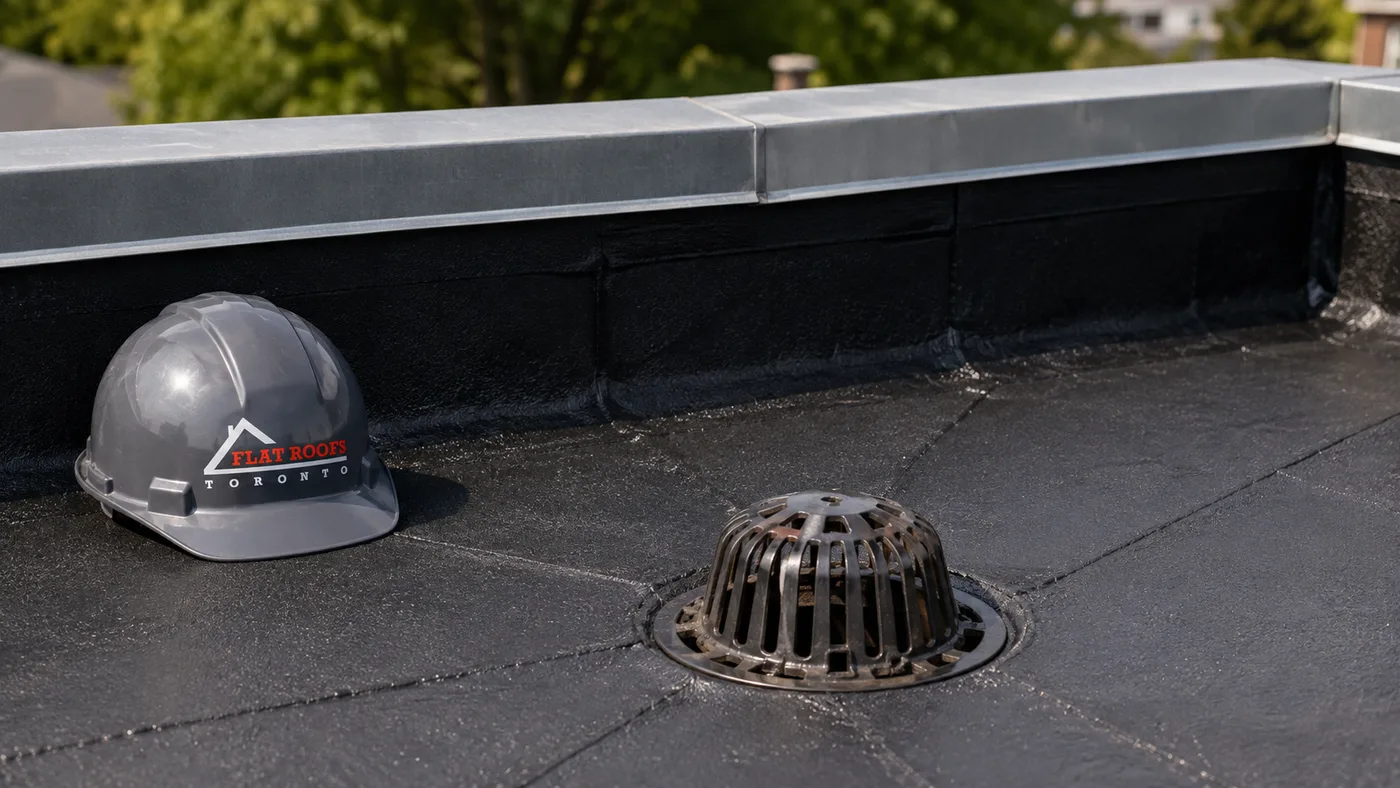
Drainage comes first. Every low-slope roof needs a defined path to move water off the surface within roughly forty-eight hours of a rainfall. That path is either internal drains, scuppers through a parapet, or a controlled edge with eavestroughs. Whichever it is, the roof has to slope toward it consistently, and the low point has to actually be at the drain. Tapered rigid insulation is the standard way to build slope on a deck that has none, and crickets are added between drains or behind large curbs to prevent dead zones. If a contractor proposes replacing a ponding roof without addressing why it ponds, the new membrane will fail in the same places as the old one. Drainage design is the single highest-value line item in most flat roofing Peel Region quotes.
Insulation on a flat roof usually sits above the deck rather than below it, which is a fundamental difference from a vented attic. In a conventional assembly, rigid insulation is laid over the deck, a vapour retarder controls moisture from inside, and the membrane goes on top. Done well, this keeps the deck warm and dramatically reduces condensation risk. Done poorly, with gaps between boards or a missing vapour control layer, warm indoor air reaches a cold deck and condenses, and the homeowner spends years chasing a leak that is not a leak at all. Where a flat roof adjoins a conventional attic space, the connected attic insulation work has to be coordinated so the two systems do not fight each other.
Ventilation is more nuanced on low-slope roofs than on shingle roofs. Compact or unvented assemblies rely on continuous air and vapour control rather than airflow, while some retrofit assemblies over an existing joist cavity still need a vented path. Mixing the two approaches, for example adding vents to an assembly designed to be sealed, tends to make things worse. This is one of the areas where an experienced flat roofing Peel Region contractor earns their fee, because the correct answer depends on the existing construction rather than a rule of thumb.
Penetrations deserve a final word. Plumbing stacks, exhaust vents, mechanical curbs and skylight frames are where most flat roofs eventually leak. Each one needs a proper curb or boot, membrane turned up and terminated correctly, and a metal counter-flashing or clamp where required. If you are adding daylight during a re-roof, integrating residential skylights at the same time is far cleaner and cheaper than cutting into a new membrane a year later.
Maintenance That Extends the Life of a Flat Roof
A flat roof is the most maintenance-sensitive roof type on a house, and also the most neglected, because nobody sees it from the driveway. The good news is that the maintenance itself is inexpensive relative to the cost of a premature replacement. Two inspections a year, spring and fall, catch nearly every issue while it is still a small repair, and that habit alone adds years to the life of a flat roofing Peel Region installation.
What matters most: keeping drains and scuppers clear, checking seams and flashings for lifting or cracking, watching for ponding that persists more than two days after rain, inspecting sealant at penetrations, and clearing debris that traps moisture against the membrane. On roofs with mechanical equipment, the area around each unit deserves particular attention because service technicians walking on a membrane cause more damage than weather does.
| Maintenance task | Recommended frequency | Why it matters | Typical 2026 cost |
|---|---|---|---|
| Full visual inspection and report | Twice yearly | Catches seam and flashing failures early | $200 to $450 per visit |
| Drain, scupper and gutter clearing | Twice yearly, more with mature trees | Prevents ponding and overflow at parapets | $150 to $350 |
| Seam and flashing resealing | As found, roughly every 3 to 5 years | Restores the most failure-prone details | $400 to $1,200 |
| Localised membrane patch repair | As needed | Stops a small breach becoming deck rot | $450 to $1,500 |
| Reflective or protective coating | Every 8 to 12 years on suitable systems | Reduces heat load and surface weathering | $2.50 to $5.00 per sq ft |
Keep the paperwork. A documented maintenance history is often required to keep a manufacturer’s material warranty in force, and it makes any future insurance or resale conversation considerably easier.
How to Choose a Flat Roofing Contractor for Peel Region
Low-slope roofing is a specialty. Plenty of capable shingle crews are genuinely good at steep-slope work and genuinely out of their depth on a torch-applied or welded membrane. When you collect bids for flat roofing Peel Region work, screen for the following.
- Low-slope specific experience. Ask what percentage of their work is flat or low-slope, and ask to see completed low-slope projects rather than a general portfolio.
- WSIB clearance and liability insurance. Request current certificates directly, not a verbal assurance. Torch-applied work in particular should never proceed without confirmed coverage.
- A written scope, not a one-line price. The quote should name the membrane system and manufacturer, number of plies, insulation type and thickness, how many layers are being removed, how deck repairs are priced, and what the drainage plan is.
- Clear warranty terms. Manufacturer material warranties and contractor workmanship warranties are separate things. Get both in writing, with the workmanship term stated in years.
- A real answer on slope. If the roof currently ponds, the contractor should explain specifically how the new assembly will drain. Vague reassurance is a warning sign.
- Local familiarity. A contractor who works across Peel and the surrounding GTA regularly will know the municipal building divisions, typical construction of the housing stock, and disposal logistics.
It is also fair to ask how a company handles the work it cannot do on the spot. Honest answers about scheduling, weather delays and the limits of a repair tell you more about a flat roofing Peel Region contractor than a glossy brochure does. Looking through a contractor’s completed project gallery is a quick way to confirm the type and quality of low-slope work they actually perform.
How much does flat roofing in Peel Region cost in 2026?
How long does a flat roof last in the Toronto and Peel climate?
Do I need a building permit for a flat roof replacement?
Which membrane is best for flat roofing Peel Region homes?
Can a new flat roof be installed over the existing one?
What time of year is best to replace a flat roof?
Book Your Flat Roofing Peel Region Consultation Today
Whether you are dealing with a leaking garage roof in Brampton, a tired addition membrane in Mississauga, or a larger low-slope surface on a Caledon property, the right starting point is an honest assessment of the existing assembly. Flat Roofs Toronto is based in the Toronto area and works throughout Peel, and every quote we provide names the system, the layer count, the drainage plan and the warranty in writing so you can compare bids on the same terms.
Call us today at (647) 333-3528 or request a free consultation to have your roof assessed and priced properly.
Flat Roofs Toronto proudly serves homeowners and building owners across Peel Region, including Mississauga, Brampton and Caledon, along with communities throughout the Greater Toronto Area.