If your building has an older built-up flat roof, there is a real chance that some layer of it contains asbestos. Asbestos roofing was not one product but a family of them: saturated felts in the plies, flashing cements at parapets, mastics around penetrations, some coatings and some older sheet products. None of it can be identified by eye. Before an old roof is torn off, the only reliable way to know is to have samples taken by a qualified firm and analysed by an accredited laboratory.
What follows covers where asbestos tends to hide in older flat roofs, how sampling works, what Ontario requires in general terms, how results change the choice between recovering and tearing off, and what testing and abatement do to cost and schedule. It is general information, not legal advice; confirm your obligations with the appropriate authority or a qualified asbestos consultant.
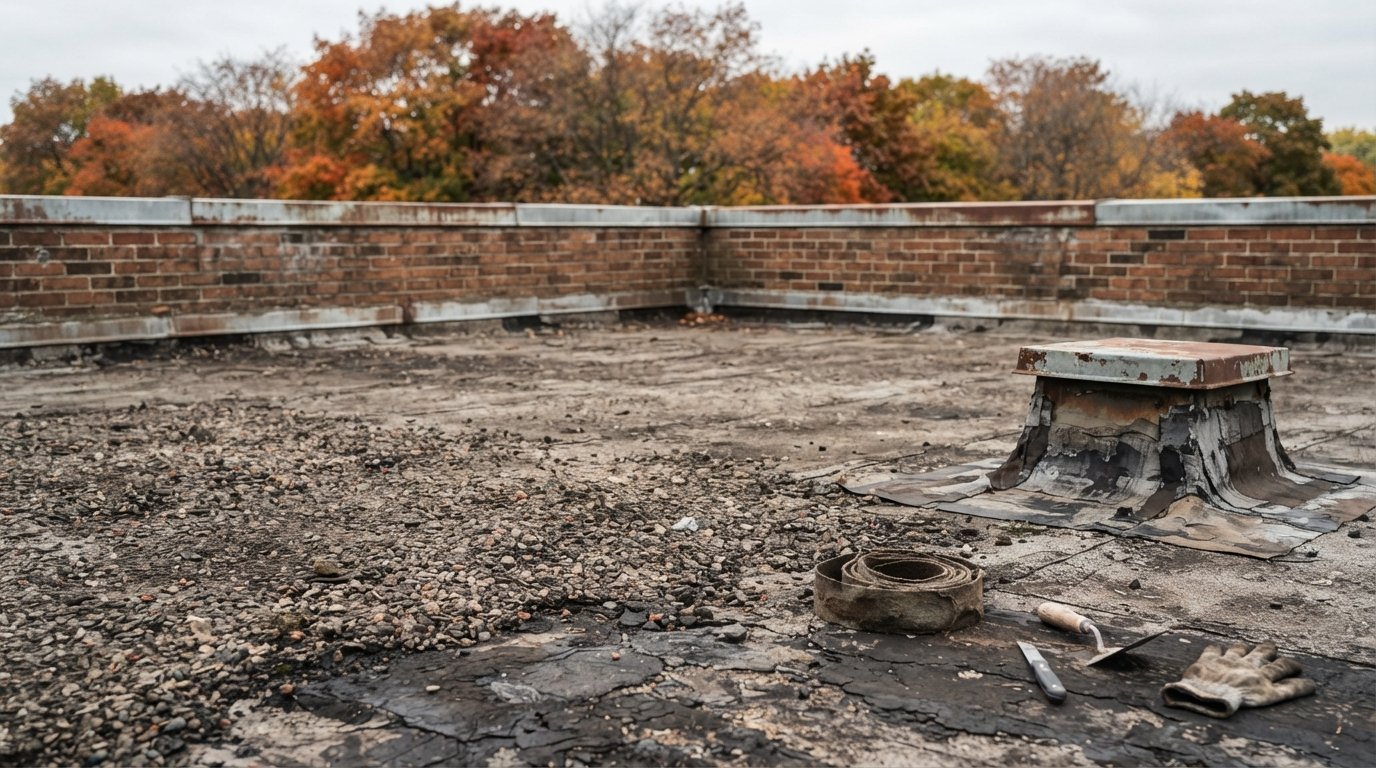
Where Asbestos Roofing Materials Are Found In Older Flat Roofs
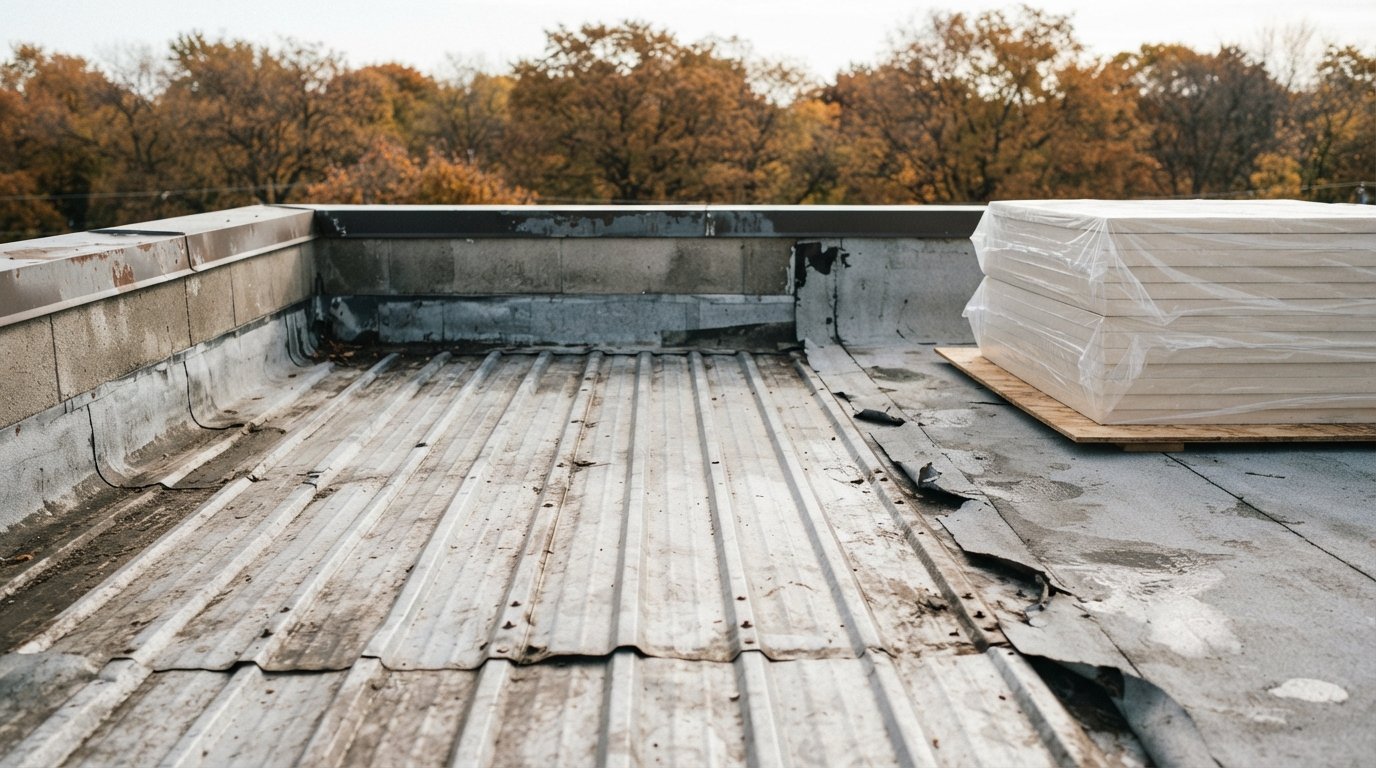
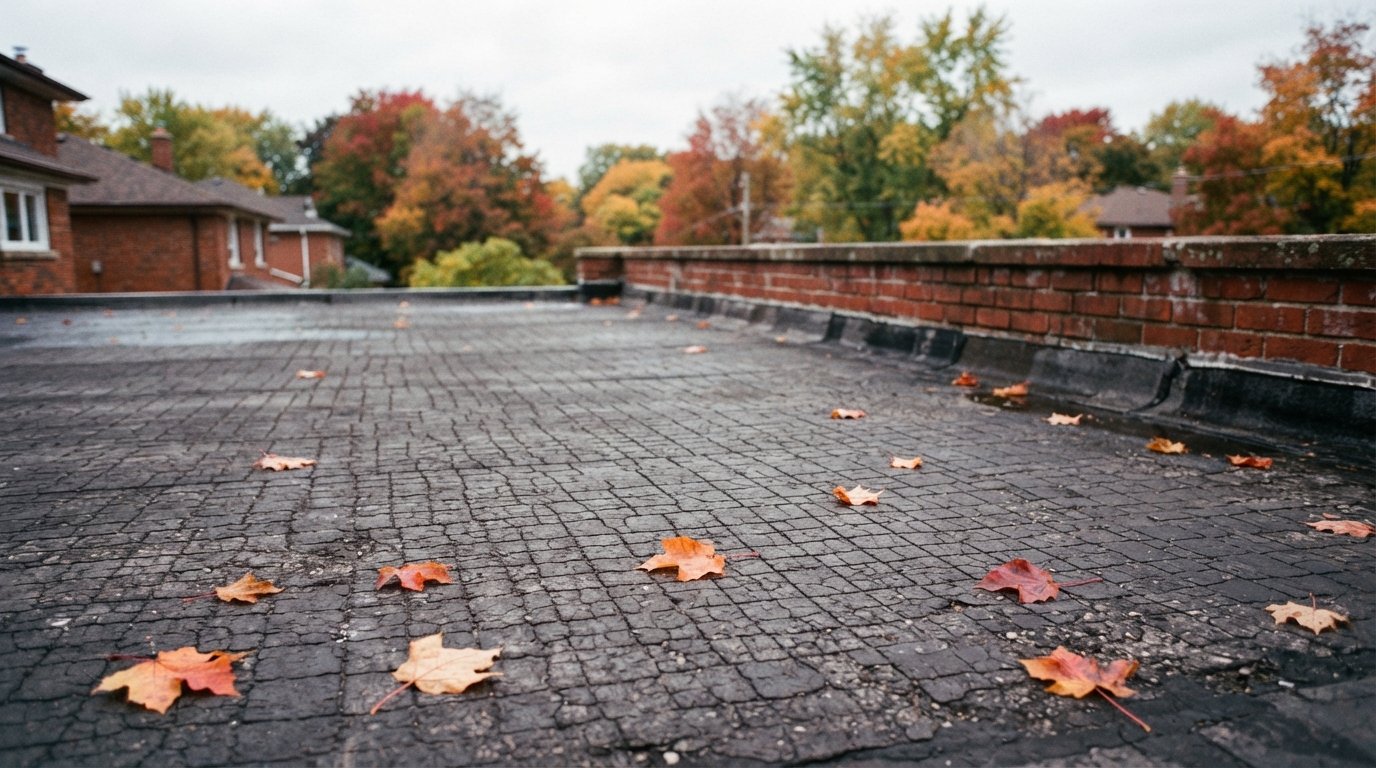
Asbestos was added to many building products for strength and fire resistance. Its use declined over several decades, and Canada prohibited the import, manufacture, sale and use of asbestos and asbestos-containing products at the end of 2018. Roofs installed well before that, particularly the oldest built-up roofs still found on Toronto-area plazas, walk-ups, schools, churches and older houses, are the ones to question. A newer cap sheet on top does not tell you what is underneath, because many older roofs have been recovered once or twice.
| Material | Where it is found | What to sample |
|---|---|---|
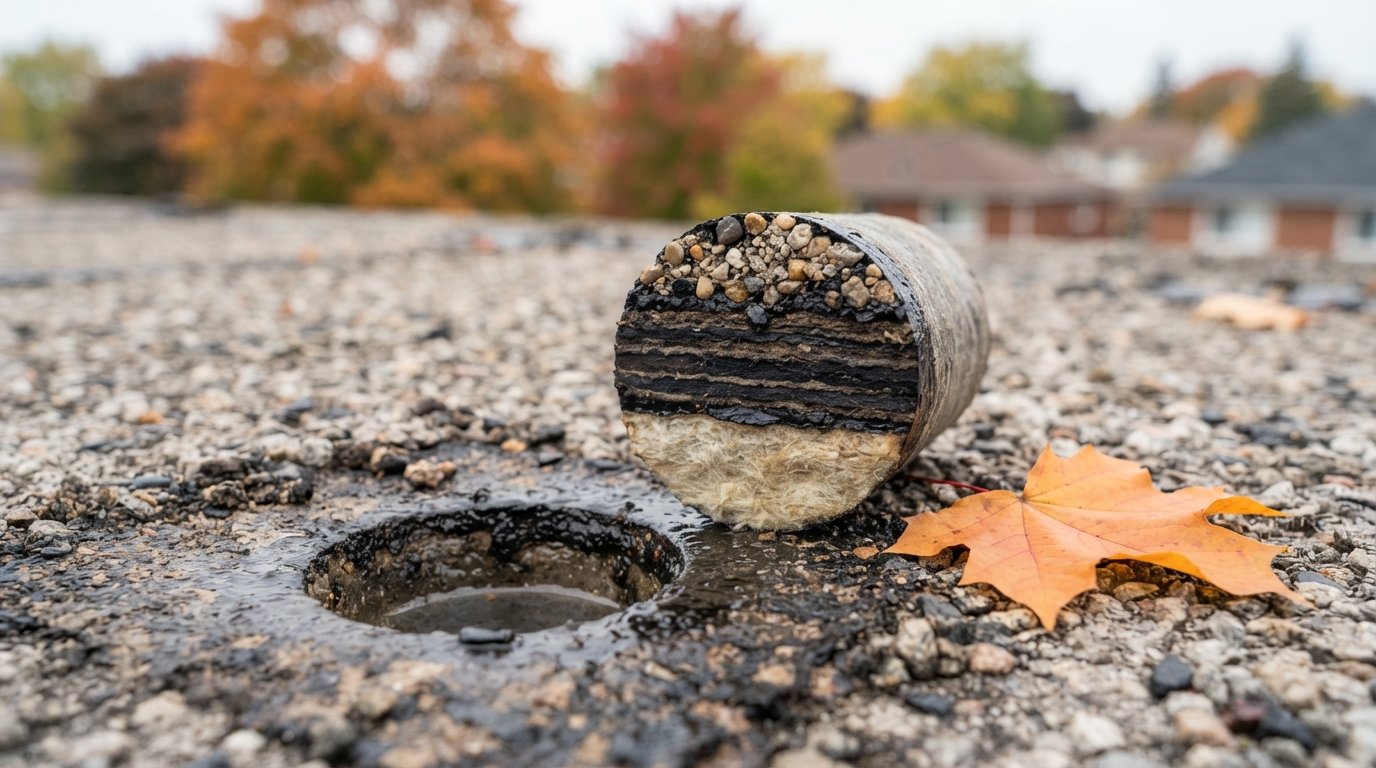
| Saturated roofing felts | The plies of older built-up (tar and gravel) roofs | Each ply type found in a core, not just the top layer |
| Flashing cement and roofing mastic | Base flashings at parapets, curbs, drains, pitch pockets | Material at several flashing locations, including old patches |
| Roof coatings | Older fibrated coatings on built-up roofs and metal | The coating layer separately from the felts below |
| Base sheets and vapour retarders | Lower layers against the deck | Bottom layers in each core |
| Asbestos-cement sheets or panels | Some older industrial roofs, fascias, soffits and parapet caps | Sheet material and any sealants at laps |
| Caulking and sealants | Coping joints, window heads near the roof, curb seams | Old sealant where removal is planned |
Not every old roof contains asbestos, and not every layer in a roof that does. Results are often mixed: the felts may be clear while the flashing cement is positive, or the reverse. That is why sampling is done layer by layer and location by location.
If you are planning a flat roof replacement on an older building, the testing should be booked before quotes are finalised, because the results can change the scope completely.
Why Testing Has To Happen Before A Tear-Off
Asbestos is a health concern when fibres are released into the air and breathed in. Intact roofing in place is generally considered a low risk. The risk rises when material is disturbed: cut, ground, broken, scraped or torn off with power equipment. A roof tear-off is exactly that kind of disturbance, and roofing crews using power cutters on older felts could be exposed, as could people in and around the building.
Testing first protects everyone involved and keeps the project on track. If asbestos roofing is discovered halfway through a tear-off, work has to stop, the area has to be secured and the job has to be re-planned with specialists. That is the most expensive and disruptive way to find out.
For homeowners, the practical advice is simple: do not cut, scrape or pull up old roofing to “see what is there”, and do not take samples yourself. Leave intact material alone until a qualified person has sampled it.
How Asbestos Sampling Works On A Flat Roof
Sampling is normally done by an asbestos consultant or an environmental firm, sometimes coordinated by the roofer. The process usually looks like this:
- Review the roof history. Age of the building, known re-roofs, any previous asbestos surveys. Commercial and institutional buildings may already have a survey on file.
- Plan sample locations. Separate roof areas, different patch repairs, flashings, curbs and drains each get their own samples, because they may have been built at different times.
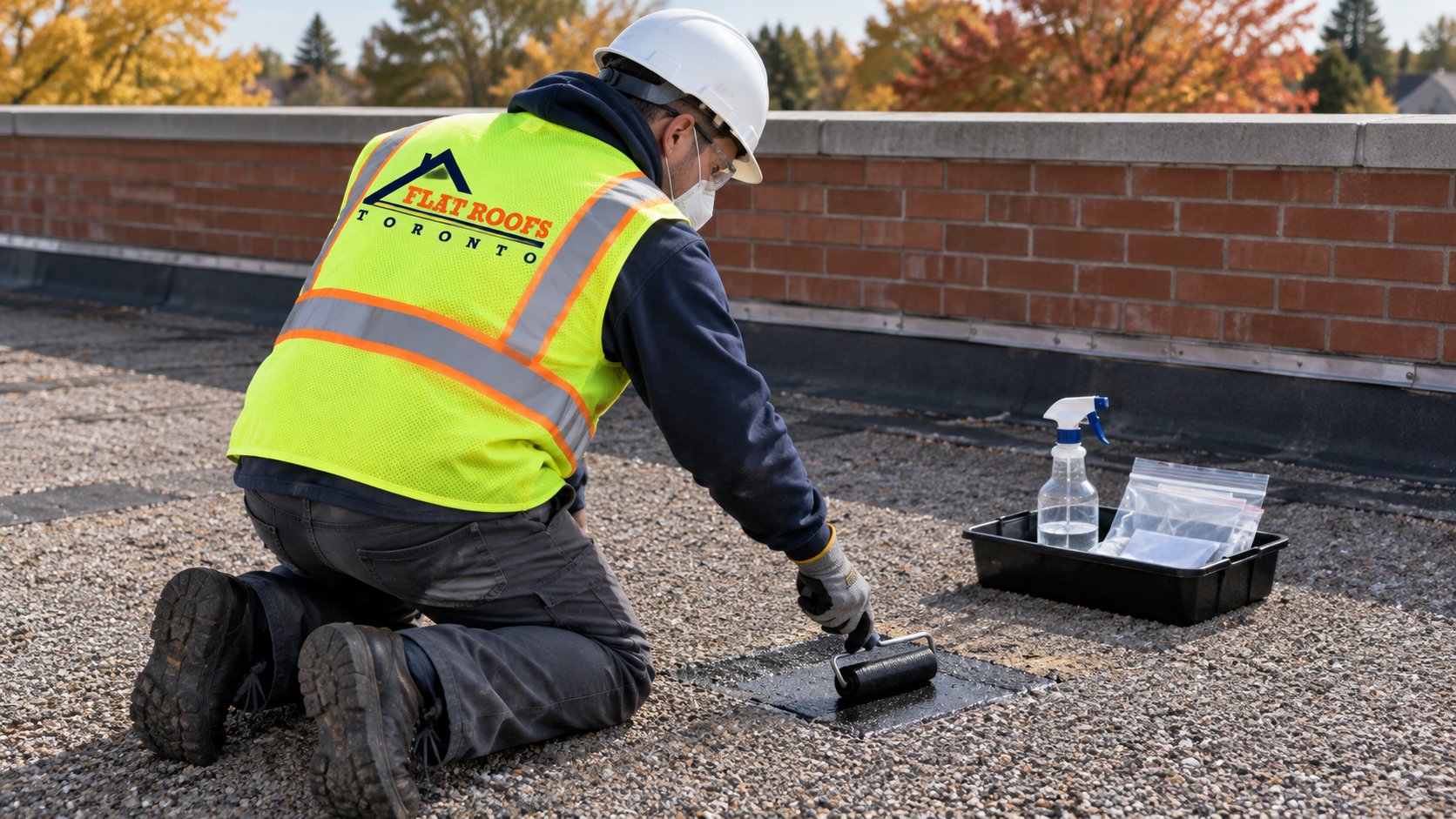
- Take samples under controlled conditions. Small cores or cut samples are taken with the material wetted and the sampler wearing appropriate protection, and each distinct layer is bagged and labelled separately.
- Make the roof watertight. Each sample location is patched immediately. On a roof that may be in use for months longer, this matters as much as the sample.
- Laboratory analysis. Samples go to an accredited laboratory, which reports whether asbestos is present in each layer and, typically, the type and approximate content.
Results commonly come back within several business days, with faster turnaround available at extra cost. The report should list every sample, its location on a roof plan, the layer it came from and the result. Keep it with your building records; you will need it again for the next roofing project.
What Ontario Requires, In General Terms
Asbestos on construction projects and in buildings is regulated in Ontario under the province’s occupational health and safety framework, with a specific regulation dealing with asbestos on construction projects, in buildings and in repair operations. Rules on transporting and disposing of asbestos waste come under environmental law. The details are technical and are updated from time to time, so the points below are a general orientation only.
- Identifying designated substances. Before construction work, project owners are generally required to determine whether designated substances such as asbestos are present and to tell prospective contractors, so bids reflect the real conditions. Contractors pass that information on to their subcontractors.
- Work categories. The asbestos regulation sorts work into categories by risk. Precautions such as wetting, protective equipment, enclosures, training and air monitoring depend on the material, whether it is friable, how much is involved and the removal method. Power cutting or grinding is treated very differently from careful hand removal.
- Trained workers. Asbestos removal is specialist work. Workers and supervisors on higher-risk operations need specific training.
- Waste. Asbestos waste has to be packaged, labelled, transported and disposed of according to the rules, and only certain sites accept it.
- Records. Building owners with asbestos present are generally expected to keep records and inform people who will work on the material.
The obligations differ between commercial buildings, rental and multi-unit properties and private homes, and they can depend on who is doing the work. Confirm your specific situation with Ontario’s labour ministry, a qualified asbestos consultant, or a licensed asbestos abatement firm, and with a lawyer where contracts or tenancies are involved.
Recover Or Tear-Off When Asbestos Roofing Is Present
A positive result does not automatically mean the asbestos has to come off. One option is to leave it in place and install a new roof over it. Whether that is possible depends on the roof itself, not just the test result.
| Factor | Recover over existing roof | Tear-off with abatement |
|---|---|---|
| Disturbance of asbestos | Minimal if done carefully; fastening and surface prep still need planning | Full removal by trained abatement workers |
| Condition of existing roof | Only suitable over dry, sound insulation and deck | Allows wet insulation and damaged deck to be replaced |
| Number of existing layers | Not appropriate if there are already multiple roofs or the structure cannot carry more weight | Takes the roof back to the deck |
| Drainage and flashings | Raises the roof surface, which affects drains, door thresholds and flashing heights | Lets drains, slope and flashings be rebuilt properly |
| Upfront cost | Usually lower now | Higher because of abatement, disposal and schedule |
| Future work | Asbestos is still there for the next roofer and must stay documented | Removes the issue from this roof for good |
A recover over asbestos roofing can be a sensible choice for a dry roof on a building with a long remaining life. It is a poor choice over wet insulation or a roof already recovered before, because the next project will face the same asbestos plus another layer to remove. Moisture testing and cores, which our commercial flat roofing team often arranges together with asbestos sampling, help settle the question.
Partial approaches are common too. If only the flashing cement is positive, the abatement contractor may remove flashings and a strip of roofing at the perimeter while the rest of the roof is handled conventionally. The new roof is then installed by the roofer once the abated area is cleared.
Older Houses, Garages And Small Residential Roofs
Asbestos is not only a commercial building issue. Many Toronto-area houses built or extended decades ago have small built-up roofs over rear additions, sunrooms, garages and porches, and some of those have been recovered with a newer membrane while the old plies remain underneath. Older homes may also have asbestos-cement siding or soffit panels next to the roof edge, or old flashing cement smeared around chimneys and vents.
For a homeowner, the approach is the same in principle, just at a smaller scale. Ask your roofer, before they quote a tear-off on an older roof, whether testing is recommended and who will do it. A reputable contractor will not guess. If the roof is clearly a recent single-layer system over a new deck, testing may not be needed; if it is decades old or has unknown layers, it is worth the modest cost.
Roof work can also expose other materials. If the job involves opening the ceiling or attic, be aware that some older loose-fill vermiculite insulation may contain asbestos and should not be disturbed until tested. Our attic insulation page explains how insulation work is approached on flat-roof homes.
Keeping The Building Safe And Occupied During Abatement
On occupied buildings, the abatement contractor’s plan should explain how people inside are protected. That typically includes restricting roof access, controlling the work area, and coordinating with the building’s mechanical contractor so rooftop units and fresh-air intakes near the work are shut down or protected, which keeps the ventilation system from drawing air from the work zone into the building. Tenants or residents should be told in advance what is happening and when.
The roof also has to stay watertight. Abatement often removes roofing in sections, and each section needs either new roofing or a temporary cover before rain. That is a sequencing question for the roofer and abatement contractor to settle together before work starts, not on the day.
Cost And Schedule Effects Of Asbestos Roofing
Testing adds a modest cost and a short delay. Abatement can add a great deal more. Both vary widely with roof size, the number of layers and locations involved, access, and the work category the removal falls into. The ranges below are rough estimates for planning only.
| Item | What drives it | Typical estimate range (CAD) and time |
|---|---|---|
| Sampling and lab analysis, small roof | Number of samples, turnaround speed | Often $400 to $1,500; results commonly within several business days |
| Sampling, larger commercial roof | Multiple roof areas, flashings, survey report | Often $1,000 to $4,000 or more |
| Targeted abatement of flashings only | Linear length, access, work category | Varies widely; often several thousand dollars and one to a few days |
| Full abatement of roof layers | Area, number of layers, enclosure and disposal needs | Can add substantially to a re-roof, from thousands on a small roof to tens of thousands on larger buildings |
| Schedule effect overall | Lab turnaround, abatement booking, weather | Often adds one to several weeks to planning |
Timing matters in autumn. As temperatures drop, some roofing materials and adhesives have minimum application temperatures, and the window for comfortable roofing narrows. If an older roof needs replacing before winter, book sampling first and early, so results are in hand before you pick a contractor and a start date.
Before You Sign: Questions For The Roofer And Abatement Firm
- Has the roof been sampled, by whom, and do we have the lab report with a sample location plan?
- Were flashings, curbs and old patches sampled separately from the main plies?
- If asbestos roofing is present, is a recover appropriate given the moisture survey and number of existing layers?
- Who is the abatement contractor, and how will their work be sequenced with the roofer’s?
- How will the building stay watertight between abatement and new roofing?
- Where will waste go, and will we receive disposal documentation?
Clear answers to these questions are the sign of a properly planned project. Our frequently asked questions page covers more about how we plan replacements, and you can see completed roofs on our projects page.
How can I tell if my flat roof contains asbestos?
Is old asbestos roofing dangerous if I leave it alone?
Can a roofer remove asbestos roofing?
Can I put a new roof over an asbestos-containing roof?
How long does asbestos testing take?
Who is responsible for identifying asbestos before roofing work?
Plan Your Asbestos Roofing Testing Before The Tear-Off
Testing first is the simplest way to keep an older roof replacement safe, on budget and on schedule. Flat Roofs Toronto helps owners plan replacements on older flat roofs, coordinates with qualified asbestos consultants and abatement firms, and installs the new roofing once the old material has been properly dealt with.
Call us today at (647) 333-3528 or request a free estimate.
Planning safe replacements of older flat roofs for owners in Toronto and across the GTA.