
A brick chimney rising out of a flat roof is one of the most leak-prone details on any Toronto house, and one of the most misdiagnosed. Most chimney flashing flat roof repairs start from the assumption that the flashing failed, but the cause is rarely that simple: the membrane has to turn up the masonry and bond to it, metal counterflashing has to shed water over the top of that membrane, the brick itself absorbs rain, and a wide chimney can dam water on the uphill side. When any of those fails, water shows up on the ceiling beside the chimney breast and the flashing gets blamed, even when the real problem is the crown or the brick.
This guide walks through how the joint between masonry and membrane should be built, how counterflashing and crickets work, why porous brick causes leaks that look like flashing leaks, and what to do with a chimney that no longer serves anything.
How A Chimney Flashing Flat Roof Detail Is Built
On a sloped roof, chimney flashing uses stepped pieces that follow the shingles. On a flat roof the approach is different, because the membrane itself becomes the first line of defence and water can sit against the chimney on every side.
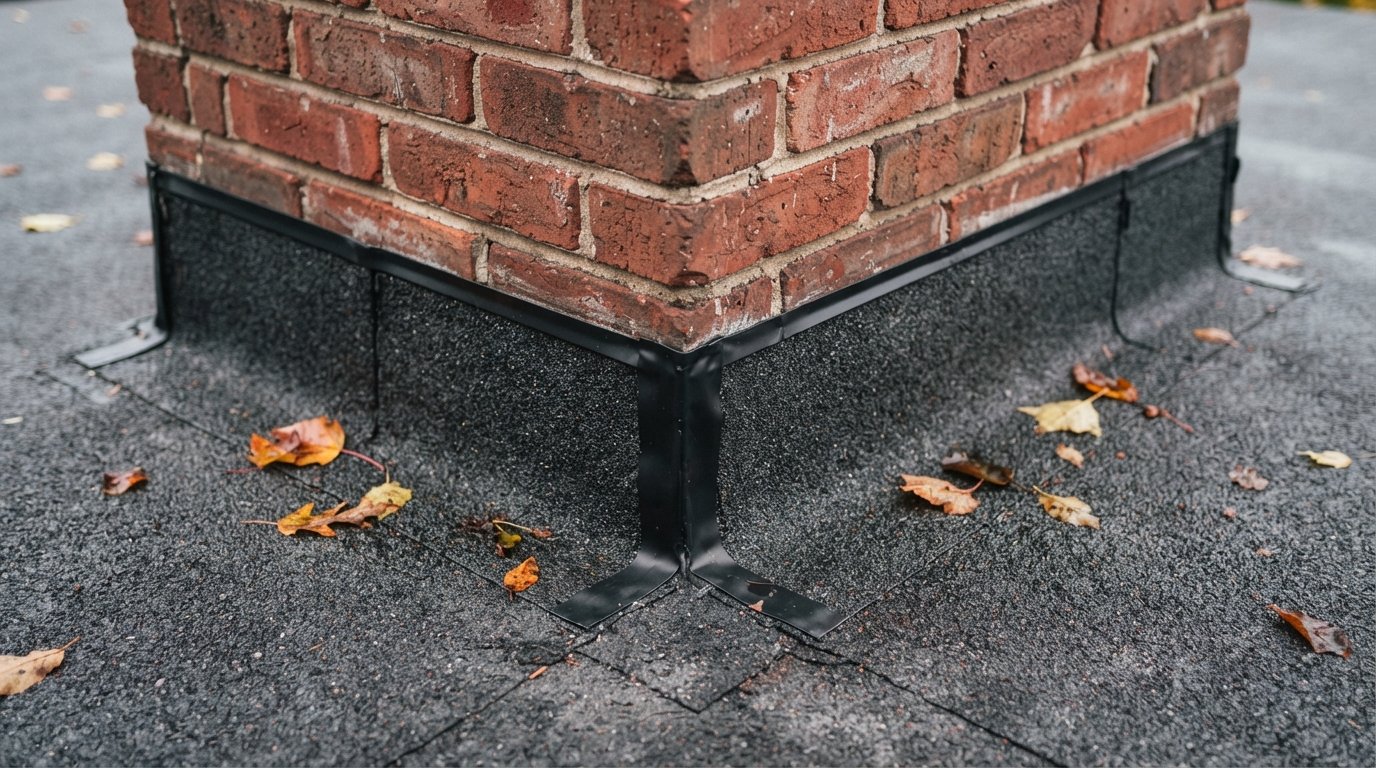
- Base flashing. Roofing membrane, or a compatible flashing membrane, is turned up the face of the chimney and fully bonded to the masonry. The height of the upturn is set by the membrane manufacturer and good practice; on most roofs it rises well above the level water could reach in a heavy storm.
- Cant or transition. On bitumen roofs, a cant strip at the base keeps the membrane from making a sharp 90-degree bend, which is where cracking starts. Some membranes are designed to turn the corner without one.
- Corner reinforcement. Outside and inside corners get extra membrane pieces, because folds and cuts there are the most common failure points.
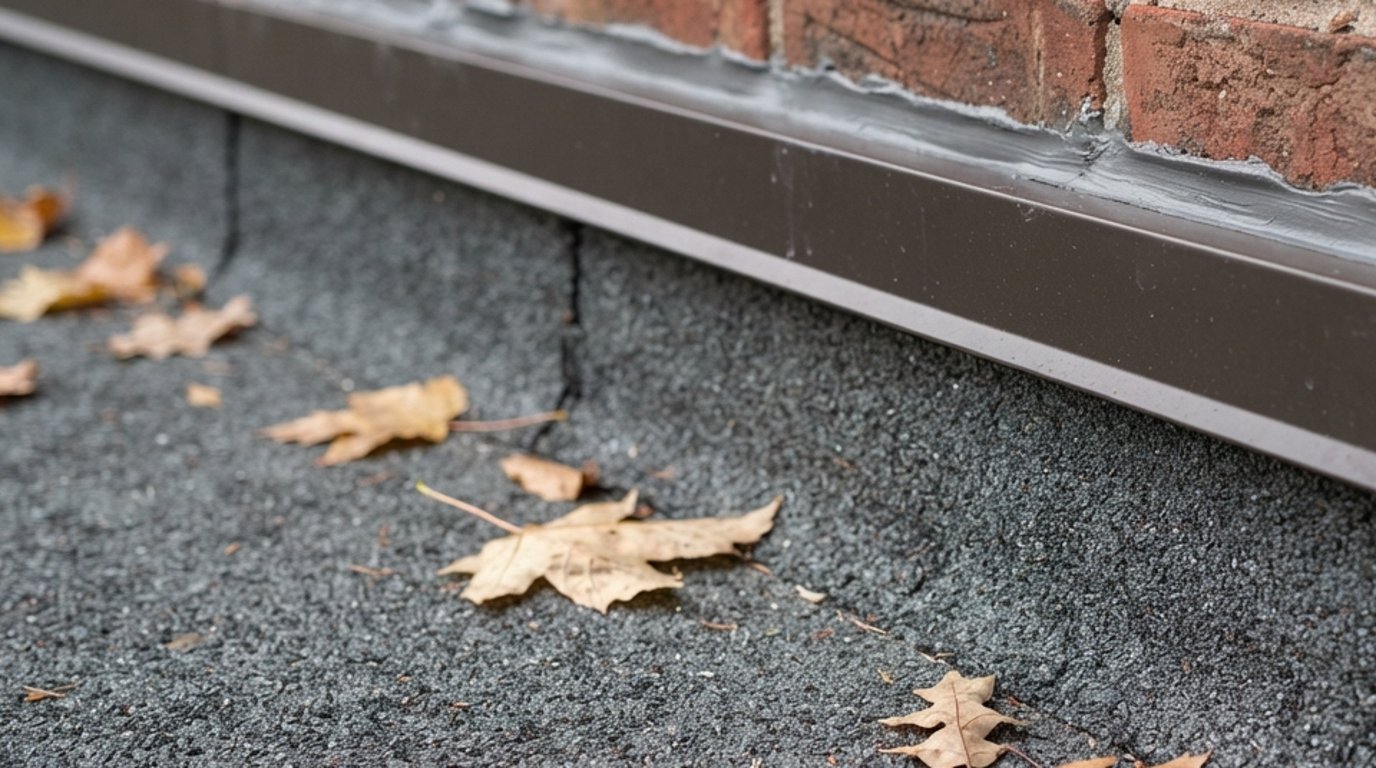
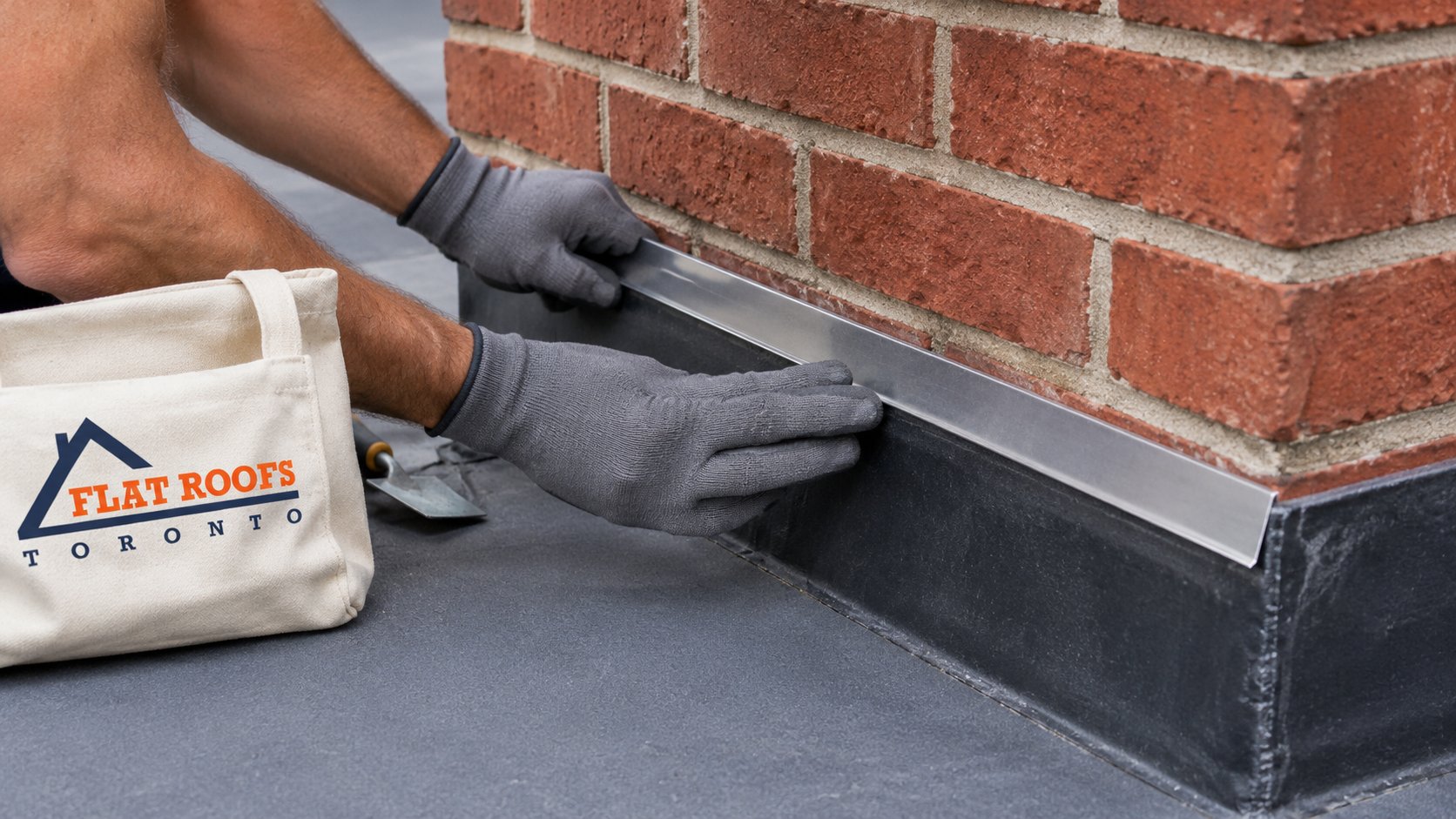
- Counterflashing. Metal flashing fixed into or onto the masonry, overlapping the top of the base flashing so water running down the brick is directed over the membrane instead of behind it.
- Cricket where needed. On the uphill side of a wider chimney, a small sloped build-up diverts water around the chimney rather than letting it pond against the brick.
Each part depends on the others. A perfect membrane upturn with no counterflashing will be undercut by water running down the brick, and great counterflashing over a poorly bonded membrane still lets water through. If you already have water coming in beside a chimney, our emergency flat roof repair crew can make it watertight and diagnose the source.
Bonding Membrane Base Flashing To Masonry
Membrane does not stick well to dirty, dusty, crumbling or damp masonry. Before base flashing goes up, the brick and mortar should be sound, clean and dry. That often means a mason repoints open joints or replaces spalled bricks first, because flashing bonded to loose mortar simply peels away with it.
The surface is then primed with the primer specified for the membrane, which soaks into the masonry and gives the membrane something to grip. On rough or uneven brick, some roofers parge the base of the chimney to create a smoother surface, though the parging must itself be sound and well bonded or it becomes the next weak layer.
Common mistakes in chimney flashing flat roof repairs include:
- Applying membrane over old roof cement smeared up the brick, so the new layer bonds to the old, failing one
- Stopping the upturn too low, so ponding water or wind-driven rain reaches the top edge
- Leaving the top edge unprotected, with no counterflashing or termination
- Patching only one side when the whole chimney perimeter is aged
Counterflashing Into Reglets And Other Options
The counterflashing is the cap over the top edge of the base flashing. How it is attached decides how long it lasts and how easy the next re-roof will be.
| Method | How it works | Strengths | Limitations |
|---|---|---|---|
| Reglet counterflashing | A shallow slot is cut into a mortar joint; the metal is bent into it, secured and sealed | Water running down the brick is shed over the membrane; durable and neat | Needs sound mortar and careful cutting; slot must be resealed when the flashing is removed |
| Two-piece receiver system | A receiver is set in the reglet and a separate removable counterflashing snaps or screws into it | Counterflashing can be removed and refitted at the next re-roof without cutting brick again | Slightly higher material cost; quality of the receiver installation matters |
| Surface-mounted termination bar with metal cover | Bar fastened to the brick face over the membrane, sealed, then covered | Useful where reglets cannot be cut | Relies on sealant at the top edge, which needs periodic renewal |
| Sealant or cement only | Membrane edge covered with roof cement or caulking | Quick | Not a proper detail; cracks and lets water behind the membrane within a few seasons |
On a flat roof, the reglet can usually run level around all four sides of the chimney, which is simpler than the stepped flashing a sloped roof needs. If the mortar joints are badly eroded, they should be repointed before the reglet is cut, or the slot will crumble.
Crickets Behind Wide Chimneys
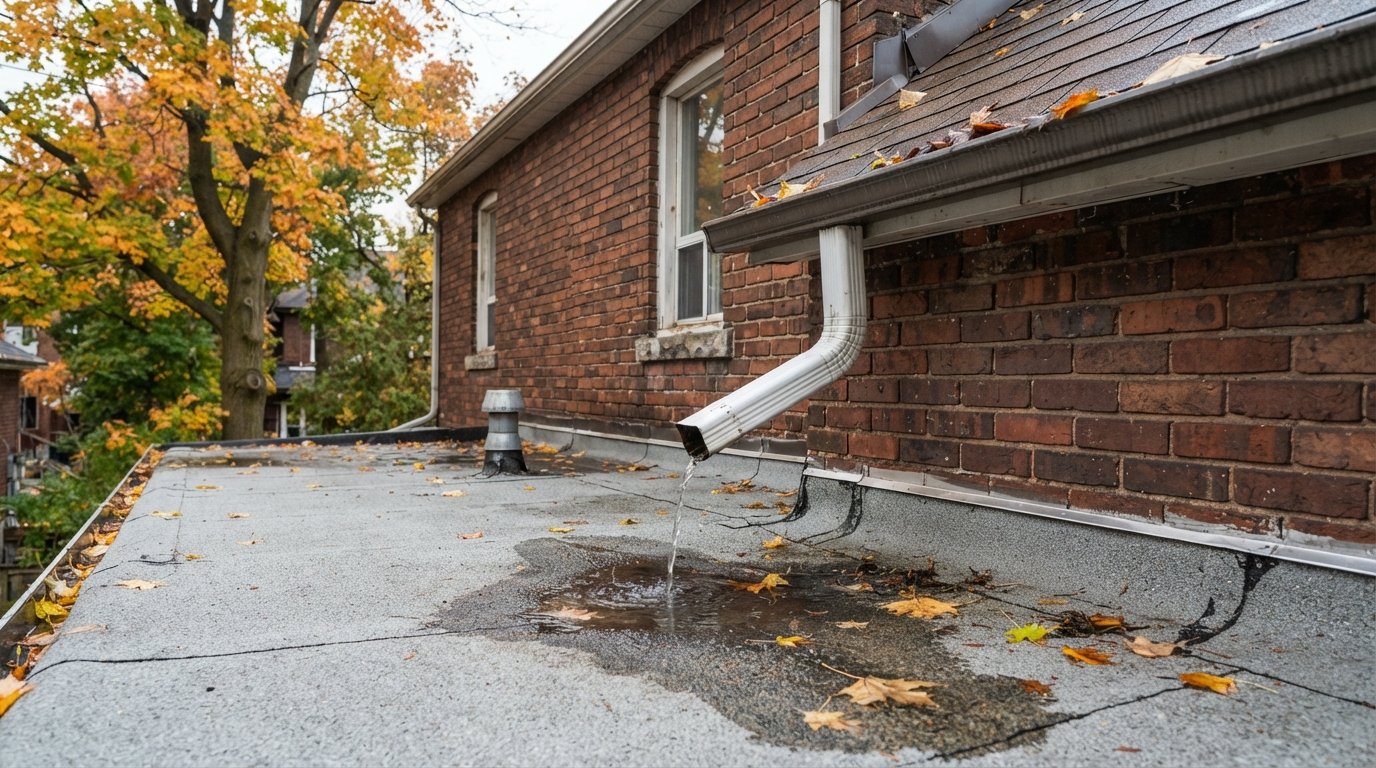
Water on a flat roof moves slowly toward its drains or scuppers. A chimney in its path acts like a dam. On the uphill side, water collects against the brick, sits there after every rain, and tests the base flashing for days at a time. Leaves pile up in the same spot each autumn, holding moisture against the membrane, and later in the season that pocket of water can freeze.
A cricket, sometimes called a saddle, solves that. On a flat roof it is usually built from tapered insulation shaped into a small ridge behind the chimney, so water divides and flows around both sides. The membrane runs over the cricket and up the chimney like any other base flashing. The wider the chimney and the more water flowing toward it, the more a cricket helps. Even on narrower chimneys, it is worth adding one during re-roofing if you can see a ring of dirt or algae on the uphill side, which shows where water has been sitting.
When The Brick Is The Leak, Not The Flashing
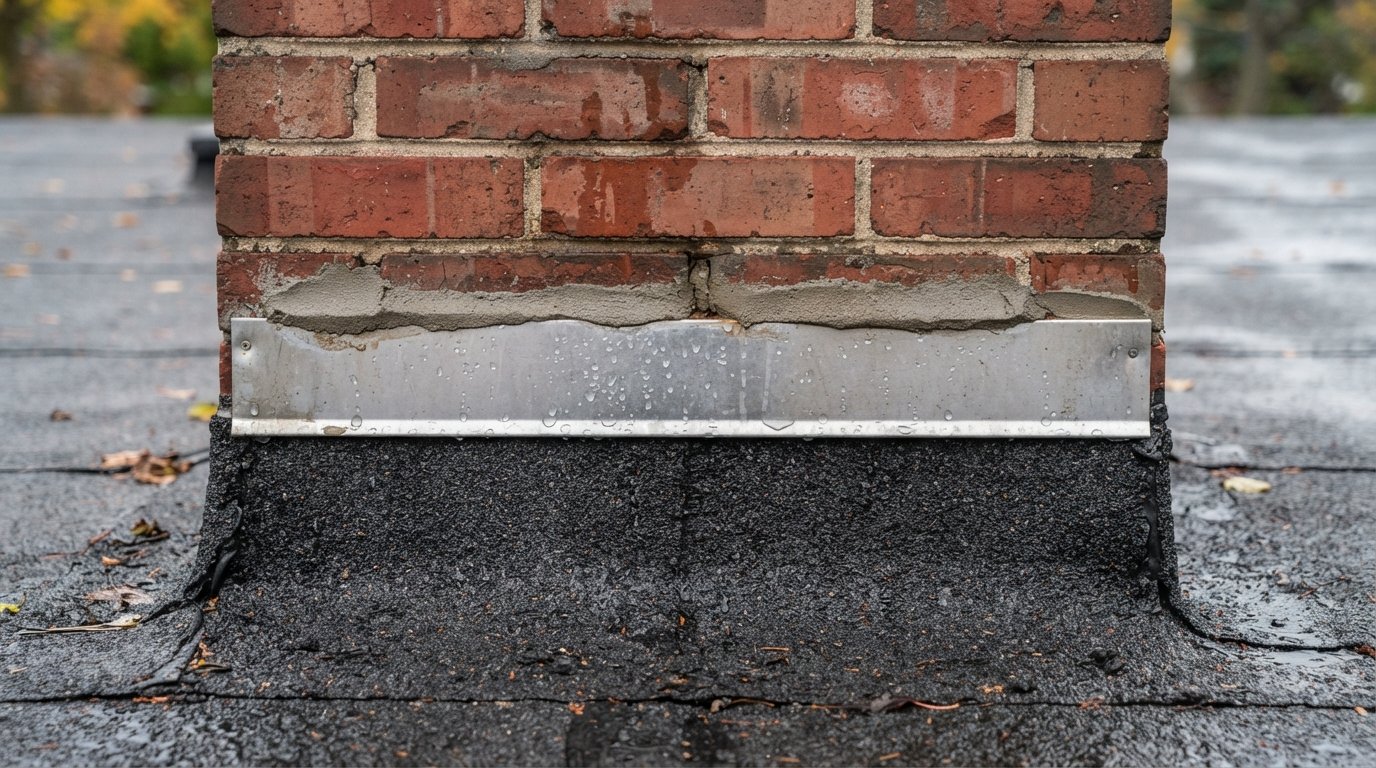
Masonry is porous. Brick and mortar absorb rain, and in a long autumn storm a chimney can take in a surprising amount of water. That water moves down through the masonry and can come out below the flashing, inside the roof or on the ceiling, even if the flashing is perfect. This is why chimney flashing flat roof leaks are often repaired repeatedly without success.
| Sign | Likely source | Usual remedy |
|---|---|---|
| Leak during long rain, even though flashing looks sound | Water absorbed through brick faces and mortar | Repointing, brick replacement, possibly a breathable masonry water repellent applied by a mason |
| Cracked or crumbling top of the chimney | Failed crown letting water straight into the masonry | New crown or a cap with an overhanging drip edge |
| Leak only in wind-driven rain from one direction | Open mortar joints or counterflashing on the exposed face | Repoint that face, check counterflashing seal |
| Water at the base on the uphill side | Ponding against the chimney, failing base flashing | Reflash and add a cricket |
| White staining or flaking on brick faces | Repeated wetting and drying, salts and freeze-thaw damage | Address water entry at the top and sides, replace spalled brick |
Finding the true source is a process of elimination. A careful diagnosis works from the bottom up: base flashing first, then counterflashing, then the brick faces, then the crown. A roofer and a mason working together usually get to the answer faster than either alone, because the repair often involves both trades.
Be cautious with sealers. Some coatings trap moisture in the brick and make freeze-thaw damage worse. If a water repellent is used, it should be a breathable product intended for masonry and chosen by someone who knows the brick.
Abandoned Chimneys: Cap, Rebuild Or Remove
Many Toronto houses have chimneys that no longer serve a fireplace or furnace, because a newer high-efficiency furnace vents out through the side wall. Before treating any chimney as abandoned, confirm with a qualified heating technician that no appliance still vents into it, such as an older water heater. Capping a flue that is still in use can send combustion gases back into the house.
Once a chimney is confirmed unused, the options are:
- Cap it. A metal or precast cap with a drip edge keeps rain out of the flue and off the crown. Capping methods vary, and some allow limited ventilation to avoid condensation inside the flue, so follow the advice of the mason or chimney professional.
- Rebuild the top. If the upper courses are spalled, rebuilding from the roof line up with new brick, a proper crown and a cap may be the most durable choice for a chimney you want to keep for appearance.
- Remove it below the roof. Taking the chimney down below the roof deck, framing and decking the opening, and roofing over it means there is no chimney flashing on that flat roof left to fail.
Removal needs care. The structure has to be checked, because the chimney may be tied into walls or framing, and on semi-detached houses chimneys are sometimes shared with the neighbour along the party wall. Removing or altering one may require agreement with the neighbour and, depending on the work, a permit, so check with the City first. Removal is often most cost-effective when the flat roof is being replaced anyway; our flat roof replacement page covers how that kind of change is planned.
A Pre-Winter Chimney Flashing Flat Roof Inspection
The weeks between leaf drop and the first hard freeze are the best time to look at a chimney, because any repair made now has a chance to cure and settle before freeze-thaw cycles start. A roofer working through a chimney flashing flat roof inspection typically checks:
- The crown and cap. Cracks, missing pieces, a crown with no overhang, or a cap that has rusted or blown loose.
- Mortar joints. Recessed or sandy joints, especially on the face that takes the prevailing weather.
- Counterflashing. Metal lifted out of the reglet, dried or missing sealant, loose fasteners or bent sections.
- Base flashing. Wrinkles, open laps, fishmouths at the top edge, split corners and membrane pulling away from the brick.
- The uphill side. Leaves, dirt rings or algae that show where water sits, and whether a cricket would help.
- Inside the house. Stains on the ceiling beside the chimney breast, peeling paint on the chimney wall, or damp patches in a closet that shares the wall.
Photos of each side of the chimney, taken during the visit, give you a record to compare against next year. On a semi-detached house with a shared chimney, it also helps to know the condition of the neighbour’s side, since water entering their half can travel into yours. Small fixes found at this stage, such as resealing a reglet or patching a corner, often prevent a winter of ceiling stains and a much larger chimney flashing flat roof repair in spring.
Typical Costs For Chimney Flashing Flat Roof Work
What chimney flashing flat roof work costs depends on chimney size, masonry condition, access and whether a mason is needed. The ranges below are rough GTA figures for planning, not quotes.
| Work | What it usually includes | Typical estimate range (CAD) |
|---|---|---|
| Reflash base of chimney | Remove old flashing, prime, new membrane upturn and corners | Often $800 to $2,500 |
| New counterflashing with reglet | Cut reglet, install metal counterflashing, seal | Often $400 to $1,200 |
| Cricket behind chimney | Tapered insulation, membrane over cricket | Often $500 to $1,500 on an existing roof |
| Crown repair or cap | New crown or metal cap with drip edge | Often $400 to $1,500 |
| Remove chimney below roof | Demolition, framing, decking, roof patch, debris removal | Often $2,000 to $6,000 or more, plus any interior work |
Repointing and brick replacement are usually priced by the mason separately. A good quote will say which trade is responsible for which part. You can see examples of finished roofs on our projects page, and answers to common questions on our FAQ page.
Why does my chimney keep leaking after the flashing was repaired?
What is a reglet?
Do I need a cricket behind my chimney?
Can roof cement fix chimney flashing on a flat roof?
Should I remove an unused chimney?
Who should fix chimney leaks, a roofer or a mason?
Get Your Chimney Flashing Flat Roof Details Checked This Autumn
Autumn rain is when chimney leaks reveal themselves, and dry spells between storms are a good window for flashing and masonry work. Flat Roofs Toronto diagnoses chimney leaks on flat roofs, rebuilds base flashing and counterflashing, adds crickets and coordinates with masons on crowns and brick so the whole chimney is watertight.
Call us today at (647) 333-3528 or request a free estimate.
Chimney flashing and masonry-to-membrane repairs on flat roofs in Toronto and across the GTA.