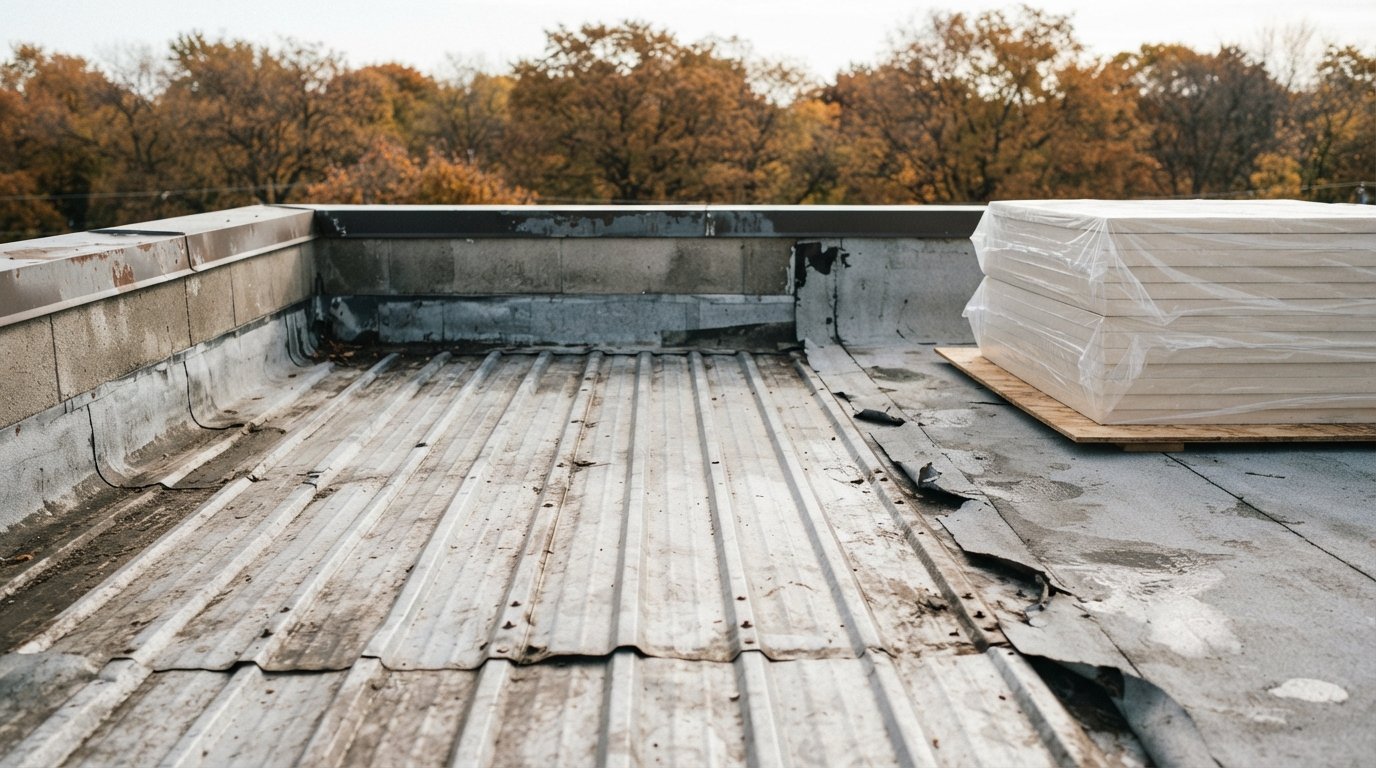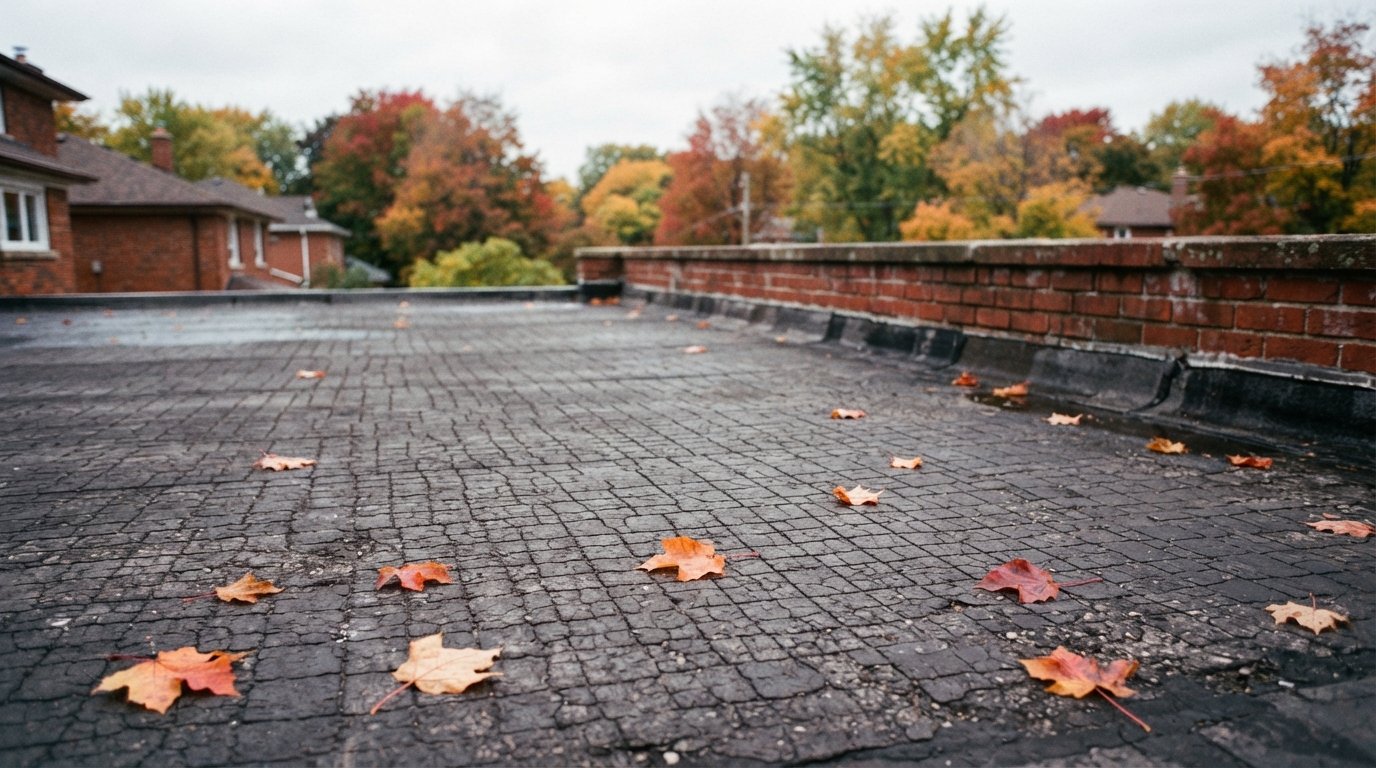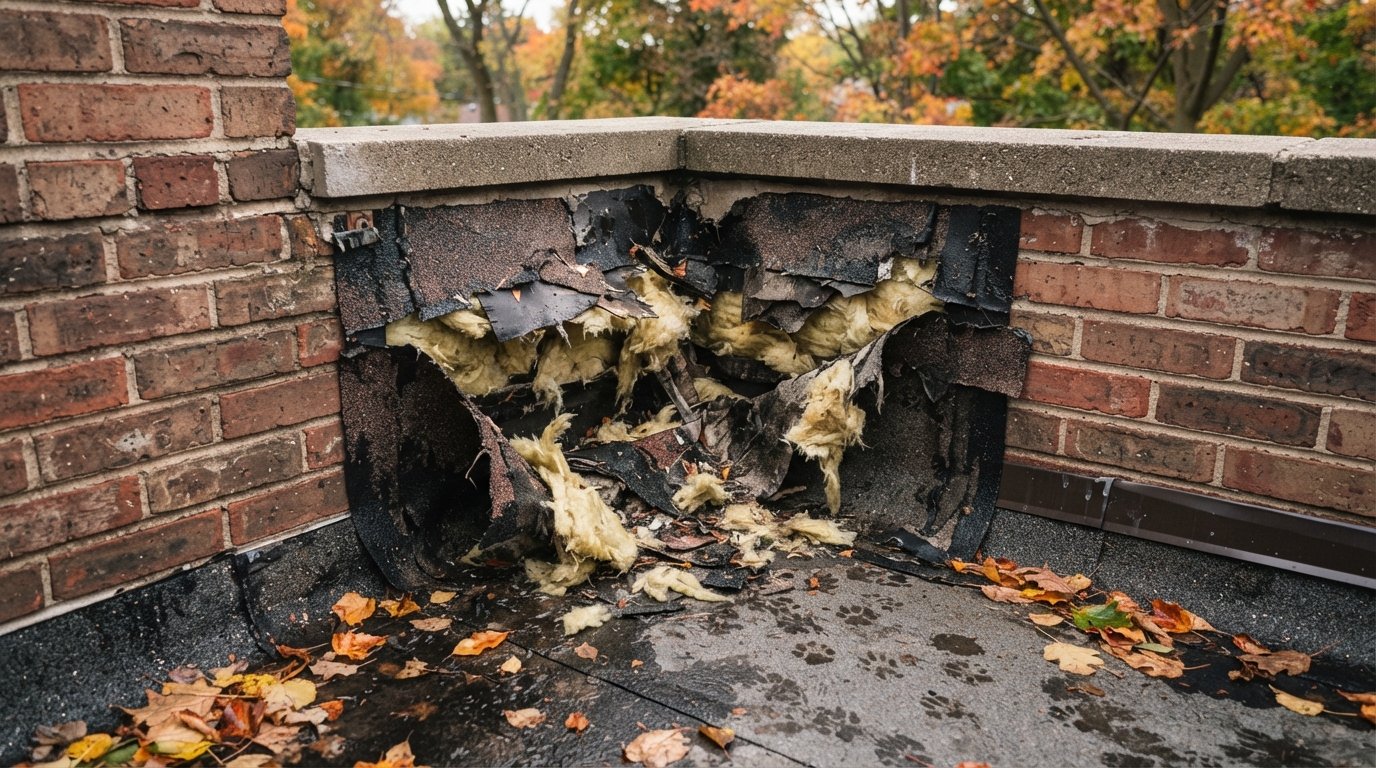

A flat roof is only as good as the path water takes to leave it. On many Toronto houses and small commercial buildings that path ends at a flat roof gutter along an open edge, or at a scupper through the parapet wall that empties into a collector box and downspout. When those parts are sized and flashed properly, nobody notices them. When they are undersized, clogged with autumn leaves or poorly sealed where they meet the membrane, they cause some of the most stubborn, hard-to-trace leaks a flat roof can have.
Edge gutters and through-wall scuppers each fail in their own way. The sections below compare them, show where they leak and why, explain sizing in general terms, look at what autumn leaves do to them, and follow the water through the downspout and away from the building.
How A Flat Roof Gutter System Moves Water
Flat roofs are not truly flat. They are built with a gentle slope, either in the structure or with tapered insulation, so water moves toward a drainage point. There are three common ways that water leaves the roof:
- Edge drainage into a gutter. The roof slopes toward an open edge with no parapet. The membrane laps over a metal drip edge or gravel stop, and water falls into an eavestrough that runs to a downspout. This is typical on rear additions, garages, porches and many older semis.
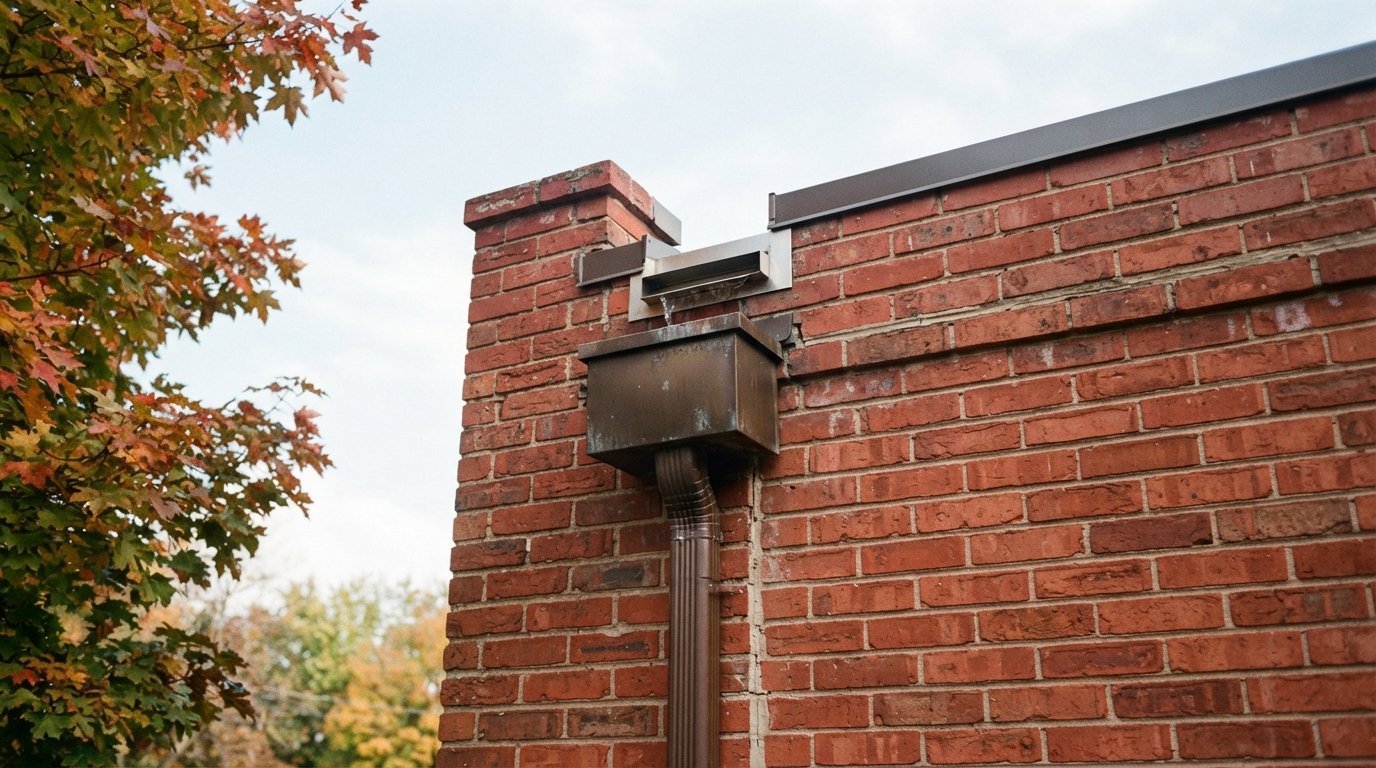
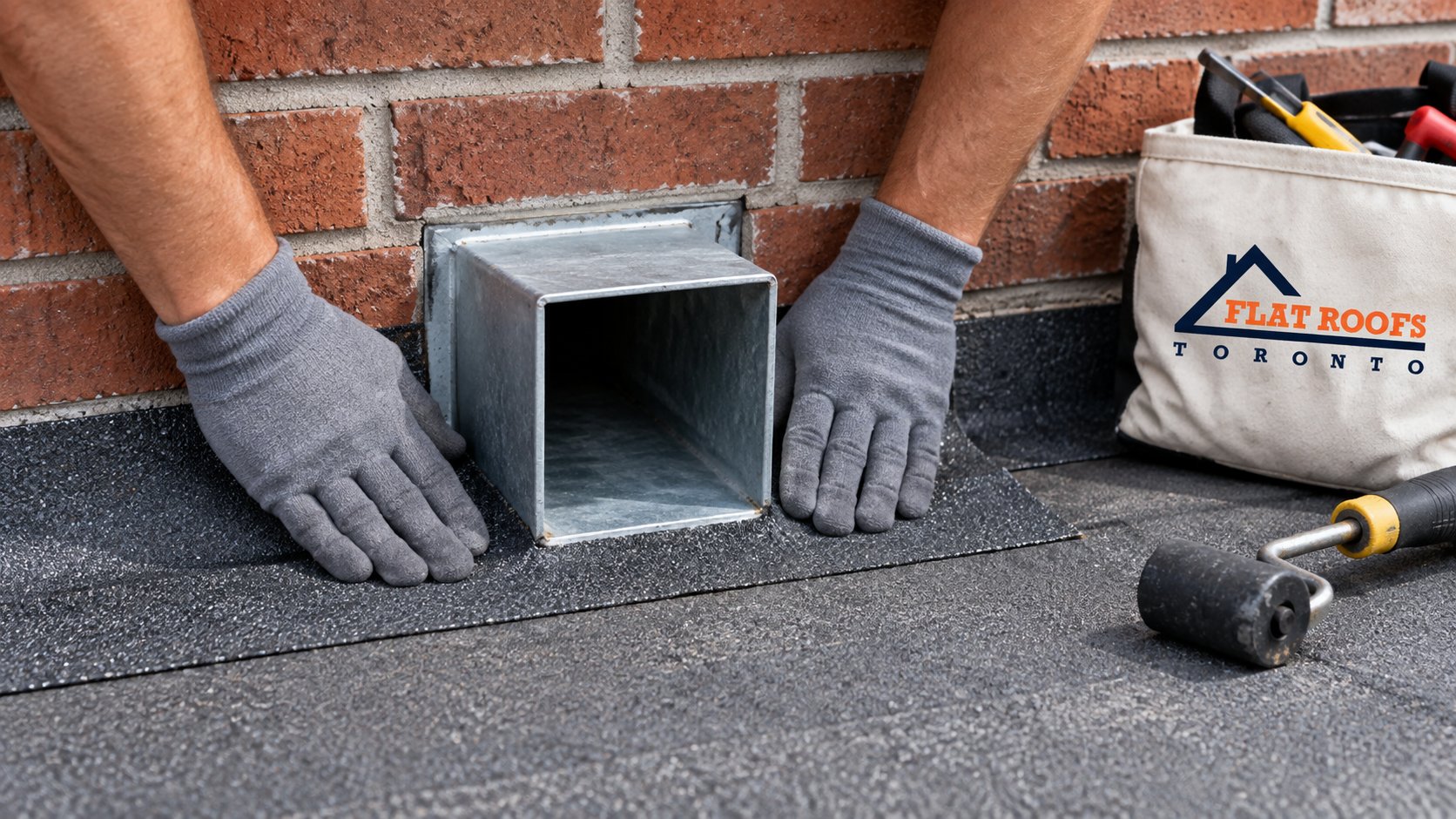
- Through-wall scuppers. On roofs with parapets, a rectangular opening is cut through the wall at the low point. A metal sleeve lines the opening and is flashed into the membrane, and water spills out into a collector box, sometimes called a conductor head, which feeds the downspout.
- Internal drains. A drain in the roof field connects to piping inside the building. These are common on larger commercial roofs and are outside the scope of this article, although overflow scuppers often back them up.
Each approach has its own weak points, and the materials and details vary with the roof system. For how modified bitumen, EPDM and TPO each handle edge and scupper flashings, see our guide to flat roofing systems.
| Drainage type | Where you usually see it | Strengths | Common weak points |
|---|---|---|---|
| Edge gutter | Houses, rear additions, garages, porches without parapets | Simple, easy to clean from a ladder, inexpensive to replace | Water getting behind the gutter, poor drip edge laps, sagging hangers, leaf clogs |
| Through-wall scupper with collector box | Roofs with parapets on houses, row buildings and small commercial properties | Keeps water off the wall face, works with parapets, clear overflow path | Leaks at the sleeve corners and flanges, undersized openings, clogged boxes |
| Overflow scupper | Higher in the parapet than the main drain or scupper | Provides a backup path if the primary drain blocks | Often missing, blocked or set at the wrong height |
| Internal drain | Larger commercial roofs and some modern homes | No exterior downspouts, works with large roof areas | Clogged strainers, leaks at the drain clamping ring, frozen leaders |
Edge Gutters On Flat Roofs
A flat roof gutter at an open edge looks like any other eavestrough, but the detail above it matters more than on a sloped roof. Water does not shed quickly off a low slope. It sheets slowly across the edge, so any gap between the membrane, the drip edge and the gutter will draw water back toward the fascia.
Getting the edge detail right
The membrane should lap onto a metal drip edge that extends far enough to drop water into the gutter, not behind it. With modified bitumen, the metal is usually set in the system and stripped in with membrane so there is no open joint. The back of the gutter sits under the drip edge, and the hangers are spaced closely enough that the gutter does not sag under a load of wet leaves or snow. When we see rot in a fascia board under a flat roof gutter, the cause is usually water running behind the gutter, a short drip edge, or a membrane that stops before the edge.
Sizing in general terms
Flat roof gutter and downspout size depends on the roof area draining to them, the slope, and the rainfall intensity used in design. A small porch roof may manage fine with a standard residential eavestrough and one downspout, while a larger flat roof that collects water from an upper wall or roof above may need a larger profile, more downspouts, or both. As a practical rule, if a gutter regularly overflows in heavy rain even when clean, it is likely undersized or has too few outlets. A roofer can measure the area and recommend a profile and outlet layout.
Through-Wall Scuppers And The Scupper Box
Where a roof has parapets, the cleanest way to get water off is often through the wall. A scupper is a lined opening at the low point of the roof; the scupper box on the outside catches the water and directs it into the downspout. Done well, this keeps water off the wall face and gives a clear path for water to leave even during heavy rain.
Where scupper sleeves leak
Most leaks at scuppers come from the sleeve itself or from the way it is tied into the roof. Common causes include:
- Open corners. The sleeve is formed from sheet metal, and the inside corners must be soldered, welded or properly sealed. Open or cracked corners let water run into the wall.
- Flanges not stripped in. The sleeve flange on the roof side should be set in the system and covered with membrane stripping. Exposed caulk alone tends to fail within a few seasons.
- Sleeve too short. The sleeve should extend past the outside face of the wall with a drip so water falls clear rather than running down the brick.
- Opening set too high. If the scupper sits above the roof surface, water ponds in front of it and works into nearby seams.
- Wall cavity issues. On older brick parapets, water may enter the wall at a cracked cap or open mortar and appear near the scupper, so the leak gets blamed on the sleeve.
If water is already running into a wall or ceiling near a scupper, a temporary repair can often hold until the sleeve is rebuilt. Our team handles both quick fixes and full scupper rebuilds; for an active leak, see our emergency flat roof repair service.
The collector box and downspout
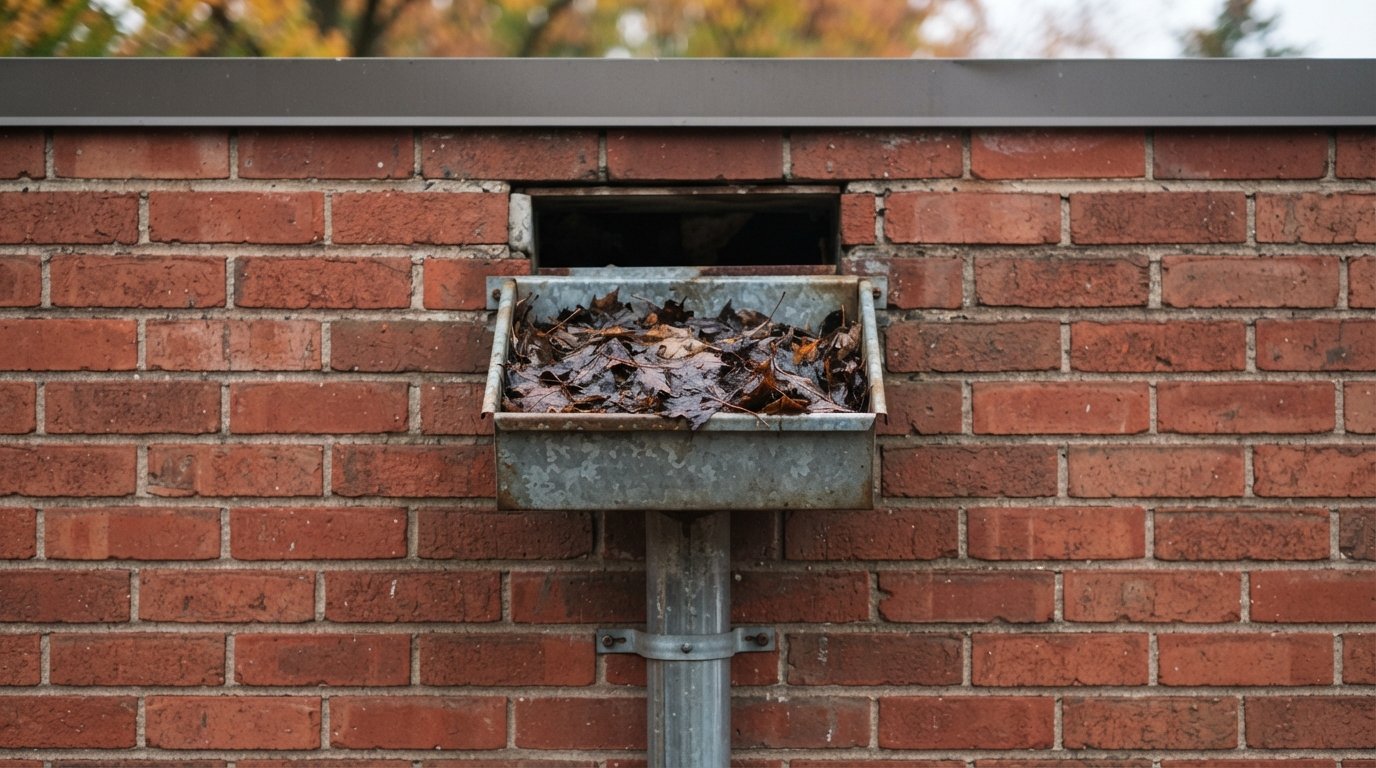
The collector box needs to be wider than the scupper opening so water does not overshoot it in heavy rain, and deep enough that it does not overflow before the downspout can take the flow. Its outlet should match the downspout size, and the box should be fastened securely to the wall with the scupper discharging well inside it. A common problem is a box that has rusted or pulled away from the wall, so water now runs down the brick. Another is a downspout that is too small for the roof area, so the box fills and spills over the sides during a storm.
Autumn Leaves, Clogs And Overflow
October is when flat roof drainage gets tested. Leaves collect at exactly the points where water converges: the corners where a flat roof gutter meets the downspout, the mouth of each scupper, and the top of the downspout inside the collector box. On a sloped roof leaves often blow off; on a flat roof they tend to settle and mat down in the rain.
What happens when they clog
A blocked flat roof gutter overflows at the low point, often right over a door or walkway, and can push water back over the drip edge into the fascia. A blocked scupper is more serious. Water ponds behind the parapet, rises against flashings and seams that were never meant to be submerged, and adds weight to the roof. If the roof has no overflow scupper, there may be nowhere else for the water to go.
Guards and strainers
Guards can help on a flat roof gutter at an open edge, but flat mesh guards often hold leaves on top instead of shedding them, so they still need cleaning. At scuppers, basket strainers can trap leaves on the roof side and block the opening quickly. In many cases it is better to keep the scupper itself open and place a removable guard at the top of the downspout inside the box, where it is easier to clear. Whatever you choose, plan on checking it after the main leaf drop.
Overflow scuppers
An overflow scupper sits higher in the parapet than the primary drain or scupper. If the main outlet blocks, water rises until it reaches the overflow and leaves the roof before it gets deep enough to cause damage. Whether an overflow is required depends on the design and the applicable code, but on a parapet roof with a single outlet it is a sensible safeguard. Overflow outlets should discharge somewhere visible so you know when the main outlet is blocked.
| Symptom | Likely cause | What to check | Typical fix |
|---|---|---|---|
| Water running behind the gutter | Short or missing drip edge, membrane not lapped over the edge | Edge metal, membrane termination, fascia condition | Rebuild edge with proper drip edge and stripping |
| Overflow at the gutter in heavy rain | Clog, undersized profile or too few outlets | Leaves, gutter size, downspout count | Clean, add outlets or upsize |
| Leak on inside of wall near scupper | Open sleeve corners, failed flange, wall cap cracks | Sleeve seams, flange stripping, parapet cap | Reseal or rebuild sleeve; repair parapet cap |
| Water spilling over the collector box | Box too small, downspout clogged or undersized | Box width and depth, downspout size, blockages | Clear, enlarge box or downspout |
| Ponding in front of scupper | Scupper set too high or roof slope poor | Scupper height relative to roof surface | Lower scupper or add crickets and tapered insulation |
Tying Into The Downspout And Away From The Building
The job is not finished when water reaches the downspout. Where it ends up matters for your foundation, your neighbours and your walkways.
- Discharge away from the foundation. Downspout extensions and splash pads should carry water away from basement walls and window wells.
- Check local rules. The City of Toronto has required many properties to disconnect downspouts from the sewer system. Rules and exemptions vary, so check current requirements with your municipality before changing where your downspouts connect.
- Do not dump onto a neighbour. On semis and row houses, discharge should not run onto the neighbouring lot.
- Think about winter. Water discharged onto a walkway or driveway area will freeze. Route downspouts so meltwater drains to soil.
- Upper roofs onto lower roofs. Where a downspout from an upper roof empties onto a lower flat roof, protect the membrane with a splash pad, or better, extend the downspout to the lower roof’s gutter or scupper so water does not erode one spot.
Repairs, Upgrades And Typical Costs
Most flat roof gutter and scupper problems can be solved without replacing the roof, as long as the membrane around them is sound. When the roof is due for replacement anyway, that is the best time to rethink drainage completely, including scupper size and position, overflows and tapered insulation. Any flat roof replacement quote should include a drainage review; if yours does not, ask for one.
| Work | What is involved | Typical cost range (estimate only) |
|---|---|---|
| Clean gutters, scuppers and downspouts | Remove leaves and debris, flush downspouts, check for leaks | Often $150 to $450 for a typical house, depending on access |
| Reseal a scupper flange | Clean, re-strip the flange with compatible membrane | Commonly $400 to $1,000 per scupper |
| Replace a scupper sleeve | Remove old sleeve, install new sealed sleeve, flash into membrane and wall | Often $900 to $2,500 per scupper, depending on wall and roof type |
| New collector box and downspout | Supply and install box, downspout and extension | Commonly $350 to $1,000, depending on height and material |
| Rebuild edge and replace gutter | New drip edge, membrane stripping, new eavestrough and downspout | Often $25 to $60 per linear foot, varying with edge condition and access |
Height, access, wall material, roof system and any hidden rot behind the fascia or inside the parapet all push these numbers up or down, so expect the real figure to come from a written quote rather than a phone estimate.
Six Drainage Questions Worth Asking
- Is the gutter or scupper the right size for the roof area draining to it?
- How will the sleeve or drip edge be tied into the membrane, and with what materials?
- Is there an overflow path if the main outlet blocks?
- Where will the downspout discharge, and does that meet local rules?
- Is there rot in the fascia or the parapet that should be repaired at the same time?
- What maintenance should I plan each autumn and spring?
Seasonal maintenance and repair questions are also covered on our FAQ page.
Does a flat roof need gutters?
What is a scupper box?
Why does my flat roof gutter overflow when it is clean?
Why is water leaking inside near my scupper?
When should gutters, scuppers and collector boxes be cleaned out?
Can I add an overflow scupper to my roof?
Get Your Flat Roof Gutter And Scuppers Ready For Winter
A short visit after the leaves come down can prevent ponding, wall leaks and frozen downspouts later. Flat Roofs Toronto can clean and inspect your gutters, scuppers and collector boxes, check how they are flashed into the membrane, and repair or upgrade what is needed before the cold weather arrives.
Call us today at (647) 333-3528 or request a free estimate.
Gutter, scupper and downspout work on flat roofs throughout Toronto and the GTA.