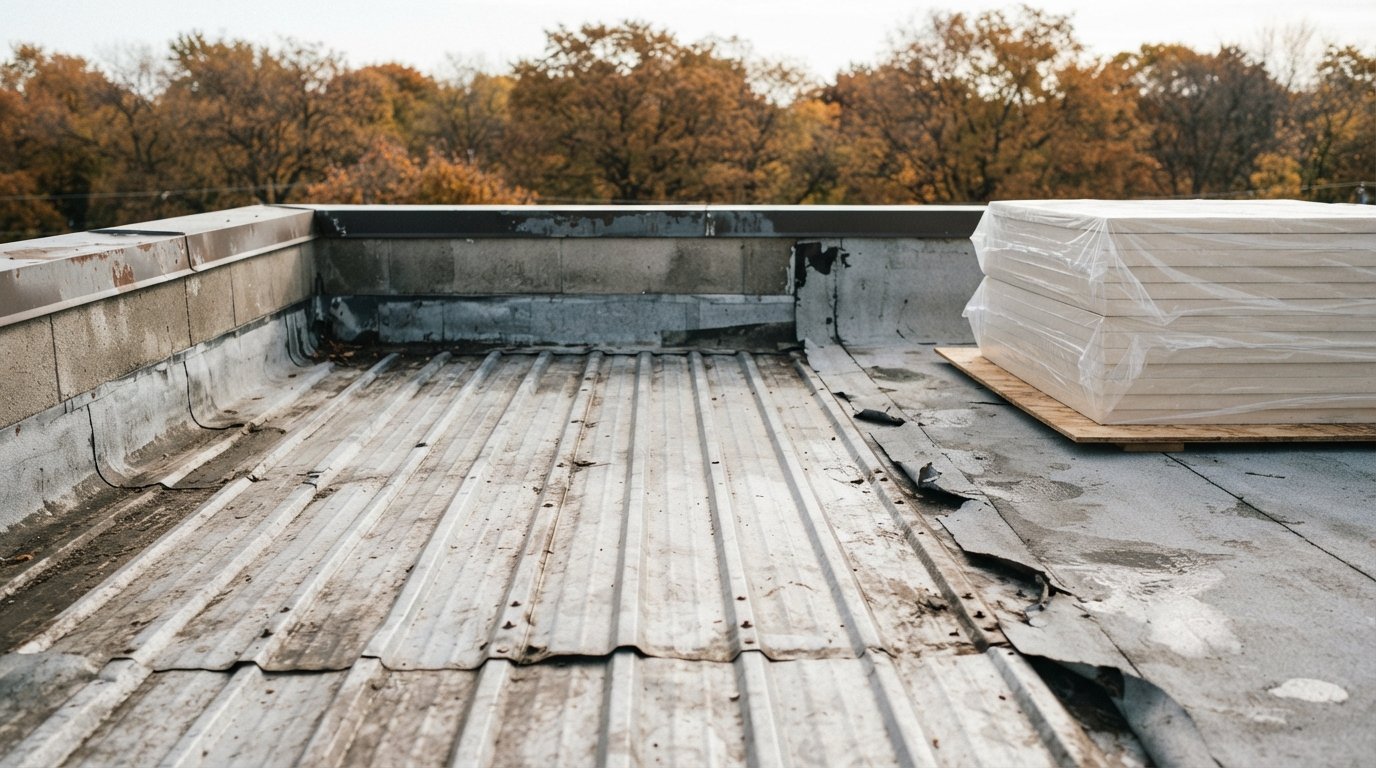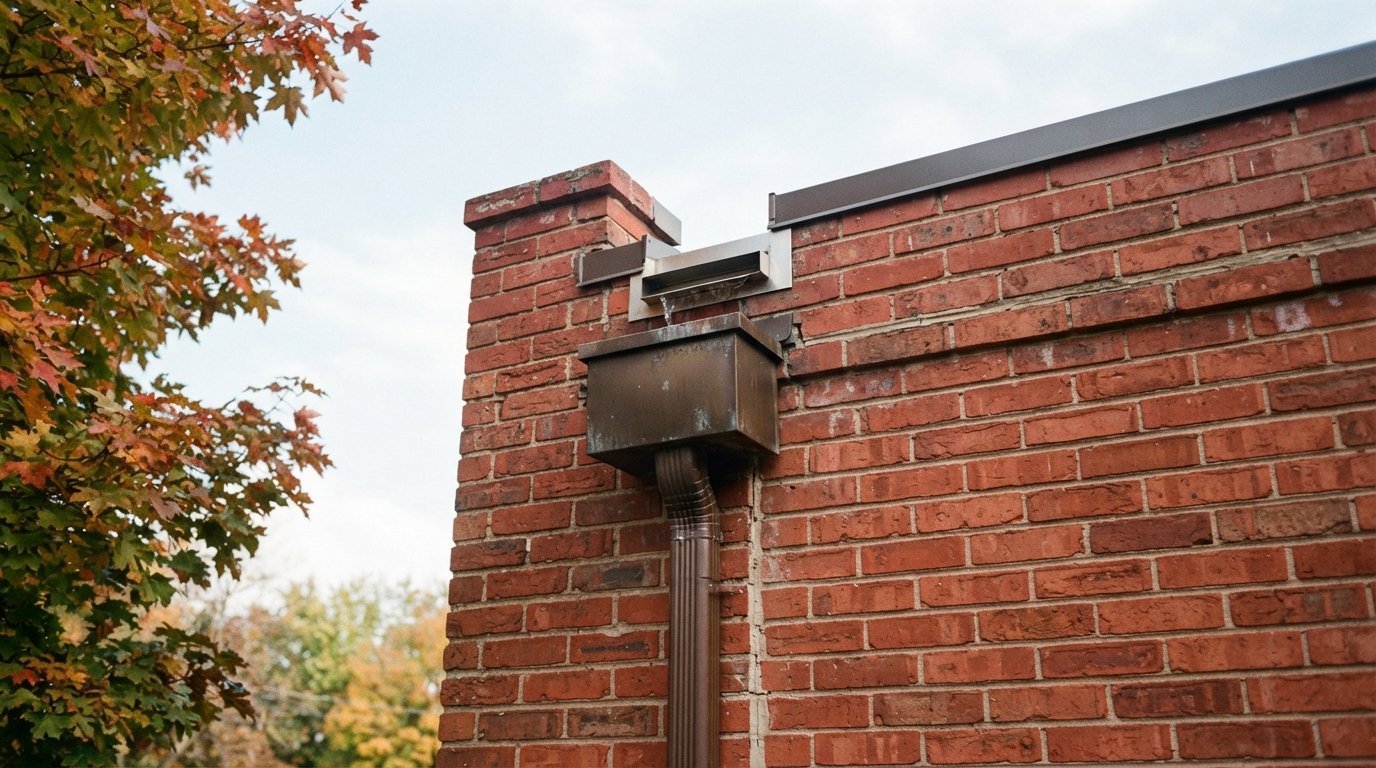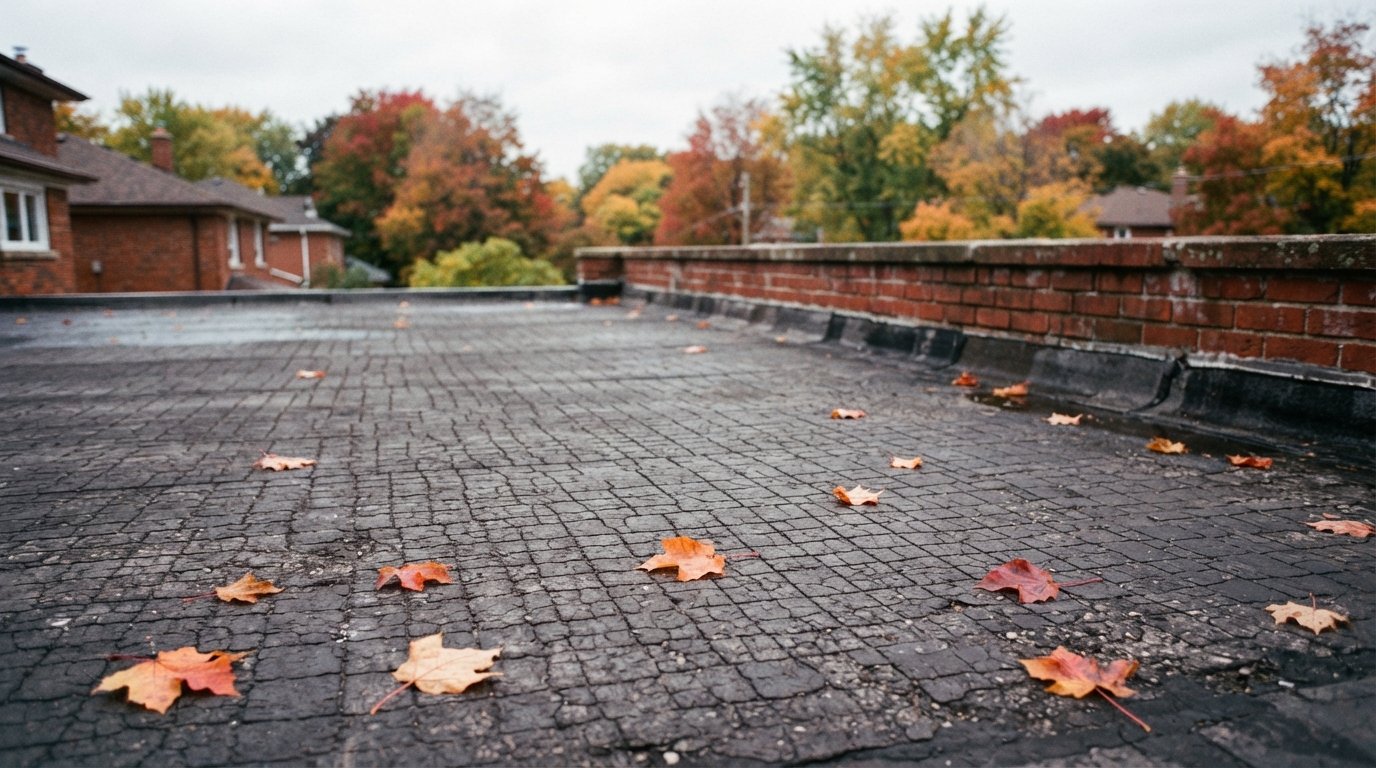

Flat roofing GTA projects rarely look the same twice, because the Greater Toronto Area is not one housing market but a dozen stitched together. A postwar bungalow in Scarborough with a rear addition, a 1990s subdivision home in Brampton with a low-slope garage roof, an estate property in King or Caledon with a large flat porch deck, and a semi-detached brick home in the old City of Toronto all carry flat roof surfaces, and each one asks a different question of the contractor. This guide walks through the GTA borough by borough, explains how local housing stock changes the specification, and sets out realistic 2026 pricing, permit expectations and timelines so you can plan flat roofing GTA work properly instead of reacting to the first leak of the season.
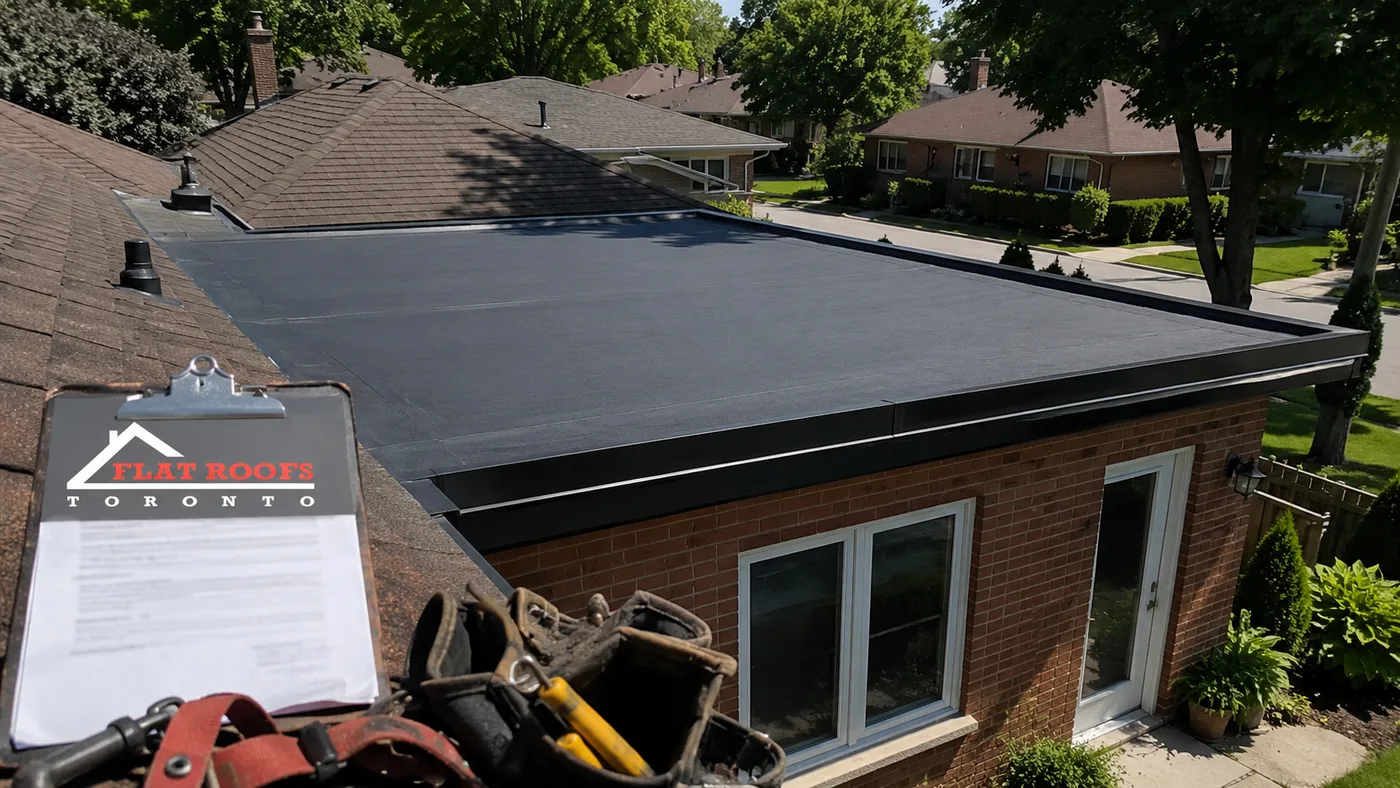
Why Flat Roofing GTA Wide Is a Regional Problem, Not a Local One
The temptation is to treat flat roofing GTA work as a single trade with a single answer. In practice, three regional variables move the specification: the age of the building, the way the flat section connects to the sloped roof beside it, and the drainage path available at the perimeter. Those three variables shift noticeably as you move outward from the old city core into Peel, York, Durham and Halton.
Older housing stock in the central boroughs tends to have flat roofs built over solid plank decking, with parapet walls, interior drains or scuppers, and decades of layered repairs. Newer subdivision housing further out tends to have plywood or OSB decking, exterior perimeter drainage to eavestrough, and a much shorter repair history. Neither is inherently harder. They simply fail in different ways and need different detailing.
Climate is the one factor that does not change much across the region, and it shapes every flat roofing GTA specification equally. Every part of the GTA sees freeze and thaw cycling through the shoulder seasons, heavy summer UV exposure, ice damming risk at roof transitions, and snow loads that sit rather than shed. That is why membrane selection and insulation strategy matter more here than in milder parts of Canada, and why a flat roof installed to the cheapest possible standard tends to announce itself within five or six winters.
Borough by Borough: How GTA Housing Stock Changes the Specification
The following is a general picture of housing character across the region. Every street has exceptions, and a proper inspection always beats a generalisation, but these patterns hold often enough to be useful when you are budgeting.
Old City of Toronto and the Inner Neighbourhoods
Semi-detached and row housing, much of it brick, much of it pre-war. Flat roofs here are frequently the main roof surface rather than a small section, often with parapet walls on both sides shared with the neighbouring property. Access is tight, material staging is difficult, and party wall detailing is the single most common source of leaks. Modified bitumen and single-ply membranes both perform well, but flashing height and counter-flashing quality matter more than the membrane brand. This is the most demanding flat roofing GTA environment for detailing.
Etobicoke, North York and Scarborough
Postwar bungalows and side-splits dominate, many with rear additions, sunrooms or carport roofs added in later decades. These low-slope sections were often built quickly and insulated lightly. When homeowners in these boroughs call about flat roofing GTA contractors, the work is usually a partial replacement of one section rather than a whole roof, and the biggest decision is whether to bring insulation up to a modern standard at the same time.
Mississauga and Brampton
A mix of 1970s to 1990s detached housing and much newer subdivision construction. Flat sections here are typically porticos, garage roofs, second-storey overhangs and small rear additions. Decking is usually sheathing rather than plank, which makes tear-off cleaner but also means water damage spreads faster once the membrane is breached. Perimeter metal and proper slope toward the eavestrough do most of the heavy lifting.
Vaughan, Markham and Richmond Hill
Newer, larger homes with more architectural complexity: multiple roof planes meeting flat terraces, walk-out balconies over living space, and flat sections tucked between gables. Complexity, not size, drives the cost of flat roofing GTA projects in these municipalities. Any flat roof over conditioned living space needs a considered vapour and insulation assembly, not just a waterproof top layer.
Durham Region: Pickering, Ajax, Whitby and Oshawa
A broad mix of older lakeshore housing and rapidly built newer subdivisions. Wind exposure closer to Lake Ontario is a real consideration for membrane attachment and perimeter fastening, particularly on fully adhered systems. Ballasted assemblies are less common on residential flat roofing GTA work here than they once were.
Halton: Oakville, Burlington, Milton and Halton Hills
Estate lots and larger custom homes appear more often, with flat roof areas used as terraces or as connectors between wings of a house. Where a flat roof doubles as a walking surface, the assembly needs a protection layer and a drainage layer above the membrane, which changes both cost and lifespan expectations.
Across all of these areas, the underlying trade is the same. What changes is access, detailing, and how much of the assembly sits above heated space. That is why quotes for flat roofing GTA projects vary so widely between two homes that look similar in square footage.
Membrane Systems Used for Flat Roofing GTA Homeowners Should Know
Four membrane families cover almost all residential low-slope work in the region. The right choice depends on the deck, the size of the area, the exposure, and whether the surface will be walked on.
| Membrane system | Typical GTA use case | Expected service life | Relative cost |
|---|---|---|---|
| Two-ply modified bitumen (torch or self-adhered) | Older central Toronto roofs, additions, parapet-heavy layouts | 20 to 30 years | Moderate |
| TPO single-ply | Mid-size suburban sections, reflective white surface, newer decking | 20 to 30 years | Moderate |
| EPDM rubber | Garage roofs, porticos, simple rectangular areas | 18 to 28 years | Lower to moderate |
| PVC single-ply | Terraces, areas near grease or chemical exposure, complex flashing | 25 to 35 years | Higher |
| Liquid-applied membrane | Awkward geometry, balconies, small areas with many penetrations | 15 to 25 years | Varies by area |
Service life figures assume competent installation, adequate slope, and periodic maintenance. A well-detailed modified bitumen roof outlives a poorly detailed PVC roof every time. If you are comparing quotes, compare the flashing details and the insulation specification before you compare membrane names.
2026 Cost Ranges for Flat Roofing GTA Projects
Pricing across the region is driven by area, access, tear-off depth, insulation upgrades and the amount of perimeter and penetration detailing. The table below reflects realistic 2026 ranges for residential work in the Greater Toronto Area. Treat these as planning figures, not quotes.
| Scope of work | Typical area | 2026 price range | Notes |
|---|---|---|---|
| Small section replacement (portico, bay, carport) | Under 200 sq ft | $2,200 to $4,500 | Minimum mobilisation costs dominate small jobs |
| Garage or single addition roof | 200 to 500 sq ft | $4,500 to $10,000 | Includes tear-off, new membrane, perimeter metal |
| Full flat roof on a semi or row house | 600 to 1,000 sq ft | $9,500 to $19,000 | Parapet and party wall detailing adds cost |
| Large flat roof with insulation upgrade | 1,000 to 1,800 sq ft | $17,000 to $34,000 | Tapered insulation and new drains add materially |
| Walkable terrace assembly over living space | Varies | $45 to $85 per sq ft | Protection board, pavers and drainage layer included |
| Emergency leak stabilisation | Localised | $450 to $1,600 | Temporary measure pending permanent repair |
Two line items surprise homeowners most often. The first is deck repair, which cannot be quoted accurately until the old membrane is off. The second is tapered insulation, which is how you correct chronic ponding without rebuilding the structure. Both should appear in a quote as a stated allowance rather than a silent omission.
Permits, Ontario Building Code and Municipal Differences
A like-for-like membrane replacement on an existing flat roof generally does not require a building permit anywhere in Ontario. What triggers a permit is structural work, a change to the roof assembly that affects the building envelope, adding or enlarging a roof, converting a flat roof into a usable terrace, or altering guards and railings. Because each municipality administers the Ontario Building Code through its own building department, the paperwork and timelines for flat roofing GTA projects differ even though the code itself does not.
| Type of work | Permit usually required | Typical review window | What the department looks for |
|---|---|---|---|
| Membrane replacement, same assembly | No | Not applicable | No submission needed in most cases |
| Deck or joist replacement beyond minor repair | Yes | 2 to 6 weeks | Structural drawings, span verification |
| New roof over an addition | Yes | 4 to 10 weeks | Full building permit with the addition |
| Converting flat roof to walkable terrace | Yes | 4 to 12 weeks | Live load capacity, guard height, egress |
| Adding roof drains through the structure | Sometimes | 2 to 6 weeks | Plumbing connection and interior routing |
| Insulation upgrade within existing assembly | Usually no | Not applicable | Compliance with current energy requirements |
Review windows are general expectations rather than guarantees, and they lengthen during the summer construction peak across every GTA municipality. Heritage designation, conservation authority regulation near ravines and watercourses, and site plan control in some areas can all add time. A contractor who works across the region should tell you early whether your project touches any of these, rather than discovering it after tear-off.
Drainage, Insulation and Getting Through a GTA Winter
Most flat roofing GTA failures are drainage failures wearing a membrane costume. Water that sits for more than 48 hours after rain is a ponding problem, and ponding accelerates membrane ageing, concentrates freeze and thaw stress, and loads the structure in ways it was not designed for. The fix is almost never more sealant. It is slope, and slope on an existing roof usually means tapered insulation built into the new assembly.
Insulation strategy matters for a second reason. A flat roof over heated living space that is under-insulated loses heat into the assembly, melts snow unevenly, and refreezes at the cold perimeter. That is the mechanism behind most ice damming at flat-to-sloped transitions. Upgrading insulation during a replacement is far cheaper than doing it as a separate project later, and it pairs naturally with attic insulation improvements where the flat section adjoins a vented attic space.
Practical drainage checkpoints worth confirming in any quote:
- Minimum slope toward drains or scuppers of roughly two per cent, achieved with tapered insulation where the deck itself is flat
- Drain and scupper sizing appropriate to the roof area, with overflow provision where interior drains are the only path
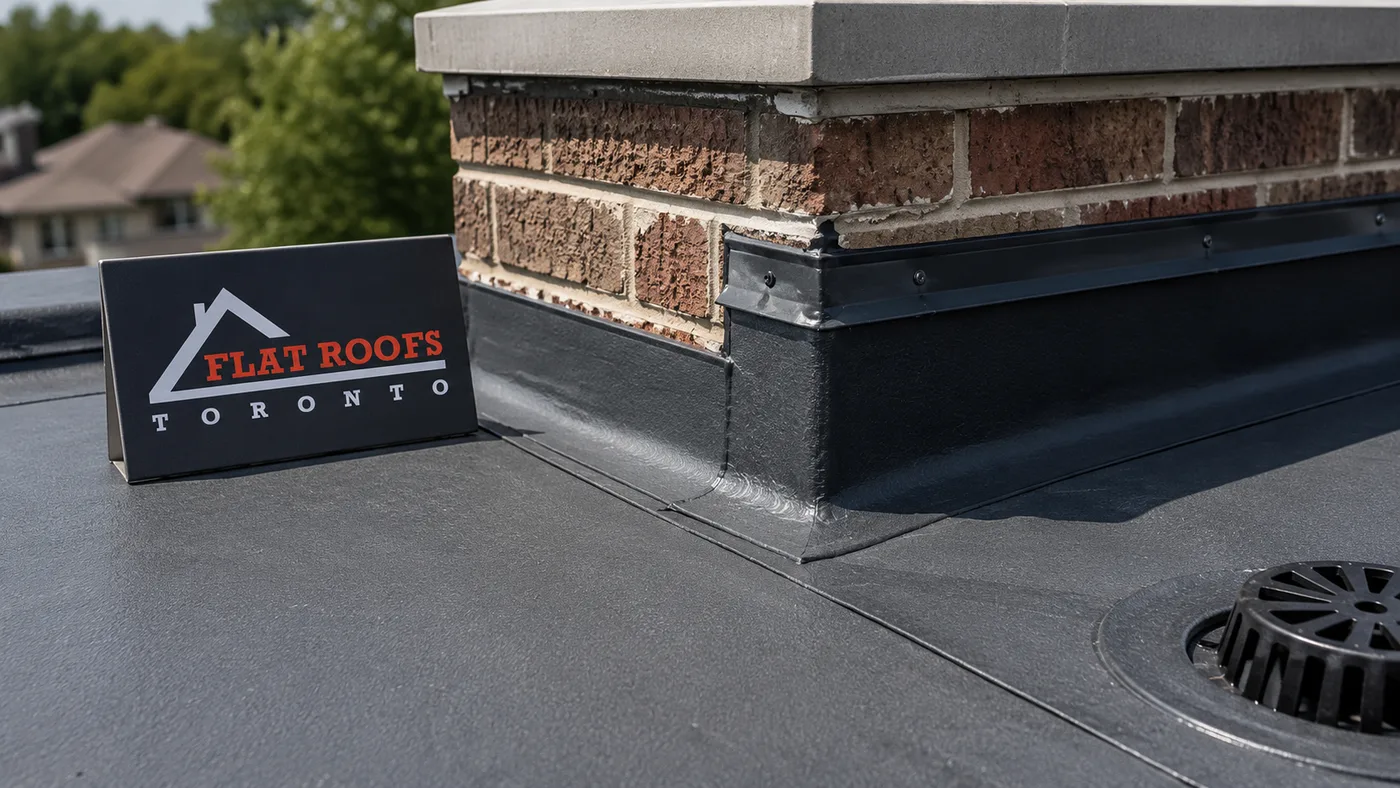
- Flashing carried a minimum of 200 mm above the finished roof surface at walls and parapets, with proper counter-flashing
- Sealed and flashed penetrations for vents, skylight curbs and any mechanical equipment
- Perimeter metal fastened and cleated to resist wind uplift, particularly on exposed lots and near the lakeshore
Where a flat roof includes glazing, the curb detail is the most common leak point of all. If you are pairing a membrane replacement with new or replacement units, coordinate the flat roof work with the skylight installation so that one crew owns the waterproofing interface rather than two trades pointing at each other.
Timelines, Seasons and Scheduling Across the Region
Residential flat roof work in the GTA runs from roughly April through November, with a narrow shoulder on either side depending on the year. Adhesives, primers and self-adhered membranes all have minimum application temperatures, and while cold-weather methods exist, the quality margin is thinner. Summer is the busiest window for flat roofing GTA crews, which means booking lead times stretch.
A realistic schedule for a straightforward residential replacement looks like this: initial inspection and quote within a week of contact, a booking window of two to six weeks in peak season, one to three days on site for most residential areas, and a final walkthrough with photo documentation on completion. Larger terrace assemblies and any permitted work extend that considerably. Anyone offering to start a full replacement tomorrow in July is either very lucky with a cancellation or not busy for a reason.
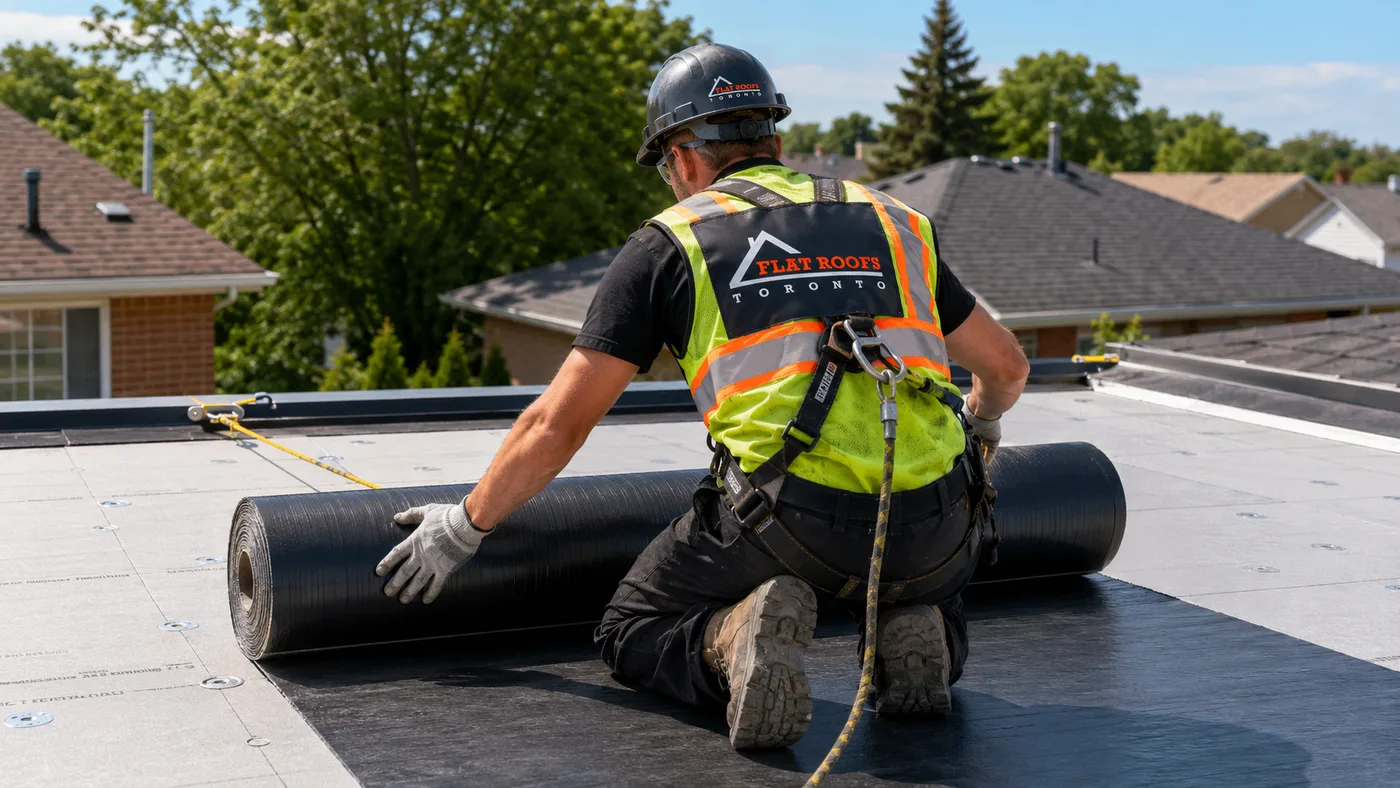
Weather also decides sequencing. Tear-off exposes the deck, so no responsible crew opens more roof than it can close and make watertight the same day. That is why a 900 square foot roof might be staged over two days rather than rushed into one, and why quotes that promise impossibly fast completion deserve a second look.
Choosing a Contractor for Flat Roofing GTA Work
The flat roofing GTA market includes excellent specialists, competent general roofers, and a seasonal fringe that appears after every storm. Sorting them is mostly a documentation exercise.
Ask for proof of WSIB coverage and general liability insurance, and verify both directly rather than accepting a photocopy. Ask specifically how many flat roofs the crew installs in a season, since sloped shingle work is a different skill set. Ask what the quote includes for deck repair and whether tapered insulation is priced or excluded. Ask who the manufacturer warranty is registered to and what the workmanship warranty covers, because those are two separate documents with different terms.
Comparing finished work also helps. Reviewing a contractor’s completed flat roof projects tells you more about detailing standards than any brochure, particularly at parapets, curbs and perimeter metal where shortcuts show. For homeowners weighing a full replacement rather than a repair, the scope of residential flat roof installation should be spelled out line by line, from tear-off and disposal through to final inspection.
Warning signs worth taking seriously:
- A quote given without anyone going onto the roof
- Large deposits requested before materials are ordered or scheduled
- No written scope listing membrane type, number of plies, insulation R-value and flashing details
- Pressure to decide the same day, or pricing that expires within hours
- Reluctance to provide WSIB and liability documentation on request
When a leak is already active, sequencing changes. Stabilise first, diagnose second, replace third. A same-visit patch that stops interior damage buys the time to plan the permanent work properly, and emergency roof repair is the right first call when water is coming through a ceiling rather than merely staining it.
Maintenance That Extends the Life of Any Flat Roof
Flat roofs are not maintenance-free, and treating them as such is the most expensive assumption a homeowner can make. Two inspections a year, in spring and late autumn, catch nearly everything before it becomes structural, and that habit alone adds years to any flat roofing GTA assembly. Clear drains and scuppers of leaves and granule debris, check that seams and flashings are intact, look for blisters or soft spots underfoot, and confirm that nothing has been fastened through the membrane since the last visit.
Document each inspection with photographs. A dated photo record turns a future warranty conversation from an argument into a review of evidence, and it makes the eventual replacement decision far easier because you can see how quickly a condition is progressing. Homeowners comparing flat roofing services across the GTA often find that maintenance programs, not headline prices, are what separate contractors who stand behind their work from those who do not.
One more habit is worth building: keep the roof clear. Rooftop planters, storage, and anything mechanical added without a proper curb are the leading causes of avoidable punctures on residential flat roofs in the region.
How much does flat roofing GTA work cost in 2026?
Do I need a permit to replace a flat roof in the GTA?
Which membrane is best for flat roofing GTA conditions?
How long does a flat roof last in the Greater Toronto Area?
Can flat roofing work be done in winter?
Why does water pond on my flat roof after rain?
Book Your Flat Roofing GTA Consultation Today
Whether you own a postwar bungalow with a tired rear addition, a subdivision home with a leaking garage roof, or a larger property with a terrace over living space, the right starting point for any flat roofing GTA decision is an inspection that looks at slope, insulation and flashing rather than just the surface. Flat Roofs Toronto is based in the Toronto area and works with homeowners throughout the Greater Toronto Area, providing written scopes that state membrane type, insulation values and flashing details so you can compare quotes honestly.
Call us today at (647) 333-3528 or request a free consultation to have your roof assessed and a realistic plan put in writing.
Flat Roofs Toronto proudly serves homeowners across the GTA, including Toronto, Etobicoke, North York, Scarborough, Mississauga, Brampton, Vaughan, Markham, Richmond Hill, Oakville, Burlington, Milton, Pickering, Ajax, Whitby and Oshawa.