Flat roof insulation plays a dual role in Toronto buildings: it keeps your heating and cooling costs down, and it prevents the moisture, condensation, and ice dam problems that destroy flat roofs from the inside out. Flat Roofs Toronto installs and upgrades flat roof insulation systems across the GTA.
Why Flat Roof Insulation Matters in Toronto
Toronto’s climate demands high insulation performance:
- Heating costs. In winter, an improperly insulated flat roof loses 25 to 35% of your building’s heat through the roof, the single largest source of energy loss.
- Cooling costs. In summer, flat roofs absorb enormous solar energy. Without insulation, interior temperatures soar and AC systems work overtime.
- Condensation prevention. When warm interior air meets a cold roof deck, condensation forms. Over time, this moisture rots the deck, degrades insulation, and causes mold. Proper insulation keeps the deck temperature above the dew point.
- Ice dam prevention. Heat escaping through an inadequately insulated flat roof melts rooftop snow. Meltwater reaches the cold roof edge and refreezes, creating ice dams that force water under the membrane.
Flat Roof Insulation Types and R-Values
| Material | R-Value/Inch | Cost/sq ft | Best For |
|---|---|---|---|
| Polyisocyanurate (polyiso) | R-5.6 to R-6.5 | $1.00 to $2.50 | Above-deck insulation, highest R per inch |
| Expanded polystyrene (EPS) | R-3.8 to R-4.4 | $0.50 to $1.50 | Tapered systems, budget-friendly |
| Extruded polystyrene (XPS) | R-5.0 | $1.00 to $2.00 | Below-membrane, moisture resistance |
| Spray foam (closed cell) | R-6.0 to R-7.0 | $2.00 to $4.00 | Irregular surfaces, retrofit from below |
| Mineral wool (stone wool) | R-4.0 to R-4.3 | $1.50 to $3.00 | Fire resistance, sound insulation |
Ontario Building Code Insulation Requirements
The Ontario Building Code sets minimum insulation requirements for flat roofs. As of 2026:
- Residential roofs: Minimum R-31 (effective). Most experts recommend R-40+ for Toronto’s climate.
- Commercial roofs: NECB (National Energy Code for Buildings) requirements vary by building type, typically R-25 to R-35.
- Continuous insulation: Insulation must be continuous, no gaps or thermal bridges through framing members.
- Air barrier: A continuous air barrier is required at the roof assembly to prevent warm interior air from reaching the cold roof deck.
Insulation Installation Methods
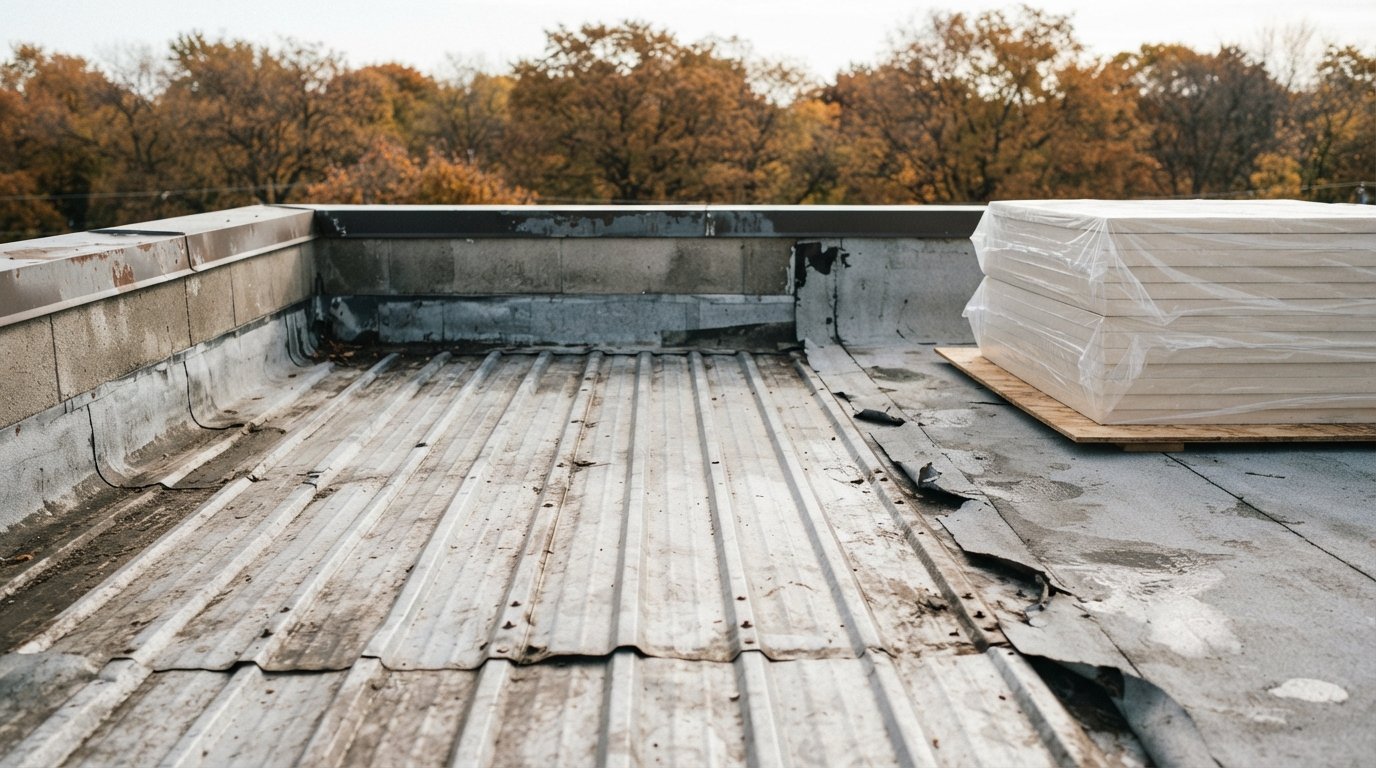
Above-deck (conventional). Insulation boards are installed on top of the roof deck, directly under the waterproof membrane. This is the standard installation for new flat roofs and replacements. Advantages: protects the deck from temperature extremes, easy to inspect and replace, best thermal break.
Below-deck (interior). Spray foam or batt insulation is installed from below, between joists. Used for retrofit situations where the membrane is in good condition and does not need replacement. Less effective than above-deck because it does not protect the deck itself.
Inverted (Protected Membrane Roof). Insulation is placed on top of the waterproof membrane, weighted down with ballast (gravel or pavers). The membrane stays at a constant temperature, dramatically extending its life. XPS is used because it resists moisture absorption. Common on green roofs and commercial installations.
Signs Your Flat Roof Needs Better Insulation
- Ice dams forming at roof edges in winter, heat is escaping through the roof
- Condensation or frost on interior ceiling surfaces below the flat roof
- Mold growth in the roof assembly visible during inspections
- Heating and cooling costs significantly higher than comparable buildings
- Uneven snow melt patterns on the roof surface, hot spots indicate insulation gaps
- Existing insulation is wet or compressed (visible during roof repair or replacement)
Cost of Flat Roof Insulation Upgrades
| Project Type | Cost | Energy Savings |
|---|---|---|
| Insulation upgrade during roof replacement | $3 to $8/sq ft above membrane cost | 20 to 35% heating cost reduction |
| Spray foam retrofit from below (existing roof) | $4 to $8/sq ft | 15 to 25% heating cost reduction |
| Tapered insulation for drainage + R-value | $5 to $12/sq ft | 25 to 35% + eliminates ponding |
Upgrade Your Flat Roof Insulation
The most cost-effective time to upgrade flat roof insulation is during a roof replacement, the deck is already exposed, and adding insulation adds minimal labour cost. Flat Roofs Toronto includes insulation assessment and upgrade recommendations with every roof replacement estimate. Contact us for a free assessment of your current insulation performance.