
Flat roofs carry most of Markham‘s commercial building stock: the strip plazas along the main arterial corridors, the low rise office and light industrial units in the business parks that grew up around the highway corridors, the medical and professional buildings tucked against residential edges, and the mixed use blocks added over the last two decades. If you own or manage one of those buildings, commercial flat roofing in Markham is one of the largest capital items you will ever budget for, and one of the easiest to get wrong. A membrane that fails early does not just cost you a second roof. It costs you tenant disruption, interior repairs, insurance friction and, in the worst cases, a business interruption claim.
This guide covers what commercial flat roofing in Markham actually involves in 2026: which membrane systems make sense for local conditions, what the work costs at realistic 2026 Ontario pricing, how drainage and insulation requirements under the Ontario Building Code shape the design, what permits and site logistics to expect, and how to tell a competent roofing contractor from a cheap one. Everything below is written for building owners and property managers, not for other roofers, so the technical points are explained rather than assumed.
What Commercial Flat Roofing in Markham Has to Withstand
The climate is the starting point for every decision. Markham sits in the same southern Ontario weather band as the rest of the GTA, which means a commercial flat roof here has to survive roughly 100 freeze and thaw cycles a year, summer membrane surface temperatures that can climb well past 60 degrees Celsius on a dark roof, ice damming at parapets and scuppers, and snow loads that concentrate in drifts behind mechanical units and along wall intersections.
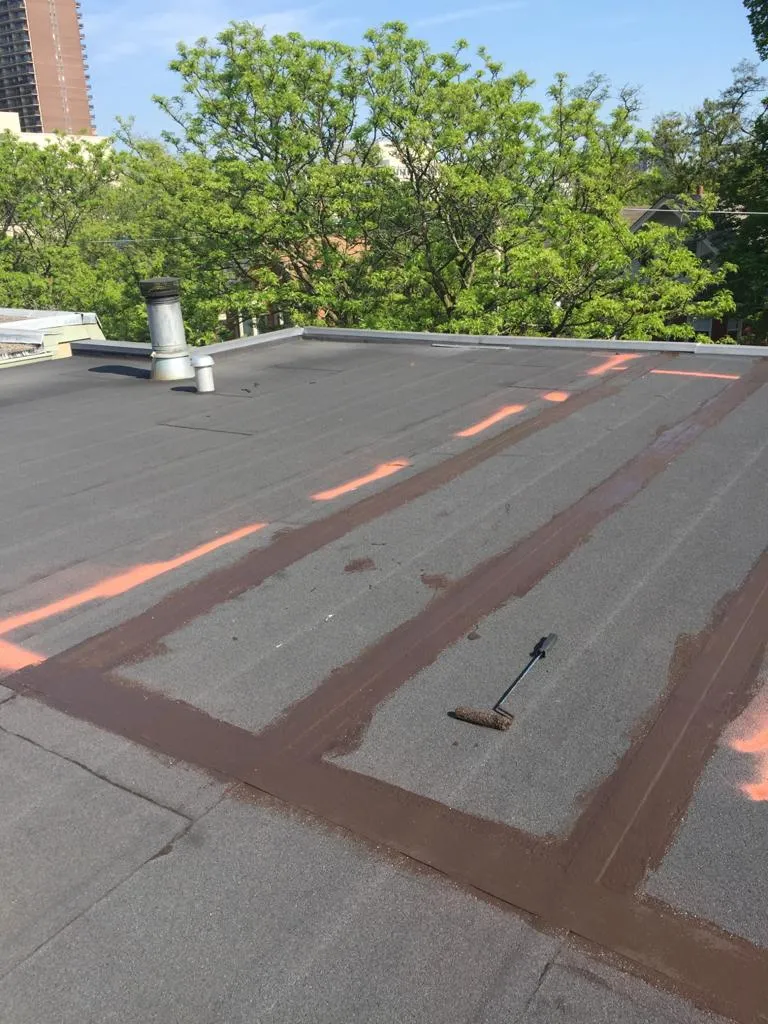
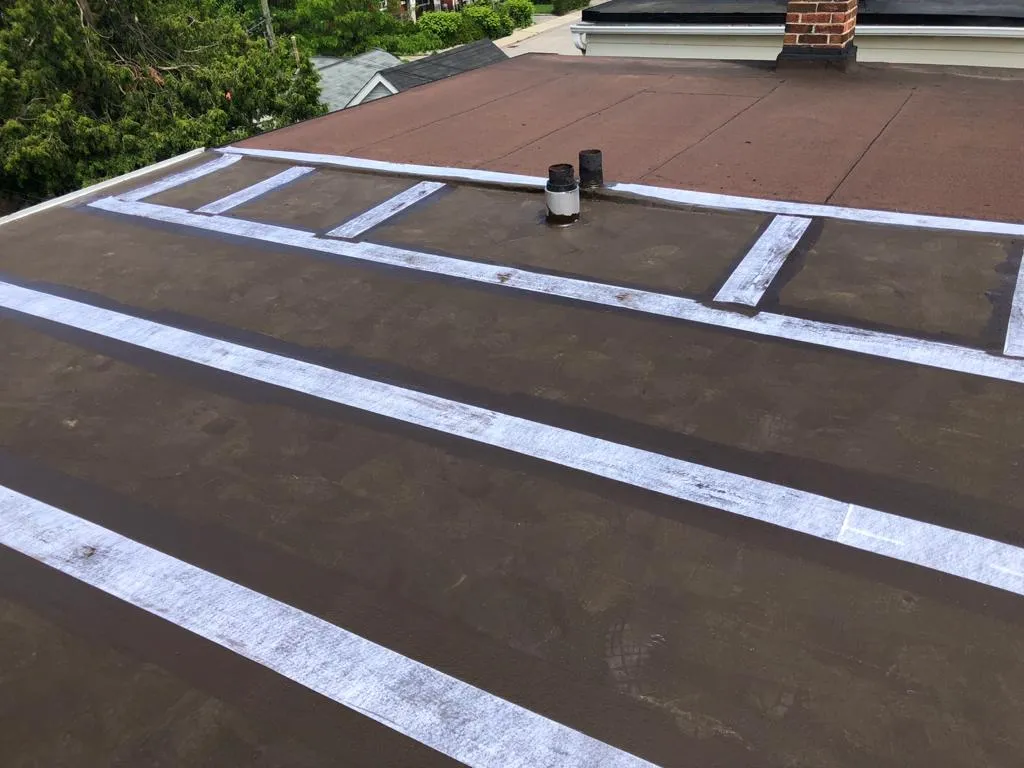
That combination is harder on a roof than either extreme on its own. Freeze and thaw cycling is what opens seams, splits aged bitumen and works fasteners loose. Ponded water that sat harmlessly through August becomes an expanding ice lens in January. Thermal movement across a large uninterrupted roof field puts constant stress on flashings at curbs, parapets and drains, which is exactly where the majority of commercial flat roof leaks begin. Any honest conversation about commercial flat roofing in Markham starts with details and terminations, not with the field of the membrane.
Wind is the second factor. Low rise buildings with parapets on open suburban sites see meaningful uplift pressure at corners and perimeters, which is why properly engineered systems use tighter fastening patterns in those zones rather than a uniform layout across the whole roof. If a quote does not mention perimeter and corner enhancement, the contractor is pricing a field rate and hoping for the best.
Markham’s Building Stock and Why It Changes the Approach
Markham is not a single kind of place, and the roofing approach shifts with the era of the building. Older Markham Village and Thornhill areas mix postwar bungalows and older brick homes with small scale commercial buildings on tight lots, often with limited setbacks and neighbouring properties close enough to complicate access and debris control. The large subdivisions built from the 1980s onward brought with them neighbourhood plazas and low rise commercial units that are now hitting the end of their second or third roof cycle. Estate lots and newer developments in the north end tend to have more generous site room, which makes staging and disposal simpler and slightly cheaper.
The practical consequence is that two buildings of identical square footage can carry very different prices. A 6,000 square foot plaza roof with a shared parking area, easy crane placement and no occupied units below is a straightforward project. The same roof over an operating clinic, with a single narrow access lane, restricted work hours and sensitive interior finishes, needs more protection, more staging and more labour hours. Good quoting for commercial flat roofing in Markham prices the site, not just the square footage.
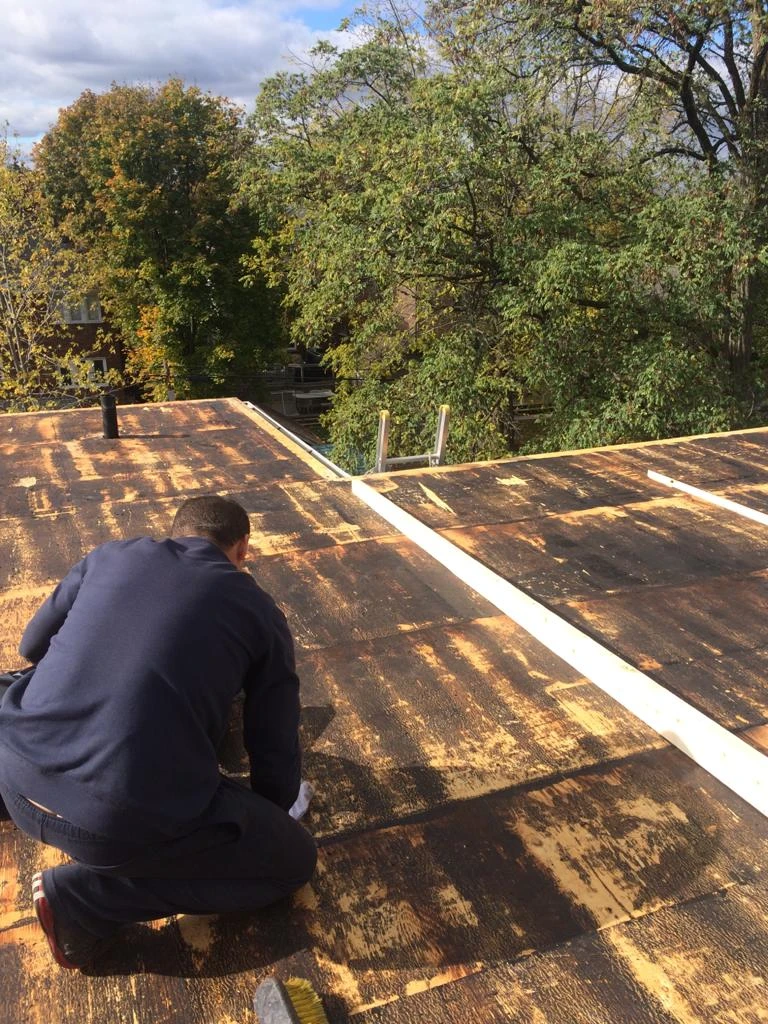
Building age also determines what is underneath. Buildings from the 1970s and 1980s frequently carry built up asphalt and gravel roofs with fibreboard or older insulation that has absorbed moisture. Buildings from the 2000s onward are more likely to have single ply membrane over polyisocyanurate. A moisture scan or a set of test cuts before the quote is the only reliable way to know whether you are looking at a recover, a partial tear off or a full replacement down to deck. Skipping that step is the most common reason a commercial flat roofing Markham project runs over budget.
Membrane Systems Compared for Commercial Flat Roofing in Markham
Four system families cover almost every commercial flat roofing job in Markham and the surrounding region. None of them is universally best. The right choice depends on roof traffic, rooftop equipment, drainage, budget horizon and how long you intend to hold the building.
Two ply SBS modified bitumen remains the workhorse for Ontario commercial roofs. It is a torch or self adhered base sheet with a granulated cap sheet, tough underfoot, forgiving of foot traffic and grease exposure, and easy for any competent crew to repair. TPO is a heat welded single ply thermoplastic, usually white, which reflects solar heat and lowers summer cooling loads. EPDM is a black synthetic rubber sheet, very stable over decades but seamed with adhesives and tapes rather than welds. PVC is the premium single ply, heat welded like TPO but with better chemical resistance, which matters for restaurant exhaust and industrial discharge.
| Membrane system | Typical service life | Installed cost per sq ft (2026) | Best suited to |
|---|---|---|---|
| Two ply SBS modified bitumen | 25 to 35 years | $11.00 to $16.50 | Plazas, mixed use blocks, roofs with regular foot traffic |
| TPO single ply (60 to 80 mil) | 20 to 30 years | $9.00 to $14.00 | Large open roof fields, buildings chasing cooling savings |
| EPDM single ply (60 to 90 mil) | 25 to 35 years | $8.50 to $13.00 | Simple roofs with few penetrations and light traffic |
| PVC single ply (60 to 80 mil) | 25 to 35 years | $12.00 to $18.00 | Restaurants, food processing, grease or chemical exposure |
| Built up asphalt and gravel | 20 to 30 years | $10.00 to $15.00 | Replacement in kind on older assemblies |
| Liquid applied restoration coating | 8 to 15 years | $4.00 to $8.50 | Sound roofs needing a service life extension, not failed ones |
One caution on coatings. A liquid applied restoration system is a legitimate tool when the existing membrane is dry, well adhered and structurally sound. It is not a repair for a wet roof. Coating over saturated insulation seals moisture in, accelerates deck corrosion and converts a manageable replacement into an expensive one. Any contractor recommending a coating without a moisture survey first is selling a product rather than solving a problem.
What Commercial Flat Roofing Costs in Markham in 2026
Pricing for commercial flat roofing in Markham is driven by four things: the system you choose, how much of the existing assembly comes off, how much insulation you add, and how difficult the site is. The table below reflects realistic 2026 Ontario ranges for a complete tear off and replacement including disposal, new insulation to current effective values, new flashings and standard warranty. Buildings with heavy rooftop equipment, extensive curb work or restricted access will land at or above the top of each range.
| Roof area | Typical building type | Full replacement range (2026) | Typical duration |
|---|---|---|---|
| 2,000 to 3,000 sq ft | Single plaza unit, small professional building | $24,000 to $46,000 | 3 to 5 working days |
| 5,000 to 7,000 sq ft | Neighbourhood plaza section, medical building | $55,000 to $105,000 | 1 to 2 weeks |
| 10,000 to 12,000 sq ft | Small industrial or office unit | $100,000 to $180,000 | 2 to 3 weeks |
| 20,000 to 25,000 sq ft | Multi tenant plaza, warehouse bay | $190,000 to $340,000 | 3 to 5 weeks |
| 40,000 sq ft and up | Distribution, large multi tenant complex | $360,000 and up | 6 weeks and up |
Line items that commonly sit outside the base square foot rate include tapered insulation packages to correct ponding at $4.00 to $8.50 per square foot over the tapered area, new roof drains and sumps at roughly $900 to $1,800 each installed, parapet cap flashing at $35 to $70 per linear metre, new mechanical curbs at $700 to $1,600 each, and structural deck repair priced on discovery. Deck repair is the reason a contingency of 8 to 12 percent belongs in every commercial flat roofing Markham budget. Nobody can see under the insulation until the roof is open.
Phasing is worth discussing early. On multi tenant buildings, splitting the work across two fiscal years by roof section is often cheaper for cash flow than it looks, though it does add mobilisation cost and creates a temporary tie in detail that has to be built properly rather than taped. If you are weighing a phased plan, get both the phased and the single phase price and compare total spend, not annual spend.
Drainage, Insulation and Ontario Building Code Requirements
Drainage is the single biggest predictor of how long commercial flat roofing in Markham lasts. Ontario practice targets a minimum slope of roughly 1:50, about two percent, toward drains, and no standing water remaining 48 hours after rainfall stops. Many older commercial roofs in Markham were built flatter than that, or have deflected over time, which is why tapered insulation and sump reconstruction show up so often on replacement scopes. Correcting drainage during a replacement costs a fraction of what it costs to retrofit later, and it is the difference between a membrane reaching its rated life and failing at year twelve.
Overflow protection matters just as much. Scuppers or secondary drains prevent a blocked primary drain from loading the structure with ponded water. On buildings where the parapet forms a continuous dam, an overflow path is not optional.
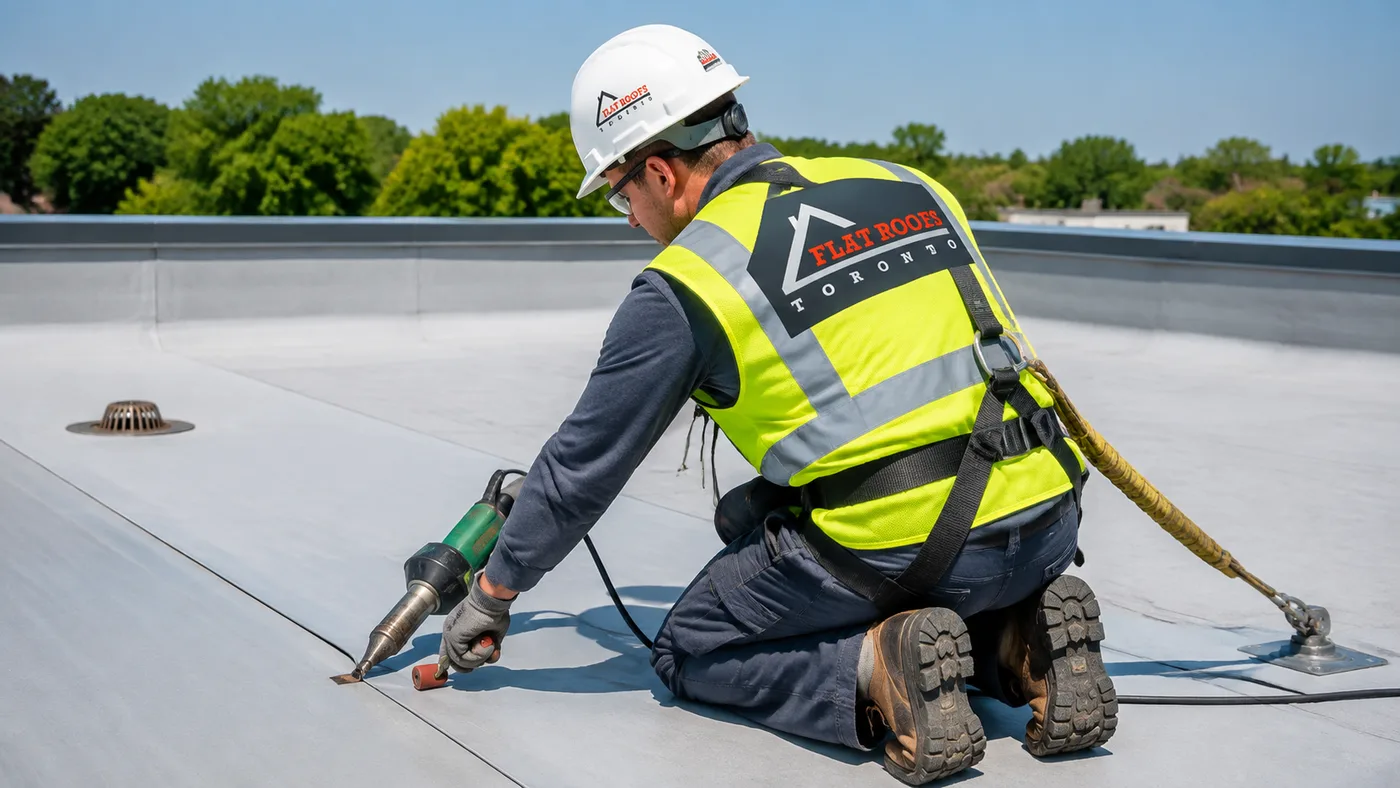
Insulation requirements have tightened considerably. Southern Ontario commercial roof assemblies are now typically built to an effective insulation value in the R-30 to R-35 range, achieved with layered polyisocyanurate with staggered joints so there is no straight thermal path through the assembly. Two layers with offset seams outperform one thick layer, and any contractor still proposing a single layer butted to the deck is working from an outdated playbook. Where a roof replacement changes the assembly rather than simply swapping membrane, the current energy requirements apply, and that upgrade needs to be in the budget from the start.
Vapour control is the third piece. Buildings with high interior humidity, including food service, laundry, fitness and some manufacturing uses, need a properly detailed air and vapour barrier at the deck. Without it, warm moist interior air condenses inside the insulation through a Markham winter and quietly destroys the assembly from below while the membrane above looks perfect.
Permits, Access and Scheduling Commercial Roof Work
A like for like membrane replacement on an existing commercial flat roof generally proceeds without a building permit. A permit is typically required once the roof assembly itself changes, when structural deck repair is involved, when new mechanical openings or curbs are cut, or when the work touches fire separations or parapet construction. Confirm the requirement with the City of Markham building department before mobilising, since the answer depends on the specific scope rather than on the building type.
Site logistics deserve equal attention. Commercial roofing runs on hoisting, so a crane or telehandler needs a clear, level setting area and adequate overhead clearance. On tighter older commercial lots, that may mean scheduling the lift for early morning before a plaza opens, or arranging temporary lane control. Disposal bins need placement that does not block fire routes or accessible parking. Occupied buildings need interior protection under any deck work and a written communication plan so tenants know what is happening and when.
Safety compliance is not a formality on commercial work. Every crew member should hold current Working at Heights training, guardrails or a tie off system must be in place before anyone approaches the perimeter, and the contractor should be able to produce a WSIB clearance certificate and proof of at least two million dollars in liability coverage without hesitation. If those documents take days to appear, that tells you something about how the company operates.
Season matters too. Adhesives, self adhered membranes and heat welding all have temperature windows, and while experienced crews work through Ontario winters using cold weather procedures, planning a replacement between May and October produces better conditions, faster progress and fewer weather delays. Emergency work is a different matter, and a failing roof in February should be stabilised immediately rather than left until spring. Our team handles urgent leaks and storm damage through emergency roof repair when a building cannot wait for a full replacement window.
Maintenance That Protects the Investment
Commercial flat roofing in Markham is a maintained asset, not simply an installed one. Most manufacturer warranties require documented inspections, and most premature failures trace back to something small that was ignored: a blocked drain, an open seam at a curb, a loose cap flashing, or damage from an HVAC technician who walked across the membrane with tools. A simple maintenance programme extends usable life by five to ten years on a typical system, which is the cheapest roofing money you will ever spend.
| Task | Frequency | Typical cost | Why it matters |
|---|---|---|---|
| Full roof inspection with photo report | Twice yearly, spring and fall | $400 to $900 per visit | Catches seam, flashing and drain issues before water enters |
| Drain and scupper clearing | Quarterly, plus after major storms | $150 to $400 per visit | Prevents ponding, ice loading and structural overload |
| Seam and flashing repairs | As identified | $300 to $2,500 per item | Small repairs prevent saturated insulation and deck damage |
| Infrared or capacitance moisture survey | Every 5 years, or before capital planning | $0.10 to $0.25 per sq ft | Maps wet insulation so budgets reflect reality |
| Post equipment work inspection | After any rooftop trade attends | $200 to $450 | Finds puncture and curb damage while responsibility is clear |
Keep the records. A photo documented history of inspections and repairs supports warranty claims, satisfies insurers, and materially strengthens your position during a building sale, when a buyer’s condition report will otherwise assume the worst about an undocumented roof.
How to Choose a Contractor for Commercial Flat Roofing in Markham
The gap between the cheapest and the most expensive quote for commercial flat roofing in Markham is often 30 percent or more, and the difference is rarely the membrane. It is insulation thickness, flashing detail, fastening density at corners and perimeters, disposal, and whether deck repair was allowed for or left as a surprise change order. Compare quotes line by line rather than by bottom line.
Ask for the full assembly specification in writing: deck preparation, vapour barrier, insulation type and layered thickness, cover board, membrane type and thickness, attachment method, and every termination detail. Ask which warranty is being offered, since a manufacturer system warranty covering both material and labour is a different instrument from a contractor workmanship warranty, and both have value. Ask to see completed commercial projects of comparable size and complexity, which is exactly what a contractor’s project gallery should show you.
Be direct about who is actually doing the work. Some companies sell the job and subcontract the crew, which is not automatically a problem, but you are entitled to know who will be on your building and who carries the warranty obligation. For owners planning capital work, our commercial flat roof installation service covers full tear off and replacement with the assembly specified up front, and you can review the full range of flat roofing services available to Markham property owners before deciding on scope. Owners of mixed buildings sometimes need residential work on an attached dwelling as well, which is handled through residential flat roof installation, and thermal performance questions often extend into attic insulation on the residential side of a property.
Finally, treat pressure as a warning sign. Legitimate commercial flat roofing work in Markham involves an inspection, sometimes test cuts, a written scope and a considered decision. A same day price with a discount that expires tonight is a sales tactic, not an engineering assessment.
How much does commercial flat roofing in Markham cost per square foot?
How long does a commercial flat roof last in the Markham climate?
Do I need a permit for commercial flat roofing in Markham?
Can a commercial flat roof be replaced while the building stays open?
Is a recover a better option than a full tear off?
What is the best time of year to schedule the work?
Book Your Commercial Flat Roofing Markham Assessment Today
If your building is approaching the end of its roof cycle, or you are seeing recurring leaks around drains, curbs or parapets, the right next step is a proper inspection and a written assessment rather than a quick patch. Flat Roofs Toronto is a Toronto area flat roofing contractor handling commercial flat roofing in Markham for property owners and managers across the municipality, and every assessment includes a review of the existing assembly, drainage, insulation and detailing, with a clear scope and price before any commitment.
Call us today at (647) 333-3528 or request a free consultation to have your roof assessed and a realistic replacement budget prepared.
Flat Roofs Toronto serves commercial and residential property owners in Markham and across the Greater Toronto Area with flat roof installation, replacement, repair and maintenance.