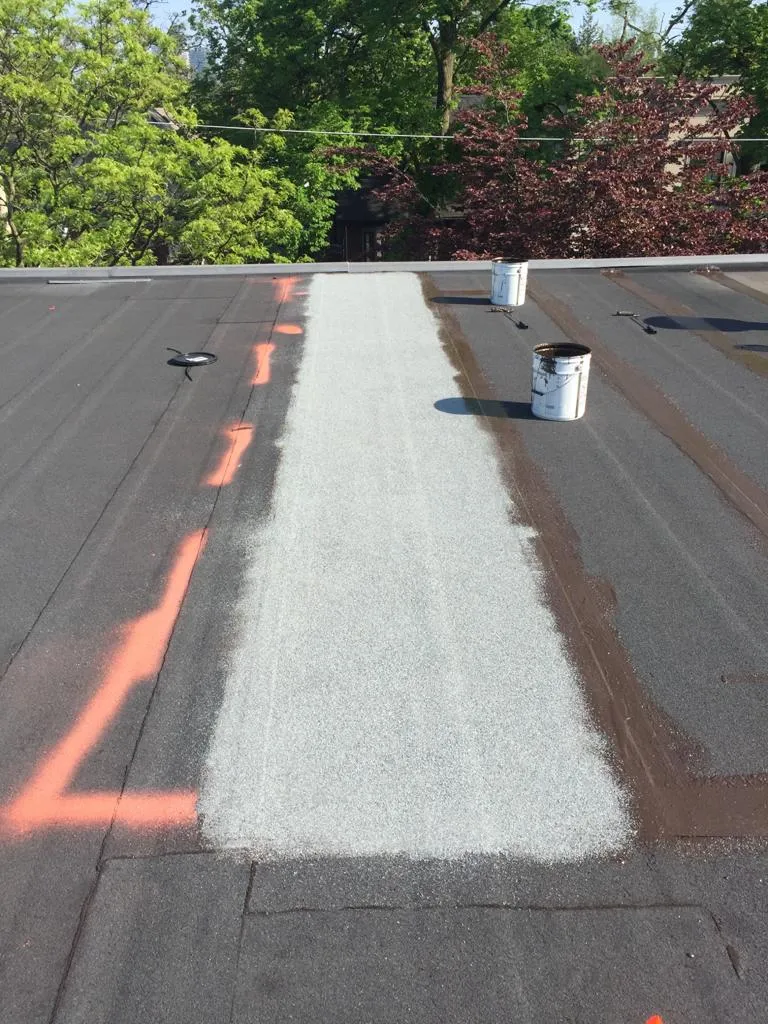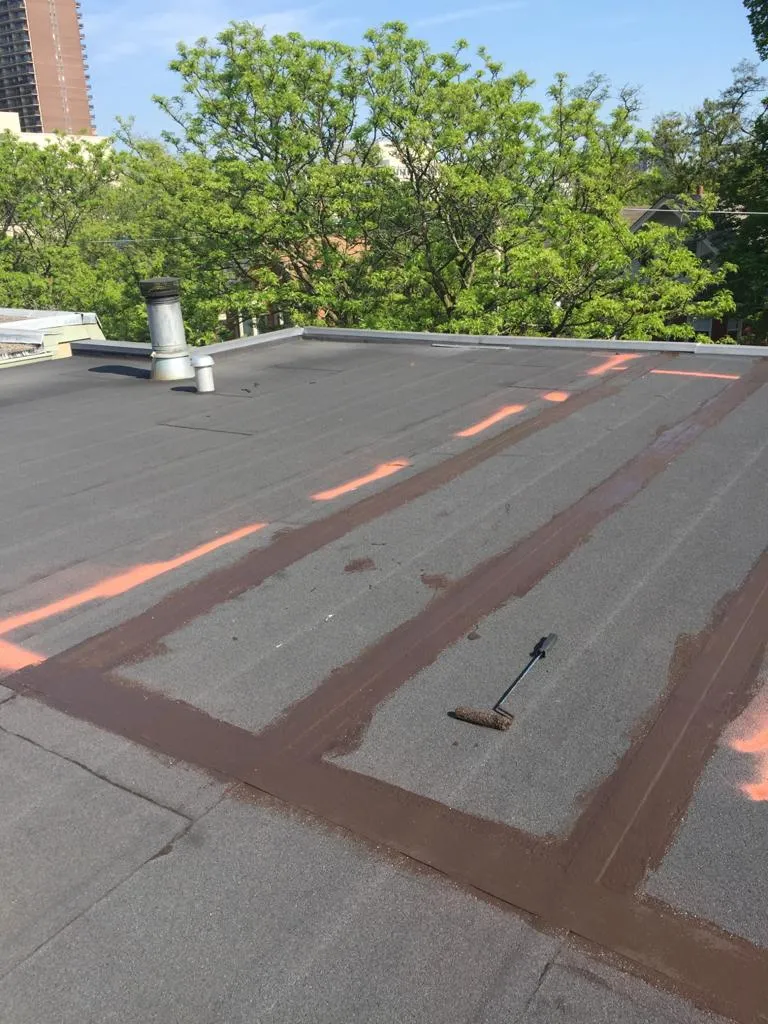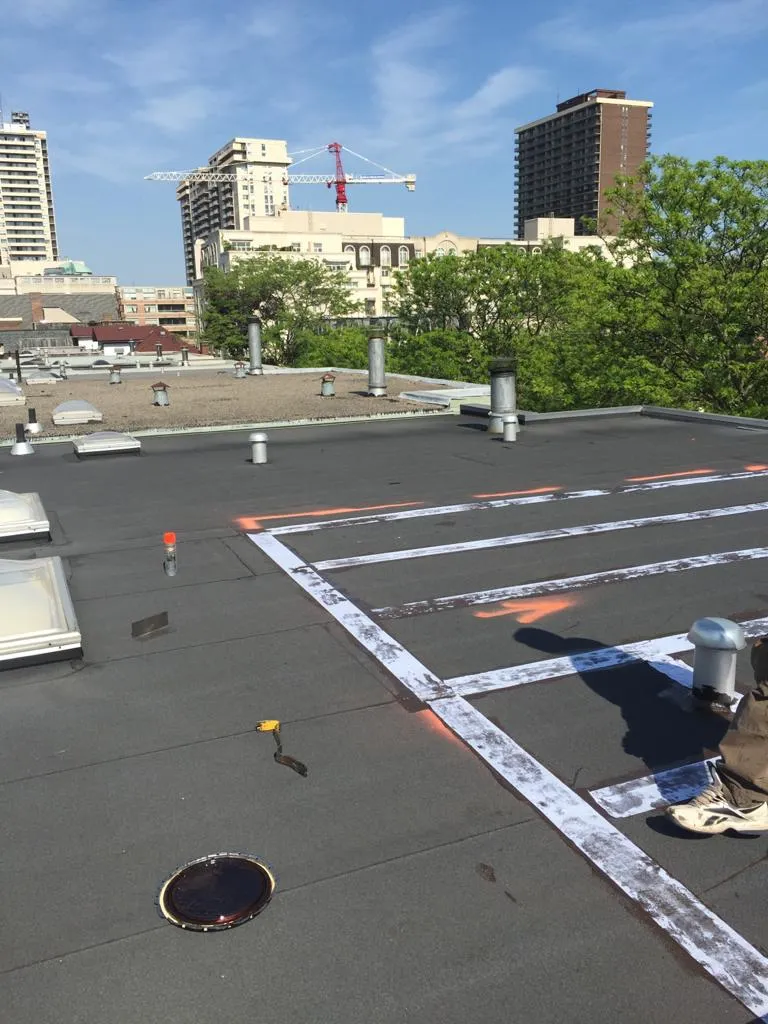

Toronto’s summer of 2026 has already delivered back-to-back heat waves that are pushing outdoor temperatures well above 35 °C for days at a stretch, and the consequences for low-slope roofing are becoming painfully visible across the GTA. Flat roof seam failure heat waves toronto is now one of the most-searched roofing terms among building owners in Mississauga, Markham, Vaughan, Brampton, Oakville, and Burlington, as property managers scramble to diagnose and fix splits, bubbles, and open laps before they escalate into interior water damage. This guide explains exactly why extreme heat triggers seam failures, how to spot the early warning signs on your own roof, what repair options are available, and what the cost implications look like so you can plan accordingly.
At Flat Roofs Toronto, we have responded to a significant surge in service calls since the first heat event of the season. What we are seeing in the field confirms what materials science predicts: membranes that are already near the end of their service life are failing at seams and lap joints when sustained surface temperatures climb past 70 °C. Even relatively young roofs can develop problems if the original installation left any gaps in adhesion, improper overlap widths, or contaminated bonding surfaces. Understanding the mechanism helps you prioritise inspections and allocate repair budgets before the summer rains arrive in full force.
This article covers the full picture, from thermal physics to material comparisons, from DIY detection checklists to professional repair timelines, so that every building owner in the Toronto area has the information needed to protect their investment this summer.
Why Flat Roof Seam Failure Heat Waves Toronto Are Increasing in 2026
The relationship between ambient temperature and membrane movement is not linear, it accelerates. On a clear Toronto day in late June with an air temperature of 34 °C, a dark EPDM or modified bitumen surface can reach 80 to 90 °C. TPO membranes in light grey or white reflect more radiation, but they still routinely hit 60 to 70 °C under sustained sun exposure. These are not edge-case scenarios; Environment Canada’s monitoring data for 2025 and early 2026 shows that the number of days per summer with a humidex above 40 has increased measurably over the previous decade, and that trend is continuing.
Seams are the weakest link in any flat roofing system for a straightforward reason: they are the points where two separate membrane sheets are joined. The bond, whether a hot-air weld, a solvent weld, a pressure-sensitive adhesive, or a torch-fused lap, must accommodate the differential movement between two overlapping layers that are both expanding and contracting simultaneously. When surface temperatures swing 50 to 60 °C between dawn and mid-afternoon, even a well-installed seam experiences stress cycles that accumulate fatigue over time. On a roof that has already logged ten or more heating seasons, the adhesive at the laps may have oxidised, the membrane itself may have lost plasticisers and become brittle, and the combination of those factors with a sudden 38 °C heat wave is enough to trigger visible separation.
The problem is compounded in Toronto’s dense urban environment by the heat island effect. Rooftop HVAC equipment, mechanical penthouses, and dark paved surfaces in surrounding areas all raise the ambient temperature around a building’s roof deck by an additional 3 to 5 °C compared with rural settings. Flat roof seam failure heat waves toronto events are therefore not purely a climate-change story, they are also an urban-density story, and they will affect buildings in downtown Toronto, the inner suburbs, and intensifying nodes like Vaughan’s VMC and Markham’s Unionville differently from a century home on a quiet street in Oakville.
Three additional factors accelerate seam stress in summer 2026 specifically. First, supply chain disruptions over 2023 to 2025 led some contractors to use alternative adhesive formulations that have not been field-tested through multiple heat cycles. Second, rapid re-roofing demand after the unusually wet spring of 2025 meant that some installations were completed over damp substrates or in marginal temperature conditions, creating adhesion deficits that are now manifesting under heat stress. Third, the age profile of Toronto’s flat roofing stock is weighted toward membranes installed in the 2000 to 2015 window, many of which are now entering or exceeding their design life.
| Membrane Type | Typical Service Life | Seam Method | Heat Resistance (Surface Temp) | Relative Seam Risk in Heat Waves |
|---|---|---|---|---|
| TPO (Thermoplastic Polyolefin) | 20 to 30 years | Hot-air weld | Up to 115 °C (welded) | Low when properly welded; high if adhesive laps used |
| EPDM (Rubber) | 20 to 30 years | Tape/adhesive lap | Up to 150 °C (membrane) | Medium, adhesive degrades faster than membrane |
| Modified Bitumen (APP/SBS) | 15 to 25 years | Torch-fused or cold-adhesive | Up to 90 °C (SBS softens above) | High for SBS in extreme heat; APP more stable |
| Built-Up Roofing (BUR) | 20 to 30 years | Asphalt mopping | Up to 80 °C (bitumen softens) | High, bleeding and shear at laps above 75 °C |
| PVC (Polyvinyl Chloride) | 20 to 30 years | Hot-air weld | Up to 100 °C (welded) | Low when welded; plasticiser migration risk in aged sheets |
How to Detect Seam Failures Before They Become Leaks
Early detection is everything. A seam that has separated by just a few millimetres is relatively simple to re-weld or seal; the same seam allowed to open over a full season will permit water infiltration, saturate the insulation board, accelerate deck rot, and potentially trigger interior ceiling damage that costs ten times as much to remediate. The following inspection approach is designed for building owners and facilities managers who want to conduct a preliminary assessment themselves before calling in a roofing professional.
Visual inspection from the rooftop, schedule this for early morning when the surface is cool enough to walk safely and the membrane is in its contracted state. Contracted seams show gaps more clearly than hot, expanded ones. Walk every lap seam in a systematic grid pattern, looking for lifted edges, open joints, or areas where the top ply is no longer bonded to the base ply. Pay particular attention to seams that run perpendicular to the roof’s primary drainage slope, as water will pond at these joints preferentially.
Hand probe testing, a blunt, rounded probe (a wooden paint-stirring stick works well) dragged gently along a seam will catch on open laps even when they are not immediately visible to the eye. Any point where the probe slips under the membrane edge indicates an unacceptable gap.
Interior ceiling inspection, water staining on interior ceilings does not necessarily appear directly below the seam failure because water travels along deck and insulation board before finding a penetration point. Document all staining with photographs and timestamps so your roofing contractor can correlate them with the rooftop findings.
Infrared thermography, a professional-grade thermal camera scan conducted in the evening hours (two to three hours after sunset) can reveal saturated insulation with exceptional accuracy. Wet insulation retains heat longer than dry insulation, creating warm spots on the thermal image. This service is available from qualified roofing inspectors and is well worth the investment for larger commercial roofs where the insulation replacement cost alone can reach tens of thousands of dollars.
If you are not comfortable accessing the roof yourself, or if the building is more than one storey, contact our emergency roof repair team for a professional inspection. We bring full fall-protection equipment, and we will show you our paperwork before any work starts, which is something you should ask of any contractor. We can also provide a written inspection report suitable for insurance or property management records.
Repair Options for Heat-Induced Seam Failures
Not all seam failures require the same remedy. The appropriate repair depends on the membrane type, the age of the system, the extent of the damage, and whether the underlying insulation has been compromised. Understanding your options helps you have a more productive conversation with your roofing contractor and avoid over-spending on complete tear-offs when targeted repairs will suffice, or conversely, avoid throwing good money after bad on a system that is already past salvaging.
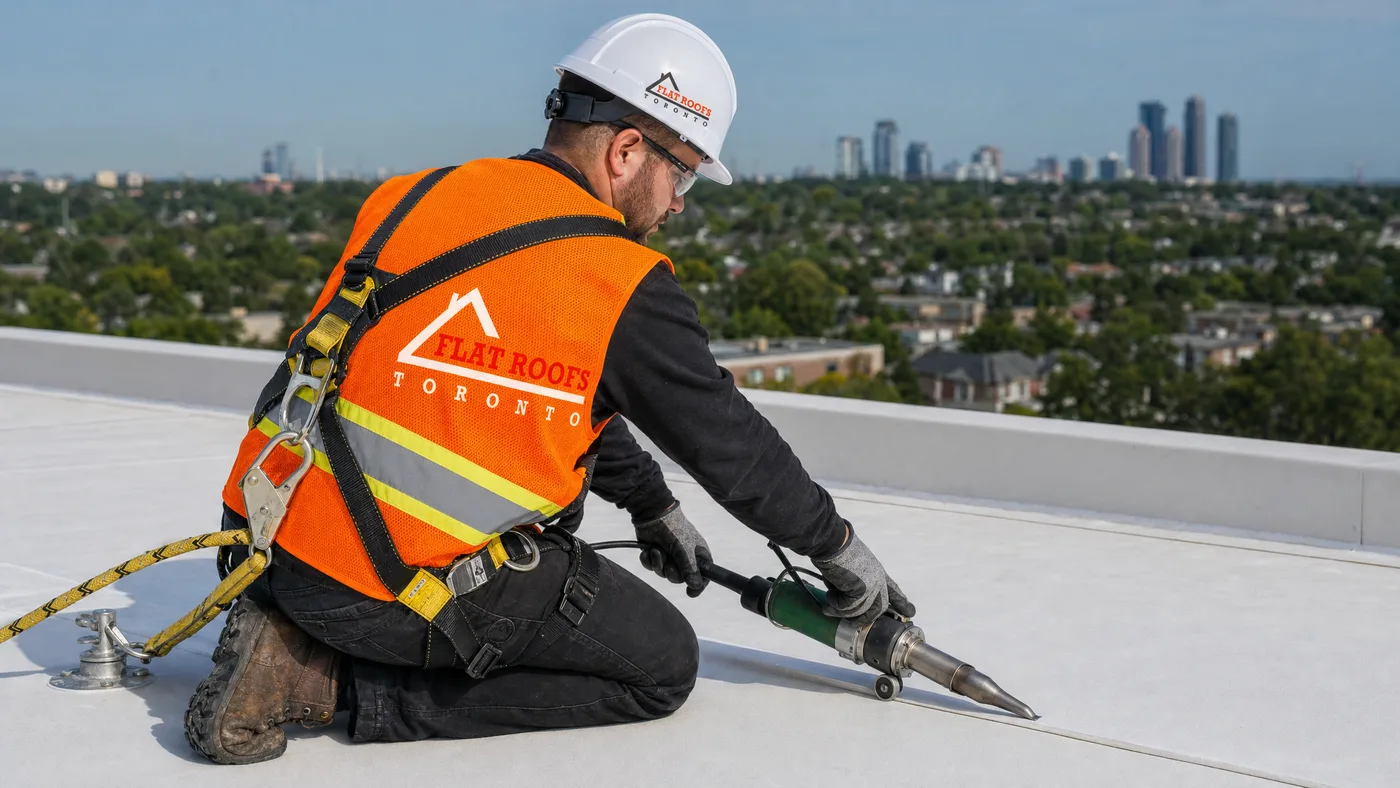
Hot-air re-welding, the preferred repair method for TPO and PVC membranes where the seam has opened but both plies remain structurally sound. A roofing-grade heat gun delivers precisely controlled airflow at 400 to 600 °C to re-fuse the thermoplastic materials, and a silicone roller applies firm pressure to consolidate the weld. A properly executed re-weld is indistinguishable from the original factory seam in terms of peel strength. This repair is fast, clean, and durable when done by a trained operator.
Seam tape and cover strip reinforcement, for EPDM systems and modified bitumen roofs, self-adhering seam tape (applied to a clean, primed surface) can restore lap integrity. On high-stress areas such as corners, upstands, and drains, a reinforcing cover strip of the same membrane type adds a second layer of protection. The key to success is surface preparation: any oxidised, chalky, or contaminated membrane surface must be abraded and primed before the tape is applied.
Liquid-applied seam sealant, urethane and silicone-based sealants are appropriate for minor open laps on membranes that are otherwise in good condition. These products are applied by brush or gun along the seam edge and cure to a flexible, watertight bead. They are a cost-effective interim solution but are not considered a permanent repair for membranes that are significantly degraded.
Partial re-roofing (section replacement), when seam failures are concentrated in a specific zone of the roof, say, a south-facing exposure that receives maximum radiation loading, it is sometimes more economical to tear out and replace that section entirely with new membrane rather than chase individual seam failures across an aged surface. Section replacement can also allow an upgrade in membrane specification, for example switching from an adhesive-lap EPDM system to a fully welded TPO in the high-risk zone.
Full membrane replacement, when seam failures are widespread, the insulation is saturated, or the membrane has aged beyond the point of cost-effective repair, a complete tear-off and re-roof is the correct path. For residential flat roofs, this project is an excellent opportunity to upgrade insulation thickness and improve R-values at the same time. See our residential flat roof installation page for details on membrane options and typical project timelines, or our commercial flat roof installation page if you are managing a larger building.
| Repair Method | Best Suited For | Typical Cost Range (CAD) | Durability | Typical Completion Time |
|---|---|---|---|---|
| Hot-air re-weld | TPO / PVC open laps, membrane structurally sound | $350 to $900 per linear 10 m | 15 to 25 years | Half-day to 1 day |
| Seam tape + cover strip | EPDM / mod-bit, lap edge lifting | $250 to $700 per linear 10 m | 5 to 15 years depending on membrane age | Half-day |
| Liquid seam sealant | Minor cracks, early-stage separation | $150 to $400 per linear 10 m | 2 to 7 years (interim) | Hours |
| Section replacement | Localised damage, saturated insulation zone | $4,500 to $15,000+ per section | 20 to 30 years (new membrane) | 2 to 4 days |
| Full tear-off and re-roof | End-of-life system, widespread failure | $8,000 to $35,000+ (residential) | 20 to 30 years | 3 to 7 days |
Summer Is the Optimal Window for Flat Roof Repairs in Toronto
One silver lining of Toronto’s intense summer heat is that it creates genuinely ideal conditions for flat roof membrane work. Thermoplastic membranes weld more consistently when ambient temperatures are above 15 °C. Adhesive-applied systems achieve better bond strength when the substrate is warm and dry. Modified bitumen torch work is safer when crews are not working on frost-covered decks. The extended daylight hours of June and July allow longer productive work windows, which compresses project timelines and reduces the labour cost per square metre.
There is also a practical urgency argument for acting in summer rather than waiting. The Toronto climate delivers significant rainfall in late July and August, and even a small open seam that is merely unsightly in June can allow hundreds of litres of water into an insulation assembly during a single intense afternoon thunderstorm. Saturated polyisocyanurate insulation loses approximately 50 per cent of its R-value when wet and does not dry out easily once moisture is trapped beneath a membrane, meaning that a repair delayed by six weeks can turn a $1,200 seam weld into a $12,000 insulation replacement.
If your building has a residential skylight or commercial skylight installation, pay particular attention to the flashing and seam work around the curb during summer inspections. Skylights create thermal bridging points where the membrane is exposed to differential movement stress from two directions simultaneously, the roof deck expanding one way and the skylight frame expanding another, making the curb perimeter seams among the most vulnerable locations on the entire roof. Summer is the best time to inspect and, if needed, renew those flashings while the materials are in their most workable state.
Scheduling your repair or inspection now also means you get priority access to crews before the post-storm surge. Every significant heat-wave event in Toronto is followed within days by a spike in emergency service calls, which can push non-urgent repair scheduling out by three to four weeks. Proactive building owners who contact us between major heat events typically get faster scheduling, more competitive pricing, and the full attention of an experienced crew rather than a rushed emergency response team.
Preventive Measures: Extending Seam Life Through the Heat Season
While professional inspection and repair are irreplaceable, there are practical steps building owners can take to reduce the rate of heat-induced seam fatigue and extend the productive life of their membrane systems.
Reflective coating application, a high-solids elastomeric or silicone reflective coating applied over an EPDM or modified bitumen surface can reduce peak membrane temperatures by 15 to 25 °C, which meaningfully reduces the thermal cycling stress on seams. Coatings must be applied to a clean, dry surface by a qualified applicator to achieve full bond, and most manufacturers require professional application to maintain warranty validity. The return on investment is typically realised over three to five years through extended membrane life, reduced HVAC cooling loads, and deferred re-roofing costs.
Drainage optimisation, ponding water at seams is a compounding hazard. Water absorbs heat during the day and releases it slowly at night, maintaining elevated membrane temperatures for longer periods. It also adds hydrostatic pressure at laps and contributes to freeze-thaw cycling in shoulder seasons. Ensuring that drains, scuppers, and internal downspouts are clear of debris at the start of summer is a simple, low-cost maintenance task that pays dividends. Flat Roofs Toronto recommends a drain inspection at the beginning of June, the beginning of August, and after every major wind event.
Mechanical equipment buffer zones, HVAC condensing units and exhaust fans discharge hot air directly onto the membrane surface beneath and around them. Equipment supports should lift units at least 75 mm above the membrane surface, and where possible, the exhaust should be directed away from membrane seam locations. If existing equipment is positioned directly above a seam, a simple sheet-metal deflector can redirect the hot discharge and substantially reduce localised temperature spikes.
Scheduled annual inspections, a professional inspection performed in late spring (before the heat season) and again in early autumn (after the heat season) catches seam fatigue at the earliest possible stage, when repairs are least expensive. The attic insulation beneath the roof deck should also be checked annually: degraded or missing insulation allows heat to transfer into the building and can also signal that roof moisture has been present long enough to damage the insulation batt.
Understanding the Cost of Seam Failure: Repair vs. Replacement Economics
The financial case for proactive seam repair is straightforward when you map the escalation pathway. A single open lap seam that is caught in June and re-welded costs a modest amount, typically a few hundred to a few thousand dollars depending on the length and accessibility of the affected seam. The same seam, ignored through a wet July and August, saturates the insulation directly below it. By September, the affected insulation section must be removed and replaced, the deck may show early signs of wood rot if it is a plywood substrate, and the interior drywall below may need to be remediated for mould. The total cost of that pathway is commonly ten to twenty times the original repair cost.
For commercial buildings, the calculus includes additional considerations: business interruption during remediation, potential liability for tenant property damage, and the risk of mould-related disputes if moisture infiltration is not disclosed promptly. Many commercial property insurance policies contain exclusions for damage caused by known or foreseeable deterioration, which means that an open seam documented in a prior inspection report and left unrepaired may not be covered when it eventually causes interior damage. Proactive repair is therefore both economically and legally prudent for commercial property owners across the GTA.
The following table provides a realistic cost comparison for a 200 m² commercial flat roof at different stages of seam failure escalation, based on our 2026 Toronto market pricing. These figures are indicative and will vary based on membrane type, access, building height, and specific site conditions.
| Damage Stage | Description | Typical Repair Scope | Estimated Cost Range (CAD, 200 m²) | Time to Resolve |
|---|---|---|---|---|
| Stage 1, Early seam lift | Lap edge lifting, no water infiltration | Re-weld or seam tape repair | $800 to $2,500 | 1 day |
| Stage 2, Open seam, dry insulation | Full seam separation, insulation still dry | Re-weld + new cover strip | $1,500 to $4,500 | 1 to 2 days |
| Stage 3, Open seam, saturated insulation zone | Water infiltration, localised insulation damage | Section repair + insulation replacement | $6,000 to $18,000 | 3 to 5 days |
| Stage 4, Widespread failure, structural risk | Multiple seams open, deck moisture damage | Full tear-off, deck repair, re-roof | $22,000 to $55,000+ | 5 to 10 days |
| Stage 5, Interior damage | Ceiling damage, mould, business interruption | Full re-roof + interior remediation | $35,000 to $90,000+ | 2 to 6 weeks |
These numbers make a compelling case for catching flat roof seam failure heat waves toronto damage at Stage 1 or 2. The difference between a proactive summer inspection and a reactive autumn emergency call can literally be tens of thousands of dollars and weeks of disruption to your tenants or your own family.
Choosing the Right Contractor for Heat-Wave Seam Repairs in the GTA
Not all roofing contractors have equivalent experience with heat-induced membrane failures, and the nuances matter. Hot-air welding of thermoplastic membranes requires calibrated equipment, operator training, and field experience to set the correct temperature, speed, and pressure for the specific membrane thickness and ambient conditions on the day of the repair. A weld that looks correct to the eye but was performed at the wrong temperature or speed may have partial fusion that passes a visual inspection but fails under the next heat cycle.
When evaluating contractors, ask specifically about their experience with the membrane type on your roof, whether they own or rent their hot-air welding equipment, and what quality-control tests they perform on completed welds. A pull-test on a small section of completed weld, or a probe test along the full seam length immediately after repair, are standard practices at reputable firms. Ask to see the result before the crew leaves the site.
Also confirm that the contractor carries adequate liability insurance and that workers on the roof are covered by WSIB (Workplace Safety and Insurance Board) clearance. Rooftop falls are a significant hazard, and an uninsured incident on your property can expose you to serious liability. Before any work commences, ask any roofing contractor for a current WSIB clearance certificate and proof of commercial general liability insurance.
Check the contractor’s local track record as well. Flat roof seam failure heat waves toronto is a specifically local phenomenon, the combination of Toronto’s urban heat island, the age profile of GTA flat roofing stock, and the specific membrane products that were dominant in this market during the installation windows of the 2000s and 2010s means that experience in the Toronto market counts for more than generic roofing credentials from elsewhere. Look for reviews from property owners in your specific part of the GTA, and ask for references from similar building types to your own.
What causes flat roof seam failure heat waves toronto property owners are seeing in summer 2026?
How do I know if my flat roof has a seam failure versus a simple surface crack?
Can I patch a flat roof seam failure myself as a temporary fix?
How much does it cost to repair flat roof seam failure caused by Toronto heat waves?
Which flat roof membrane type is most resistant to seam failure during Toronto heat waves?
How does flat roof seam failure heat waves toronto damage affect my building’s insurance coverage?
Schedule Your Flat Roof Seam Consultation Today
Flat Roofs Toronto is the GTA’s dedicated flat roofing specialist with a proven track record of diagnosing and resolving heat-induced membrane failures quickly and cost-effectively. We understand the specific membrane products, installation vintages, and urban heat conditions that drive flat roof seam failure heat waves toronto events, and we bring that local expertise to every inspection and repair we perform.
Call us today at (647) 333-3528 or request a free consultation to get started.
Flat Roofs Toronto proudly serves Toronto, Mississauga, Markham, Vaughan, Brampton, and Oakville with prompt, professional flat roofing services throughout the summer season and beyond.