Executing the thermal envelope of a massive flat roof in the Greater Toronto Area is one of the most highly complex, legally strict, and mathematically unforgiving architectural challenges in the entire construction industry. A traditional pitched roof easily hides massive, fluffy mounds of blown-in fiberglass in a sprawling, highly ventilated attic space. A flat roof possesses absolutely zero attic. The ceiling of the luxury top-floor penthouse or the sprawling commercial warehouse is frequently separated from the brutal, -20°C January blizzard by nothing more than a few inches of heavy wood and a thin sheet of rubber. If the thermal engineering is flawed by even a single millimeter, the massive flat roof does not just lose expensive furnace heat; it violently creates a catastrophic thermodynamic collision known as the “dew point.” Warm, humid interior air violently slams into the freezing cold roof deck, instantly liquefying into massive volumes of condensation that violently rot the heavy structural joists and breed incredibly toxic black mold. Flat Roofs Toronto specializes in the flawless, uncompromising execution of advanced thermal envelopes. This exhaustive 2026 engineering guide dissects the exact, critical mechanics of flat roof insulation Toronto building codes mandate, exposing the massive dangers of below-deck fiberglass and defining the absolute supremacy of above-deck rigid Polyiso foam.
The Absolute Legal Mandate: The Ontario Building Code
The decision regarding how much insulation to install is no longer a financial suggestion; it is an aggressive, uncompromising legal mandate dictated by the Ontario Building Code (OBC). As the government aggressively pushes to slash massive greenhouse gas emissions, the minimum required thermal resistance (R-Value) for flat roofs has violently skyrocketed. In 2026, executing a massive new commercial roof or a luxury residential flat roof addition requires an incredibly massive R-Value (frequently R-30 or R-41 depending on the specific zone and assembly type).
Attempting to cut corners and install cheap, thin insulation to save money is a catastrophic legal error. The municipal building inspector will demand explicit, documented proof of the massive R-Value assembly. If the residential flat roof fails the thermal audit, the inspector will instantly issue a massive stop-work order, violently halting the entire construction project and legally forcing the contractor to tear off the brand new rubber membrane at massive expense to fix the thermal deficiency. Furthermore, commercial buildings that fail to meet these stringent new thermal mandates will face massive municipal carbon taxation penalties and be entirely disqualified from lucrative green energy rebates, making thermal compliance the single most financially critical phase of the entire roofing project.
| Insulation Material | R-Value per Inch | The Architectural Thickness Required for R-30 |
|---|---|---|
| Polyisocyanurate (Polyiso) Rigid Foam | R-5.7 to R-6.0 | Approximately 5 to 5.5 inches of massive foam boards. |
| Extruded Polystyrene (XPS) Foam | R-5.0 | Exactly 6 inches of incredibly dense blue or pink foam. |
| Expanded Polystyrene (EPS) Foam | R-3.8 to R-4.0 | Approximately 7.5 to 8 inches of highly fragile white foam. |
| Standard Fiberglass Batt (Below Deck) | R-3.1 to R-3.4 | Requires extremely deep 10-inch massive wooden ceiling joists. |
Above-Deck vs. Below-Deck: The Architectural War
The single most terrifying architectural decision in flat roof design is determining exactly where the massive insulation physically goes. There are two distinct methodologies, and deploying the wrong one in the brutal Toronto climate guarantees a massive, multi-million dollar structural disaster.
The Catastrophe of Below-Deck (Cold Roof)
In a below-deck assembly, the roofing contractor simply slaps the rubber membrane directly onto the top of the wooden plywood deck. The general contractor then aggressively stuffs massive amounts of pink fiberglass insulation directly between the wooden ceiling joists inside the house (below the roof deck). This is an incredibly dangerous, highly obsolete strategy.
Because the insulation is inside the house, the physical roof deck outside remains freezing cold during a -20°C winter. If the massive 6-mil polyethylene vapor barrier on the warm ceiling has even a tiny, microscopic tear from an electrician running a pot light, the highly humid, warm interior air violently rushes up into the joist cavity. It slams into the freezing plywood roof deck and instantly condenses into massive sheets of heavy liquid water. The pink fiberglass instantly acts like a massive sponge, soaking up gallons of water. Within a single brutal winter, the heavy wooden joists aggressively rot into a black, mushy paste, and the ceiling violently collapses.
The Absolute Supremacy of Above-Deck (Warm Roof)
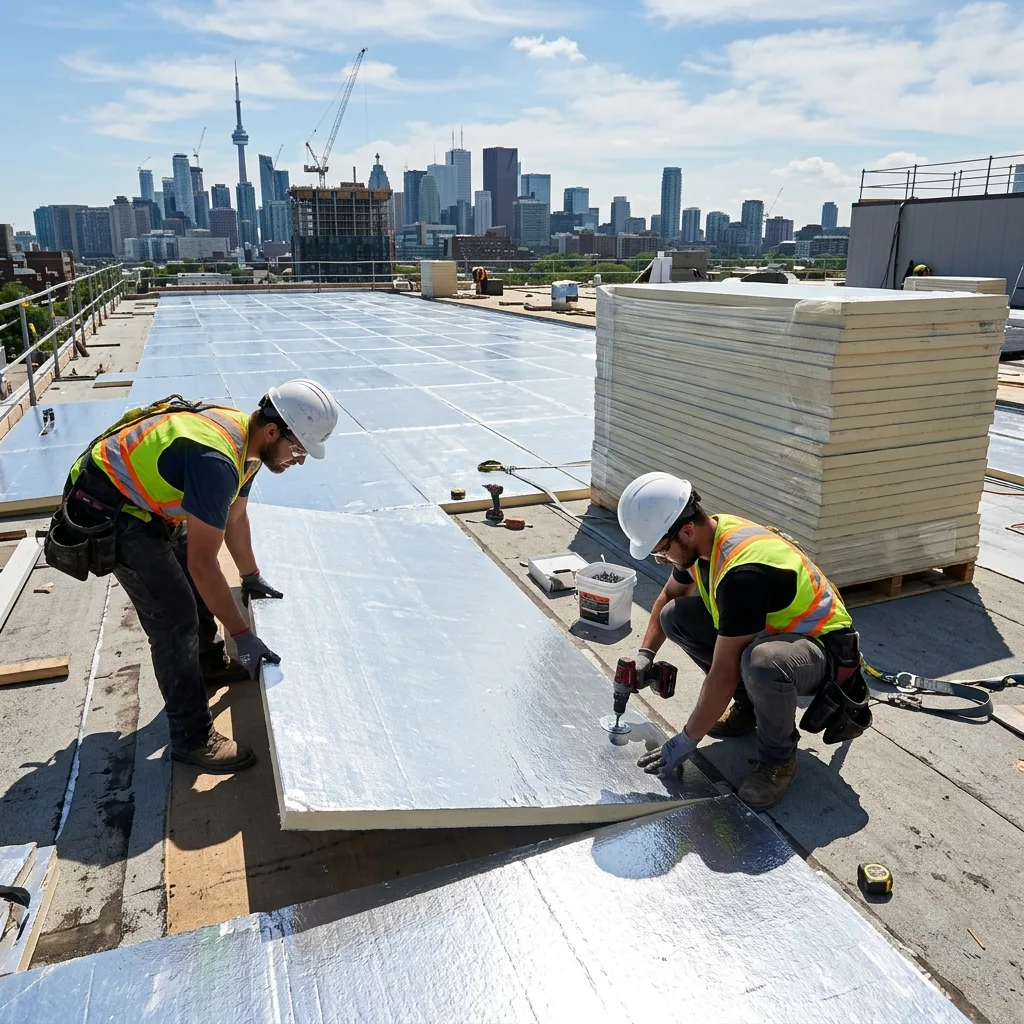
Elite commercial and luxury residential architecture completely rejects the below-deck method. We exclusively deploy the “Above-Deck” (Warm Roof) system. The massive structural steel or wooden deck is left completely bare on the inside. All the incredibly thick, massive rigid foam insulation (Polyiso) is installed directly on top of the exterior roof deck, completely burying the structure in a massive thermal blanket. The brilliant white TPO or PVC rubber membrane is then heat-welded directly over the foam.
Because the massive foam is on the outside, the actual structural roof deck remains completely warm, perfectly matching the interior temperature of the living room or warehouse. Therefore, when warm, humid air rises to the ceiling, it hits a warm surface. The dew point is mathematically destroyed. It is absolutely physically impossible for condensation to occur, guaranteeing the massive structural joists will survive for a century with zero rot.
| Insulation Assembly Method | Thermodynamic Condensation Risk | The Structural Consequence |
|---|---|---|
| Below-Deck Fiberglass (Cold Roof) | Catastrophic. Highly vulnerable to vapor barrier punctures from pot lights. | Massive winter condensation, severe black mold, violent structural joist rot. |
| Above-Deck Rigid Foam (Warm Roof) | Virtually Zero. The structural deck remains incredibly warm all winter. | Absolute perfection. Mathematically eliminates the dew point, guaranteeing a dry structure. |
| Spray Foam (Closed Cell) Under Deck | Very Low. The heavy foam acts as its own massive vapor barrier. | Excellent for tight, complex renovations where massive above-deck height is impossible. |
| Hybrid Assembly (Flash and Batt) | Low. Spray foam seals the deck, cheap fiberglass fills the deep cavity. | A highly complex, cost-saving compromise used in incredibly deep massive wooden joists. |
The Heavyweight Champion: Polyisocyanurate (Polyiso)
For an elite, massive above-deck installation, you cannot use cheap pink fiberglass. It would instantly crush under the weight of a heavy HVAC technician. Elite commercial roofing demands incredibly dense, highly advanced rigid foam boards. The absolute undisputed king of the industry is Polyisocyanurate (Polyiso).
Polyiso provides an astronomical R-Value (frequently R-5.7 per inch), meaning you can achieve the massive legally mandated thermal resistance without making the massive roof ridiculously thick. More importantly, Polyiso is incredibly rigid and features heavy fiberglass facers on both sides. It effortlessly supports the massive, crushing weight of heavy commercial AC units and extreme foot traffic without violently compressing or crushing. Furthermore, it possesses an incredibly high melting point, making it the absolute safest, most highly fire-resistant massive foam base for a hot-air welded TPO or PVC commercial flat roof.
The Genius of Tapered Insulation
On massive commercial warehouses with perfectly level steel decks, moving thousands of gallons of rainwater to the massive interior drains is a highly complex hydraulic challenge. Flat Roofs Toronto eradicates the catastrophic threat of standing ponding water by deploying “Tapered Polyiso.”
Instead of using flat boards, we utilize massive rigid foam boards that are precisely, aggressively manufactured with a 1% to 2% slope built directly into the foam. Our elite engineers lay out an incredibly complex, massive geometric puzzle across the sprawling 50,000 square foot deck. When fully assembled, this massive layer of tapered insulation not only provides elite, uncompromising thermal resistance, but it artificially creates a perfect, highly aggressive slope across the entire building, mathematically forcing every single drop of water to violently flow precisely toward the massive heavy-duty drains.
The highly specialized layout of a massive tapered system frequently includes the strategic deployment of “crickets.” A cricket is a specially built diamond-shaped saddle of rigid foam installed directly behind massive HVAC units or heavy commercial chimneys. Because these massive steel structures completely block the natural flow of water, a cricket aggressively diverts the heavy rainwater around the massive obstacle, preventing a catastrophic deep puddle from forming behind the unit. This absolute elite level of custom hydraulic engineering mathematically guarantees that the massive TPO or PVC membrane will never be subjected to the highly destructive hydrostatic pressure of standing water, ensuring a flawless lifespan.
The Financial Equation: Longevity vs. Capital Expenditure
The decision to deploy an elite, heavily insulated above-deck system is frequently scrutinized by corporate boards obsessed with immediate capital expenditure. It is true that installing 6 inches of massive Polyiso rigid foam directly on top of the heavy steel deck is initially more expensive than blindly stuffing pink fiberglass below the deck. However, the long-term mathematical ROI is completely undeniable. A massive flat roof engineered with an invincible above-deck thermal envelope absolutely eliminates the devastating risk of condensation-induced structural rot, completely preserving the multi-million dollar structural steel and wooden trusses. Furthermore, the massive R-30 or R-41 thermal resistance dramatically, aggressively slashes the massive commercial HVAC heating and cooling bills by up to 40% annually, guaranteeing that the massive capital investment pays for itself within the first decade of operation.
| Financial Factor | Below-Deck Fiberglass Strategy | Elite Above-Deck Polyiso Strategy |
|---|---|---|
| Initial Capital Cost | Aggressively cheap. Minimal material costs. | High premium. Requires expensive, massive rigid foam. |
| HVAC Energy Savings | Poor. Thermal bridging through joists wastes massive heat. | Absolute elite. Continuous foam blanket slashes hydro bills by 40%. |
| Structural Rot Risk | Catastrophic. Highly vulnerable to devastating winter condensation. | Zero. Mathematically eliminates the dew point entirely. |
| Long-Term Financial ROI | Negative. Guarantees a massive, multi-million dollar roof replacement. | Massively positive. Roof survives for decades while saving massive energy costs. |
Why is it a catastrophic legal error to install cheap, thin insulation on my massive Toronto flat roof in 2026?
What violently happens if I stuff cheap pink fiberglass insulation in the joists below my massive flat roof?
What is the “Above-Deck” (Warm Roof) strategy, and why is it the absolute elite architectural standard for flat roof insulation Toronto installations?
Why is Polyiso (Polyisocyanurate) considered the absolute heavyweight champion of massive commercial flat roof foams?
If my sprawling commercial warehouse has a perfectly level, massive steel deck, how do you stop water from violently pooling on the roof?
Can I install attic insulation spray foam directly against the underside of the massive flat roof deck?
Schedule Your Elite Thermal Engineering Consultation Today
Do not gamble the massive structural integrity of your property on obsolete below-deck fiberglass that guarantees catastrophic winter condensation rot. Elite flat roofing demands uncompromising, massive above-deck Polyiso integration.
Call us today at (647) 333-3528 or request a comprehensive thermal envelope diagnostic to discover how aggressive tapered foam engineering can permanently secure your absolute legal building code compliance and structural survival.
Flat Roofs Toronto has been the elite, highly technical authority for massive commercial thermodynamic design, aggressive Polyiso installations, and absolute structural waterproofing across the Greater Toronto Area for decades. From precision insulation execution to invincible TPO integration, our master craftsmen deliver uncompromising durability and absolute engineering perfection.