
Durham Region has one of the most varied housing stocks in the Greater Toronto Area, and that variety is exactly why flat roofing in Durham Region needs a different approach than a standard sloped shingle job. Between the postwar bungalows in older parts of Oshawa and Whitby, the mid-century side-splits scattered through Ajax, the large newer subdivisions in north Pickering and Brooklin, and the estate-lot homes on the rural fringe, a low-slope roof here can sit over a 1950s addition, a 2018 rear extension, an attached garage, or a full second-storey deck. Each of those situations calls for a different membrane, a different insulation strategy, and a different drainage plan.
This guide to flat roofing in Durham Region covers what homeowners and property managers in Ajax, Pickering, Whitby and Oshawa should know before commissioning a low-slope roof: which membranes hold up in Durham’s lake-influenced climate, what installed pricing looks like in 2026, when a permit is required, how the Ontario Building Code affects insulation values, and how to tell a competent contractor from a cheap one. Everything below reflects how low-slope work is actually specified and priced in Ontario today.
What Makes Flat Roofing in Durham Region Different
The single biggest factor shaping flat roofing in Durham Region is proximity to Lake Ontario. Ajax, Pickering, Whitby and south Oshawa all sit within a few kilometres of the shoreline, and lakeside microclimates produce more freeze and thaw cycling through winter than inland areas north of Highway 407. A low-slope membrane in Durham can swing through dozens of freeze and thaw cycles between December and March. Every one of those cycles expands and contracts the membrane, works at the seams, and drives water into any opening that already exists.
Wind exposure is the second factor. Open lakefront corridors and the wide arterial layouts of newer subdivisions leave roofs with far less shelter than a mature tree-lined street in central Toronto. Perimeter and corner uplift pressures on an exposed Durham roof are meaningfully higher, which changes fastening patterns, adhesive coverage rates, and edge-metal detailing. Skipping enhanced perimeter fastening is one of the most common shortcuts on low-cost installations, and it is the reason wind-lifted membrane edges show up so often on roofs less than ten years old.
The third factor is deck construction. Older Oshawa and Whitby homes frequently have plank decking, sometimes with gaps between boards, sometimes with generations of previous roofing still stacked on top. Newer Pickering and north Ajax builds use plywood or OSB with engineered joists. The correct approach for flat roofing in Durham Region depends heavily on which of these you are standing on, and no responsible quote gets issued without someone physically inspecting the deck.
Housing Character Across Ajax, Pickering, Whitby and Oshawa
Durham’s four lakeshore municipalities each present a slightly different mix of low-slope roofing work, and understanding that mix helps set expectations on cost and scope.
Oshawa
Oshawa carries a large stock of older brick homes and postwar bungalows, many with rear additions or enclosed porches built decades after the original house. These additions are where most low-slope roofing lives. Expect to find tar and gravel built-up systems, multiple layers of aged roofing, undersized or absent insulation, and drainage that was never properly planned. Full tear-off is usually the honest recommendation rather than another overlay, and Oshawa accounts for a large share of the end-of-life flat roofing in Durham Region we are asked to replace.
Whitby
Whitby spans older downtown-area housing and large newer subdivisions north toward Brooklin. Downtown properties resemble Oshawa’s older stock. Newer Whitby homes often have architectural flat sections over garages, entry canopies and second-floor bonus rooms, where the failure point in flat roofing in Durham Region is almost always the junction between the low-slope membrane and the adjacent sloped shingle roof or brick wall.
Ajax
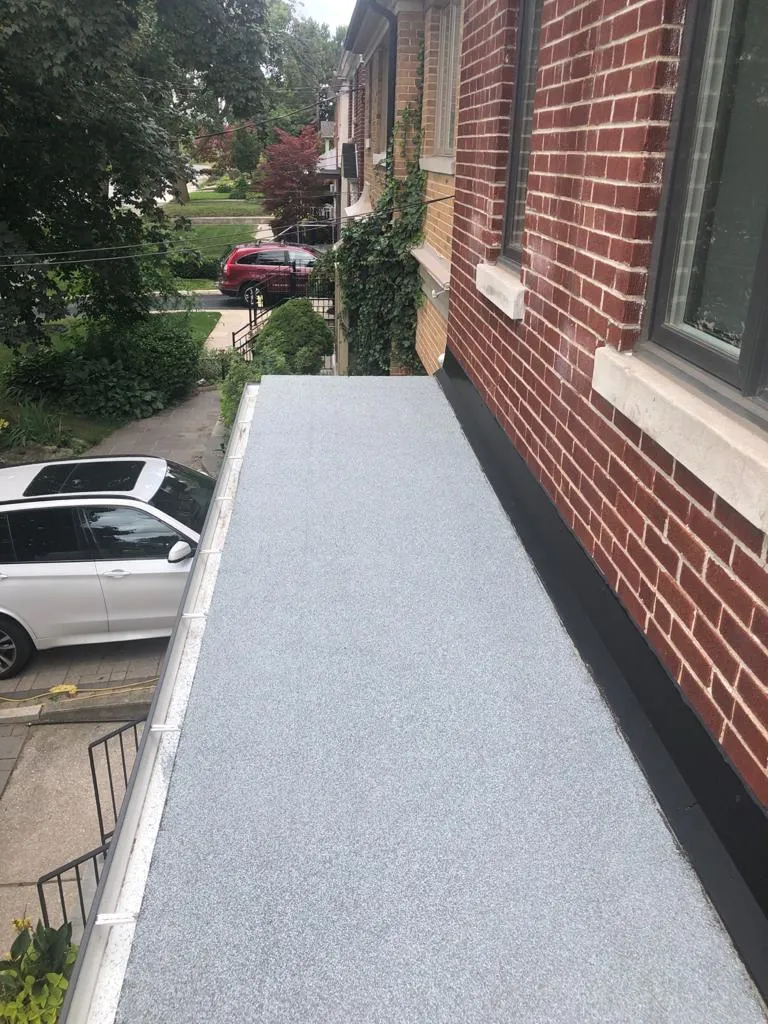
Ajax has a heavy concentration of homes built from the 1970s onward, plus significant newer development. Side-splits and back-splits with partial flat sections are common, and so are attached garages with low-slope roofs that were originally finished cheaply by the builder. Many of those builder-grade roofs are now at or past the end of their service life, which is why Ajax generates steady demand for flat roofing in Durham Region replacements.
Pickering
Pickering combines lakeside neighbourhoods, large post-2000 subdivisions in the north, and estate lots on the rural edge. Estate properties often have the most complex low-slope work: multiple roof planes, large flat decks over living space, integrated drainage, and detailing around skylights and mechanical equipment. These jobs demand the most careful specification of any flat roofing in Durham Region, and unsurprisingly they sit at the top of the pricing range.
Across all four municipalities, homeowners searching for flat roofing in Durham Region tend to fall into two groups: those replacing a failed builder-grade roof, and those adding or renovating living space and needing a properly engineered low-slope assembly for the first time. The material choice differs significantly between the two.
Flat Roofing Materials That Suit Durham Region’s Climate
There is no single best membrane. There is a best membrane for a given deck, exposure, budget and drainage condition, and matching the two is most of the work in specifying flat roofing in Durham Region. The table below reflects installed pricing and realistic service life for systems commonly specified for flat roofing in Durham Region in 2026.
| Membrane system | Realistic service life | Installed cost per square foot (2026) | Best suited to |
|---|---|---|---|
| Two-ply SBS modified bitumen | 25 to 30 years | $11 to $16 | Residential additions, garages, roofs with foot traffic |
| TPO single ply | 20 to 30 years | $9 to $14 | Larger simple rectangles, reflective white surface |
| EPDM rubber | 20 to 30 years | $8 to $13 | Straightforward decks with few penetrations |
| PVC single ply | 25 to 35 years | $12 to $18 | Commercial roofs, kitchen exhaust and grease exposure |
| Built-up tar and gravel | 20 to 30 years | $10 to $15 | Replacement in kind on older heavy-deck structures |
| Liquid-applied membrane | 15 to 25 years | $14 to $22 | Small, complex decks with heavy detailing |
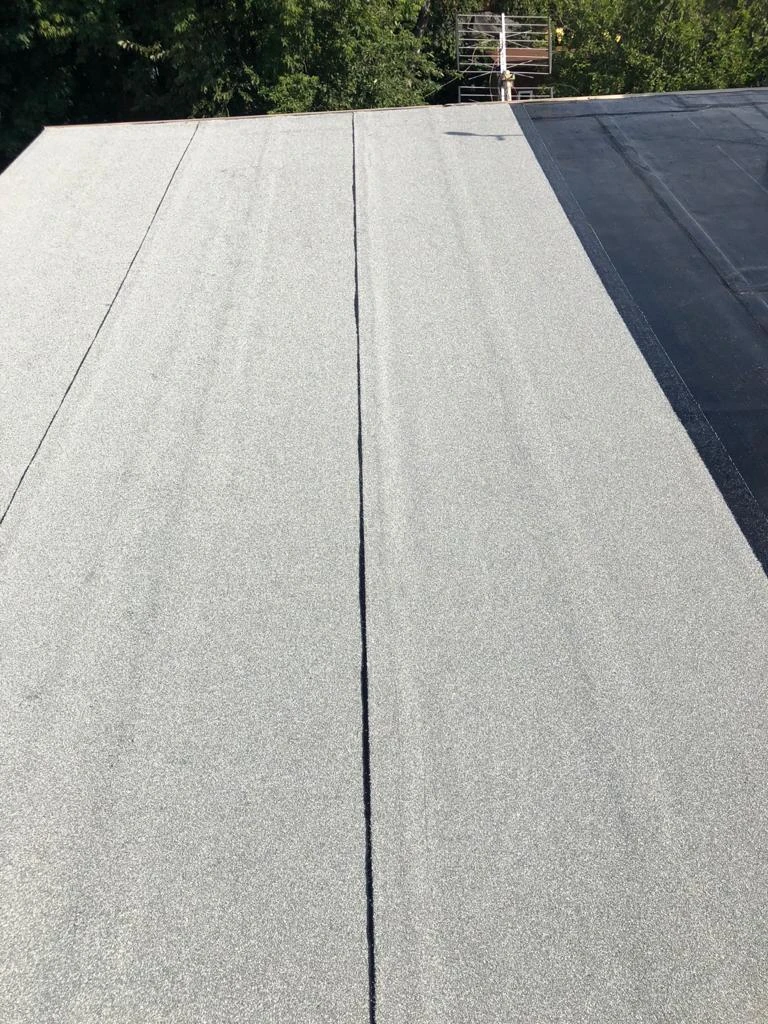
For most Durham homeowners, two-ply SBS modified bitumen remains the default residential recommendation. It tolerates foot traffic, it can be repaired in sections without replacing the field, and its multi-layer construction gives redundancy that single-ply systems do not. The granulated cap sheet also stands up well to the UV load a south-facing lakeside roof takes through summer.
Single-ply systems earn their place on larger, simpler roofs. A white TPO or PVC surface reflects solar gain, which matters on a roof over conditioned living space, and installation is faster on wide-open areas. The tradeoff is that seam quality becomes everything: one poorly welded seam is a single point of failure across the whole assembly.
Insulation is not optional in either case. Ontario’s Building Code sets minimum effective thermal resistance for roof assemblies in new construction and for roofs undergoing substantial replacement in many circumstances, and modern low-slope assemblies in this climate zone are typically built to an effective R-value in the low to mid thirties. Achieving that on a low-slope roof usually means layered polyisocyanurate with staggered joints, plus tapered board where slope needs correcting. Homeowners comparing quotes should confirm insulation type, thickness and R-value in writing, because it is the easiest line item for a low bidder to quietly shrink. Where heat loss is coming from below rather than through the roof deck, pairing the roof work with proper attic insulation upgrades is often the more cost-effective fix.
What Flat Roofing in Durham Region Costs in 2026
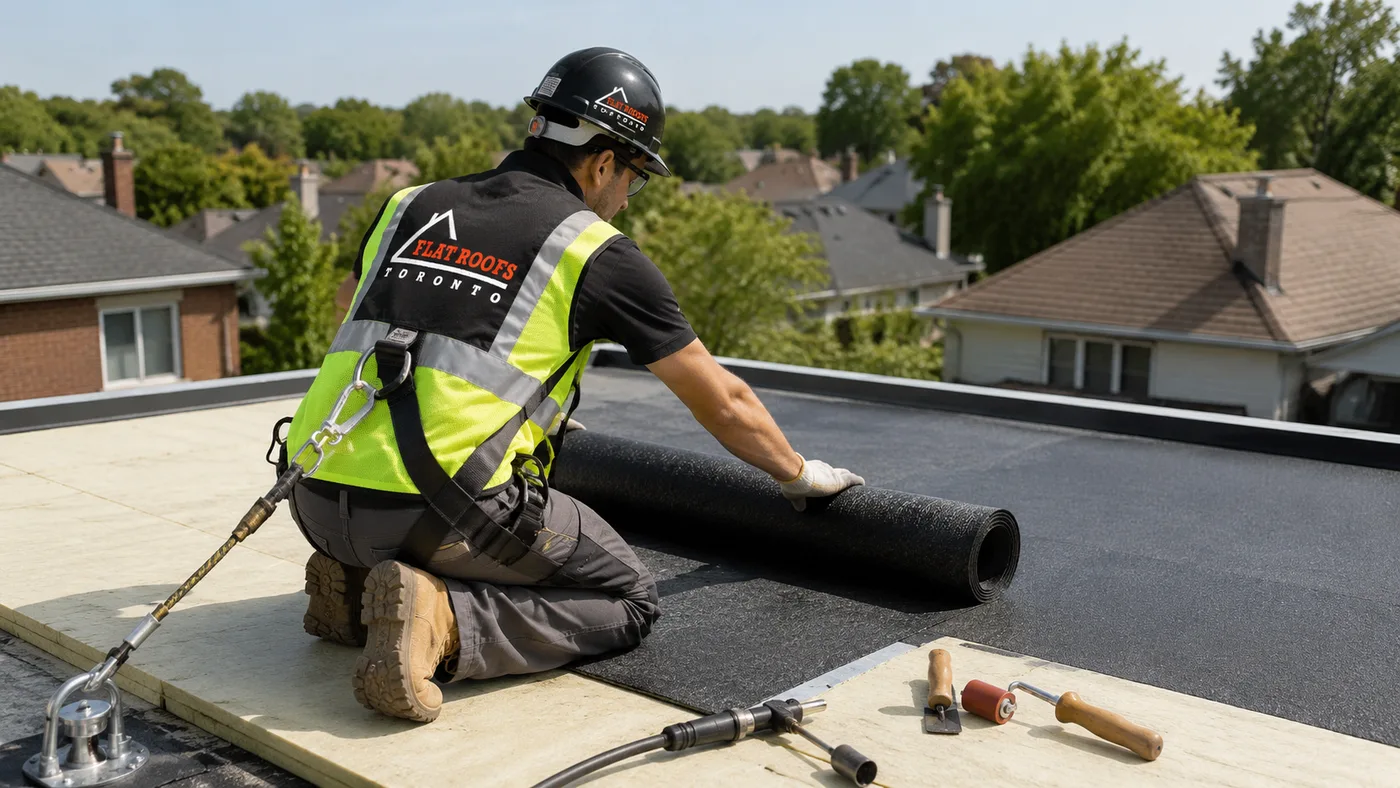
Pricing for flat roofing in Durham Region tracks closely with the wider GTA market, with minor differences driven by travel time and site access. The figures below cover complete installations including tear-off of a single existing layer, new insulation, membrane, flashings and edge metal, plus disposal.
| Project type | Typical roof area | Installed range (2026) | Typical on-site duration |
|---|---|---|---|
| Attached garage or entry canopy | 200 to 400 sq ft | $3,000 to $6,500 | 1 day |
| Rear addition or kitchen extension | 400 to 700 sq ft | $5,500 to $11,000 | 1 to 2 days |
| Full low-slope roof on a bungalow | 800 to 1,400 sq ft | $10,000 to $21,000 | 2 to 3 days |
| Two-storey rear roof with parapets | 1,000 to 1,800 sq ft | $14,000 to $28,000 | 3 to 4 days |
| Small commercial or mixed-use building | 2,500 to 6,000 sq ft | $28,000 to $78,000 | 4 to 10 days |
Several variables move a project within or beyond those ranges. Removing a second or third existing layer typically adds $1.25 to $2.50 per square foot in labour and disposal. Bringing an under-insulated assembly up to a modern effective R-value adds roughly $3 to $6 per square foot depending on the thickness required. New roof drains or scuppers generally run $600 to $1,400 each installed. Structural repair to rotted decking is billed as found, commonly $12 to $22 per square foot of replaced sheathing. Poor access, meaning no driveway staging area, a rear-lane property, or a roof reachable only over a neighbouring surface, can add a full day of labour.
Homeowners should be cautious about any quote materially below these ranges. The usual explanations are thin or omitted insulation, an overlay applied over a wet existing system, reduced perimeter fastening, or reused flashing metal. Each of those saves money on day one and creates a leak within a handful of winters.
Permits, Ontario Building Code and Municipal Requirements
A like-for-like roof covering replacement generally does not require a building permit in Ontario. Once the work goes beyond re-covering, permits enter the picture. Structural changes to the roof deck or framing, converting a roof to a walkable terrace or rooftop deck, adding a new roof over an addition, or altering the building envelope in ways that change its thermal performance all typically trigger a permit application through the local municipal building department. Ajax, Pickering, Whitby and Oshawa each administer their own building services, and requirements and fees differ between them.
Where a permit applies, plan review will look at the roof assembly’s structural capacity, its effective thermal resistance, vapour control layer placement, and drainage design. Low-slope roofs in Ontario are expected to shed water rather than pond it, with a minimum slope typically designed at roughly 2 per cent, or a quarter inch of fall per foot, achieved either structurally or with tapered insulation. Secondary or emergency overflow drainage is a standard requirement for parapet-enclosed roofs so a blocked primary drain cannot load the structure with standing water.
Contractors performing this work must carry valid WSIB coverage and commercial general liability insurance. Ask for current certificates directly rather than accepting a verbal assurance. If a contractor cannot produce both within a day, treat that as disqualifying regardless of price.
Common Flat Roof Problems on Durham Region Homes
Most low-slope failures fall into a small number of recognizable patterns. Catching them early is the difference between a routine repair and a full replacement plus interior restoration.
| Symptom | Likely cause | Typical corrective work | Typical 2026 cost |
|---|---|---|---|
| Water still ponding 48 hours after rain | Inadequate slope or compressed insulation | Tapered insulation crickets and drain relocation | $900 to $3,500 |
| Blisters or open seams on modified bitumen | Trapped moisture or poor adhesion at install | Cut out, dry, patch and re-cap the area | $450 to $1,200 |
| Interior staining at a wall junction | Failed counter-flashing or parapet cap metal | Reflash the junction and replace cap metal | $700 to $2,200 |
| Ice buildup at the roof edge each winter | Heat loss from below into the roof assembly | Air sealing plus insulation upgrade | $1,800 to $4,500 |
| Bare patches and exposed bitumen on gravel roofs | Wind scour and UV ageing of the flood coat | Re-flood and re-gravel, or overlay the field | $1,500 to $4,000 |
| Cracked, chalky, brittle rubber membrane | End of service life | Full tear-off and replacement | See installation pricing above |
Ponding deserves particular attention. Standing water is not automatically a leak, but it accelerates membrane ageing, concentrates dirt and biological growth, adds structural load, and turns any small seam defect into an active leak. If water sits on a roof for more than about two days after rainfall, the drainage design needs correcting rather than the puddle simply being tolerated.
Active leaks during a storm are a different category of problem. Water travelling through a low-slope assembly can emerge many metres from its entry point, so interior stain location is a weak guide to the source. When water is entering the building, emergency roof repair service is the right call, followed by a proper diagnosis once conditions allow safe access.
Commercial and Multi-Unit Flat Roofing Across Durham
Durham Region has a substantial base of low-rise commercial, industrial and multi-unit residential buildings, from plaza retail and light industrial in Whitby and Oshawa to office and service buildings across Ajax and Pickering. Nearly all of it sits under low-slope roofing, and commercial flat roofing in Durham Region carries priorities that differ from residential work: tenant disruption, warranty terms, rooftop mechanical equipment, roof traffic pads, and phased replacement budgets all become central.
On commercial buildings, PVC and TPO dominate for good reasons. Wide sheet widths reduce seam count on large areas, welded seams are testable, reflective surfaces reduce cooling load, and PVC in particular resists the grease and chemical exposure found near restaurant and industrial exhaust. Two-ply SBS remains a strong choice where roof traffic is heavy or where phased tie-ins to an existing bitumen system are needed. Property managers planning a full-building replacement or a staged capital project should review the scope for commercial flat roof installation before setting a budget year, because insulation upgrades and drainage corrections frequently carry more cost than the membrane itself.
Residential projects follow a simpler path. Most homeowners are dealing with one or two roof sections, a defined budget and a short timeline, and standard residential flat roof installation covers the work end to end. Where a low-slope roof sits over a darker interior space, adding a curbed unit at the same time is far cheaper than opening the membrane again later, and residential skylight installation is commonly bundled into a replacement for exactly that reason.
Maintenance That Extends a Flat Roof’s Service Life
Maintenance is the cheapest lever available on flat roofing in Durham Region. A low-slope roof that is inspected and maintained routinely will commonly outlast an identical neglected roof by five to ten years. The maintenance itself is inexpensive relative to that gain.
- Inspect twice a year, ideally in spring after the freeze and thaw season and again in late autumn before winter loading begins.
- Keep drains, scuppers and gutters clear. Maple keys, leaf litter and shingle granules from adjacent sloped roofs are the usual blockage sources in Durham’s mature neighbourhoods.
- Check every penetration. Vent stacks, exhaust hoods, mechanical curbs and skylight perimeters are where the large majority of leaks originate, not in the open field of the membrane.
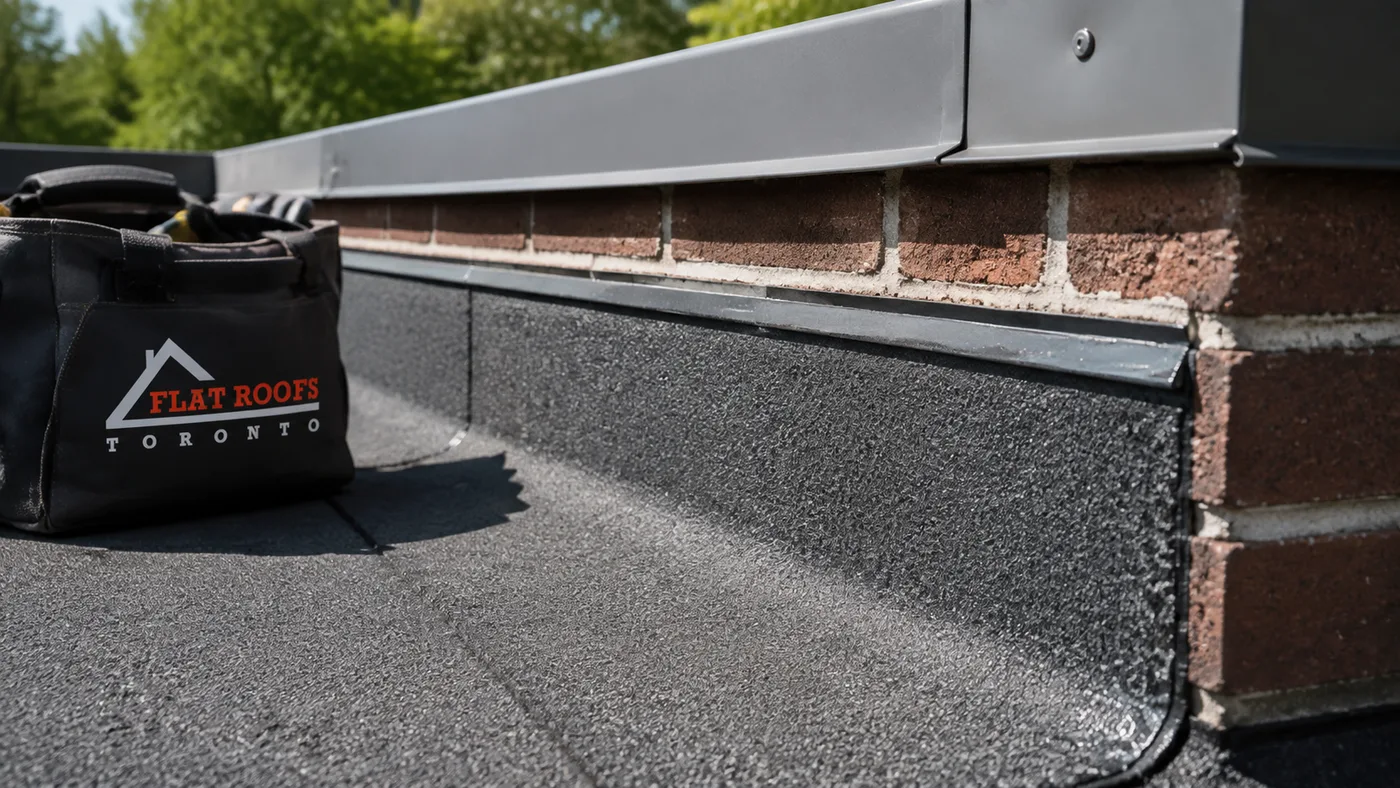
- Inspect flashing and parapet cap metal annually. Loose or lifted metal at a wall junction is the single most common source of interior water staining.
- Trim overhanging branches back so limbs cannot abrade the membrane in wind and so debris load is reduced.
- Address blisters and small seam openings immediately. A $500 repair in June routinely becomes a $5,000 problem after one winter of water intrusion.
- Keep documentation. Photographs and dated inspection notes protect warranty coverage and help a future buyer’s inspector.
Walking a low-slope roof safely requires fall protection and knowledge of where the assembly can bear weight. Homeowners should stay off the roof and have inspections done by someone properly equipped rather than risk both injury and membrane damage.
Choosing a Flat Roofing Contractor in Durham Region
Low-slope roofing is a specialty. Many capable shingle roofers have limited experience with membrane systems, and the failure modes are different enough that experience matters more than general roofing tenure. When evaluating quotes for flat roofing in Durham Region, look for the following.
- A written scope with specifics. Membrane type and thickness, number of plies, insulation type and R-value, fastening pattern, flashing details and edge metal should all be named. A one-line quote is not a scope.
- Proof of insurance and WSIB. Current certificates, provided on request, without hesitation.
- Manufacturer credentials. Membrane manufacturers restrict their better system warranties to trained installers, and that warranty only exists if the installer qualifies for it.
- Two separate warranties explained. The manufacturer covers material defects; the contractor covers workmanship. Ask for the term on each in writing.
- Evidence of comparable completed work. Reviewing a contractor’s completed flat roofing projects shows whether they routinely handle roofs like yours.
- A tear-off decision they can justify. An overlay is sometimes appropriate. Recommending one over a saturated or twice-layered roof is not.
Get three quotes, insist that all three price the same scope, and read what each excludes. The lowest number in a stack of quotes is frequently the one that quietly omitted insulation, disposal, or new flashing metal. Homeowners comparing providers of flat roofing services throughout Durham Region should weigh scope clarity and warranty terms at least as heavily as the bottom-line figure.
Timelines and What to Expect During Installation
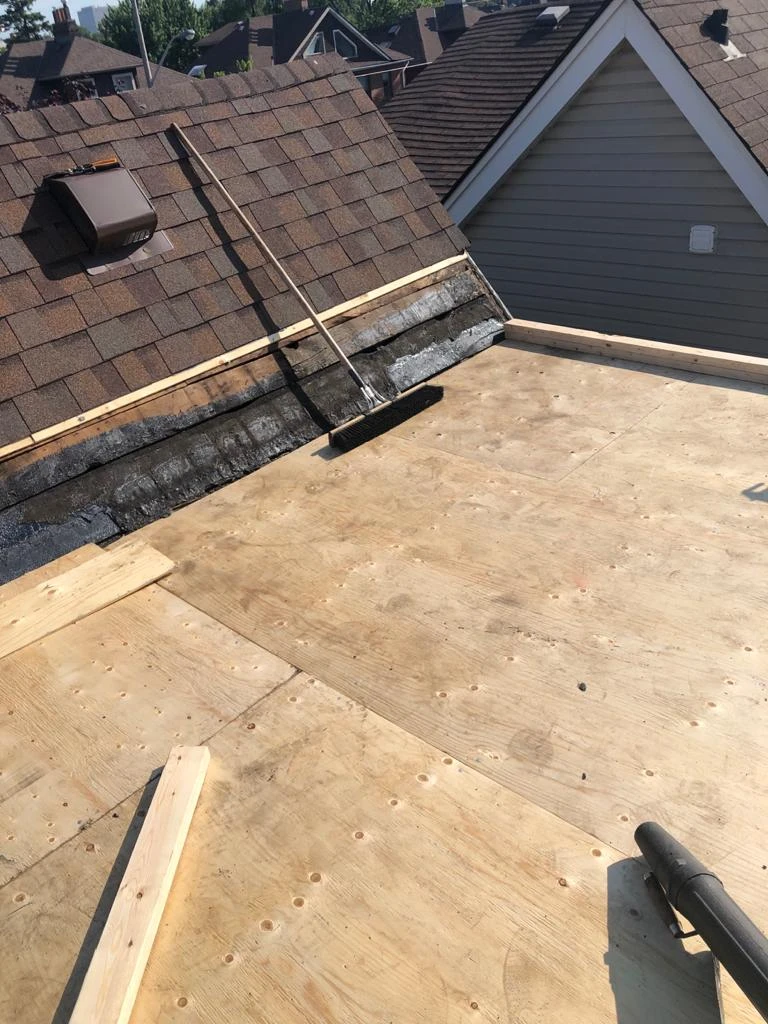
Most residential low-slope replacements in Durham finish in one to three working days. The crew arrives early, protects landscaping and the driveway, and stages disposal. Tear-off of the existing system runs first, and this is the loudest and dustiest phase. Once the deck is exposed it gets inspected for rot, delamination and fastener condition, and any structural repair is confirmed with the homeowner before it proceeds.
Insulation and vapour control go down next, followed by base sheet and cap sheet or the single-ply membrane, then flashings, edge metal and drain or scupper connections. A final walk-through should include photographs of the completed detailing, particularly at penetrations and wall junctions where you cannot easily see the work from the ground.
Scheduling for flat roofing in Durham Region follows predictable seasonal demand. Late spring through early autumn is the busiest window and lead times stretch accordingly. Torch-applied and adhesive-set systems have minimum temperature requirements, so late-season work needs planning rather than improvisation. Booking flat roofing in Durham Region for early spring or the shoulder season generally means shorter waits and more scheduling flexibility.
How much does flat roofing in Durham Region cost in 2026?
Which flat roof membrane lasts longest in Durham’s climate?
Do I need a permit for flat roofing in Durham Region?
Is water pooling on a flat roof a serious problem?
How long does a flat roof replacement take?
Can a new flat roof be installed over the old one?
Book Your Flat Roofing in Durham Region Consultation Today
Whether you are replacing a failed builder-grade garage roof in Ajax, planning a low-slope roof over a new addition in Whitby, correcting chronic ponding on an older Oshawa property, or budgeting a commercial replacement in Pickering, the right flat roofing in Durham Region specification decided early saves years of repair cost later. Flat Roofs Toronto is a Toronto-area low-slope roofing specialist serving homeowners and property managers throughout Durham Region, and every project begins with an on-site assessment of the deck, drainage and existing assembly rather than a guess from the driveway.
Call us today at (647) 333-3528 or request a free consultation to have your roof assessed, your options explained in plain terms, and a written scope you can compare line by line.
Flat Roofs Toronto serves Ajax, Pickering, Whitby, Oshawa and communities throughout Durham Region and the Greater Toronto Area with residential and commercial low-slope roofing.