
Planning a flat roof replacement in Vaughan is one of the larger maintenance decisions a homeowner in this part of York Region will make, and the price range in 2026 is wide enough that a vague quote helps nobody. A small rear addition might be resurfaced for a few thousand dollars, while a full tear off across a modern flat roofed home with heavy insulation upgrades can climb well past twenty thousand. The difference is not mystery pricing. It comes down to square footage, the number of layers coming off, the membrane system going on, the amount of insulation required, and how complicated the roof is to access and detail.
This guide explains what a flat roof replacement in Vaughan actually costs in 2026, what drives those numbers up or down, which membrane systems suit local conditions, and how the permit and Ontario Building Code side of the job works. The goal is simple: give you enough detail to read a quote critically, ask better questions, and avoid paying twice for the same roof.
What a Flat Roof Replacement in Vaughan Actually Involves
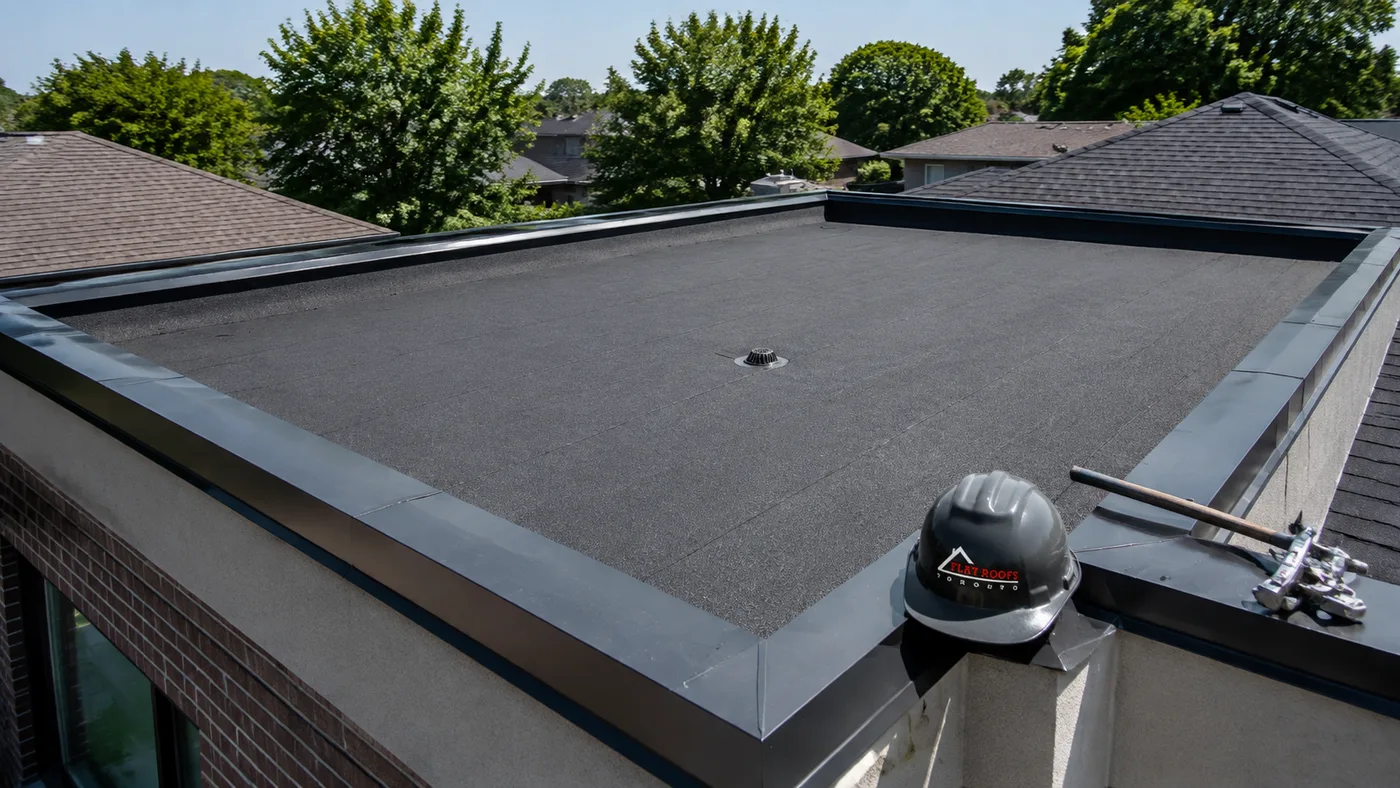
A flat roof replacement in Vaughan is not a resurfacing job. A true replacement means removing the existing roof assembly down to the structural deck, inspecting and repairing that deck, installing new insulation and cover board where required, then applying a new waterproofing membrane with fresh flashings, edge metal, and drainage components. Anything less is a recover or an overlay, which is a legitimate option in some cases but should never be quoted at replacement prices.
The word “flat” is misleading. Every properly built low slope roof has a designed fall toward drains or scuppers, usually between one quarter inch and one half inch of drop per foot. Part of the value in a full replacement is the chance to correct drainage that was never right in the first place. Ponding water that sits for more than forty eight hours after rainfall is the single most common cause of premature membrane failure across the GTA, and it is almost always fixable during a replacement by adding tapered insulation.
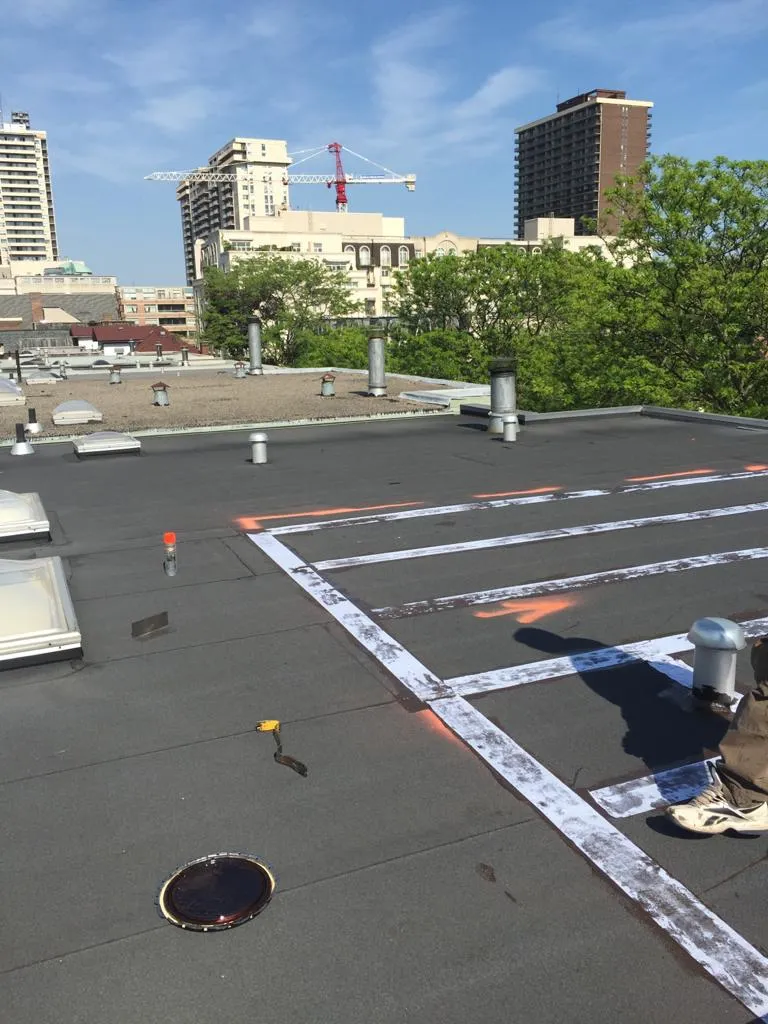
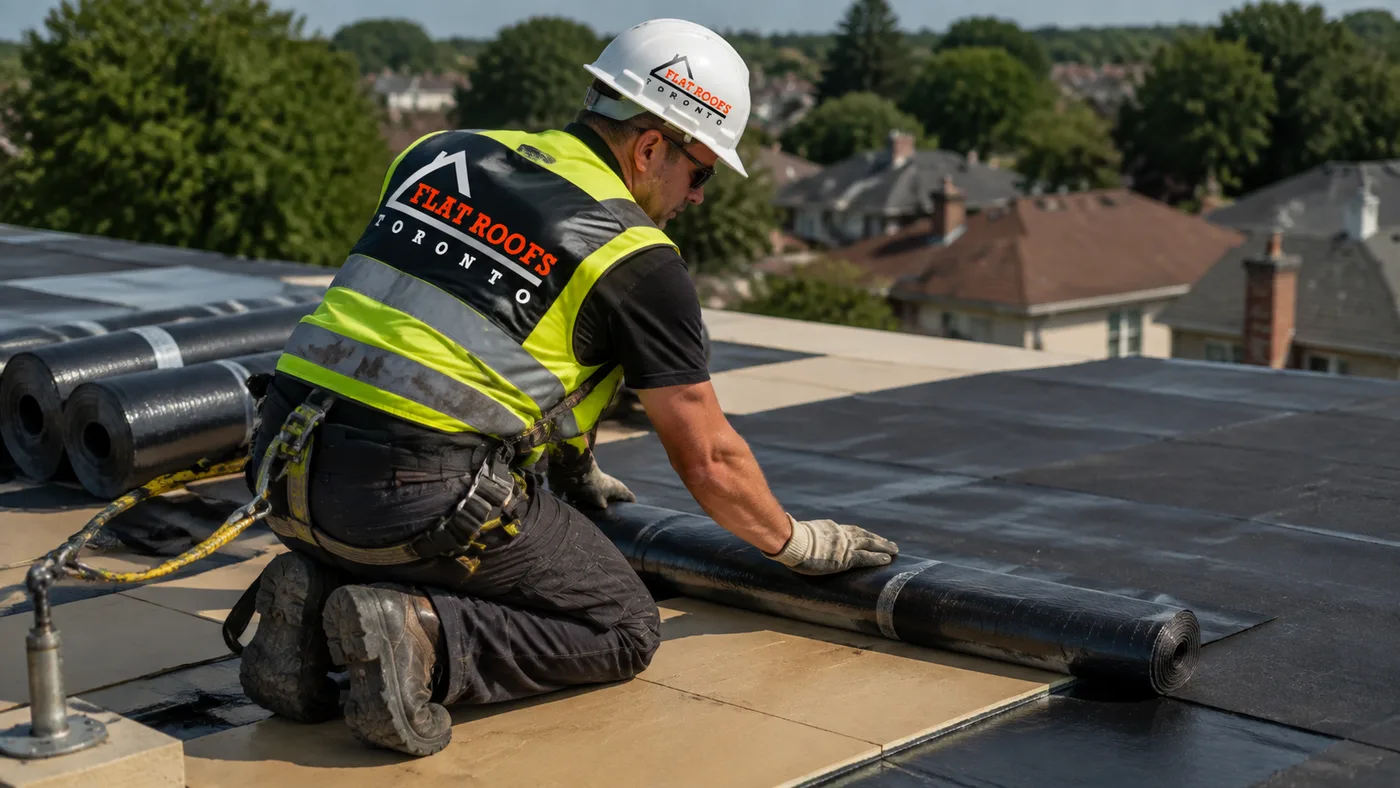
A typical residential flat roof replacement in Vaughan follows a predictable sequence: site protection and material staging, tear off of the old assembly, deck repair, vapour retarder and insulation installation, membrane application, flashing and termination detailing, drain and edge metal installation, then cleanup and final inspection. On a straightforward roof under one thousand square feet, that sequence takes two to four working days in summer conditions.
Why Vaughan Housing Stock Affects Flat Roof Replacement Pricing
Vaughan is not one kind of neighbourhood, and that matters for pricing. The cost of a flat roof replacement in Vaughan depends heavily on which category of housing you own. The older established pockets around the historic village centres include postwar bungalows and mid century homes where flat roofs usually appear as rear additions, carport covers, garage roofs, or porch canopies. These are small areas, often between one hundred and four hundred square feet, but they carry a high proportion of tricky detail work: wall flashings, tie ins to a sloped shingle roof above, and old built up assemblies that were patched repeatedly over decades.
The newer subdivisions built from the late 1990s onward, along with the larger estate lots and the contemporary infill homes appearing across the city, are a different problem entirely. Many of these use flat or very low slope roofs as a design feature, sometimes across an entire upper level, sometimes over a garage wing or a second storey terrace. Areas of one thousand to three thousand square feet are common, and the assemblies tend to include substantial insulation, interior drains rather than perimeter scuppers, and parapet walls that need careful membrane termination.
Then there is the mixed category: older brick homes that had a flat roofed addition put on at some point, where the original roof structure and the newer one meet awkwardly. These jobs often reveal surprises once the tear off starts. If you own one of these, budget a contingency of ten to fifteen percent for deck repair you cannot see from the outside.
Access is the quiet cost driver nobody mentions in advertising. A ground level garage roof that a crew can reach from a ladder is far cheaper to replace than a third storey terrace behind a tight side yard where every bundle of material has to be hoisted. When you compare quotes for a flat roof replacement in Vaughan, confirm that each contractor has actually looked at how material will get up and debris will come down.
Flat Roof Replacement in Vaughan: 2026 Cost Ranges
The table below reflects realistic installed pricing for residential work in the Greater Toronto Area in 2026, including tear off, disposal, standard insulation, membrane, and basic flashing. Prices assume reasonable access and a structurally sound deck. Commercial and multi unit work runs on different economics and is quoted separately.
| Roof Area | Typical Application | 2026 Installed Cost Range | Working Days |
|---|---|---|---|
| 150 to 300 sq ft | Porch canopy, small rear addition | $2,800 to $5,500 | 1 to 2 |
| 300 to 600 sq ft | Garage roof, single storey addition | $5,000 to $9,500 | 2 to 3 |
| 600 to 1,200 sq ft | Large addition, upper terrace | $9,000 to $18,000 | 3 to 5 |
| 1,200 to 2,500 sq ft | Full flat roofed home or upper level | $17,000 to $36,000 | 5 to 9 |
| 2,500 sq ft and up | Estate home, complex multi level roof | $34,000 and up | 8 to 15 |
Expressed per square foot, most residential flat roof replacement in Vaughan lands between fourteen and twenty two dollars installed in 2026, with small awkward roofs pushing higher on a unit basis because mobilisation, disposal, and setup costs are fixed regardless of size. That is why a two hundred square foot porch roof rarely costs one fifth of a one thousand square foot roof.
Two figures are worth separating in any quote. First, the tear off and disposal allowance, which typically runs two to four dollars per square foot depending on how many existing layers there are and whether the old material is gravel surfaced. Second, the insulation package, which can represent a quarter of the total on a heated space and is the line item most often trimmed to make a quote look competitive.
Membrane Systems and Which Ones Suit Vaughan Conditions
Southern Ontario asks a lot of a low slope roof. Summer surface temperatures on a dark membrane can exceed seventy degrees Celsius, winters bring freeze thaw cycling, and snow load sits for weeks. The membrane you choose for a flat roof replacement in Vaughan should be selected for that cycling, not for the lowest bid.
| System | Typical Installed Cost per sq ft | Expected Service Life | Best Suited To |
|---|---|---|---|
| Two ply modified bitumen (SBS), torch applied | $14 to $20 | 25 to 30 years | Residential additions, garages, most GTA homes |
| Two ply SBS, self adhered or cold applied | $16 to $23 | 25 to 30 years | Roofs over occupied space where open flame is a concern |
| TPO single ply, mechanically fastened | $12 to $18 | 20 to 25 years | Larger open areas, reflective white surface preferred |
| EPDM single ply, fully adhered | $12 to $17 | 20 to 25 years | Simple rectangles with few penetrations |
| Liquid applied urethane over existing | $9 to $15 | 10 to 15 years | Recover work, complex detailing, restricted access |
Two ply SBS modified bitumen remains the default choice for residential flat roof replacement in Vaughan and across the GTA, and for good reason. It is redundant by design, meaning a base sheet and a cap sheet both contribute waterproofing, it handles thermal movement well, and its granulated cap surface resists ultraviolet degradation and foot traffic better than a bare single ply. When a roof has many penetrations, parapets, or wall tie ins, the two ply approach also detail flashes more reliably.
Single ply TPO earns its place on larger, simpler areas where its reflectivity meaningfully reduces summer heat gain into the space below. The tradeoff is that seams are heat welded, so quality depends entirely on the installer’s welding discipline and on proper probe testing of every seam.
Liquid applied systems belong in the recover category rather than the replacement category. They can extend the life of a sound assembly at reasonable cost, but they do not address wet insulation, failed decking, or bad drainage. If a contractor proposes a liquid coating as a substitute for replacement on a roof with saturated insulation, that is a repair being sold as a solution.
The Replacement Process Step by Step
Understanding the sequence helps you judge whether a crew is cutting corners, and it makes the line items on a quote for a flat roof replacement in Vaughan much easier to interpret. A properly run project moves through the following stages.
Inspection and measurement
Before any quote is written, the roof should be measured on site, core sampled or probed where moisture is suspected, and the deck condition assessed from below where the underside is visible. Anyone quoting from satellite imagery alone is guessing about the two things that matter most: layer count and deck condition.
Tear off and deck repair
Old layers come off in sections so the roof is never left open overnight in a way that risks water entry. Rotted plywood or deteriorated plank decking is replaced at this stage. On older Vaughan homes, expect at least some deck repair on roofs that have been leaking for more than a season.
Vapour control and insulation
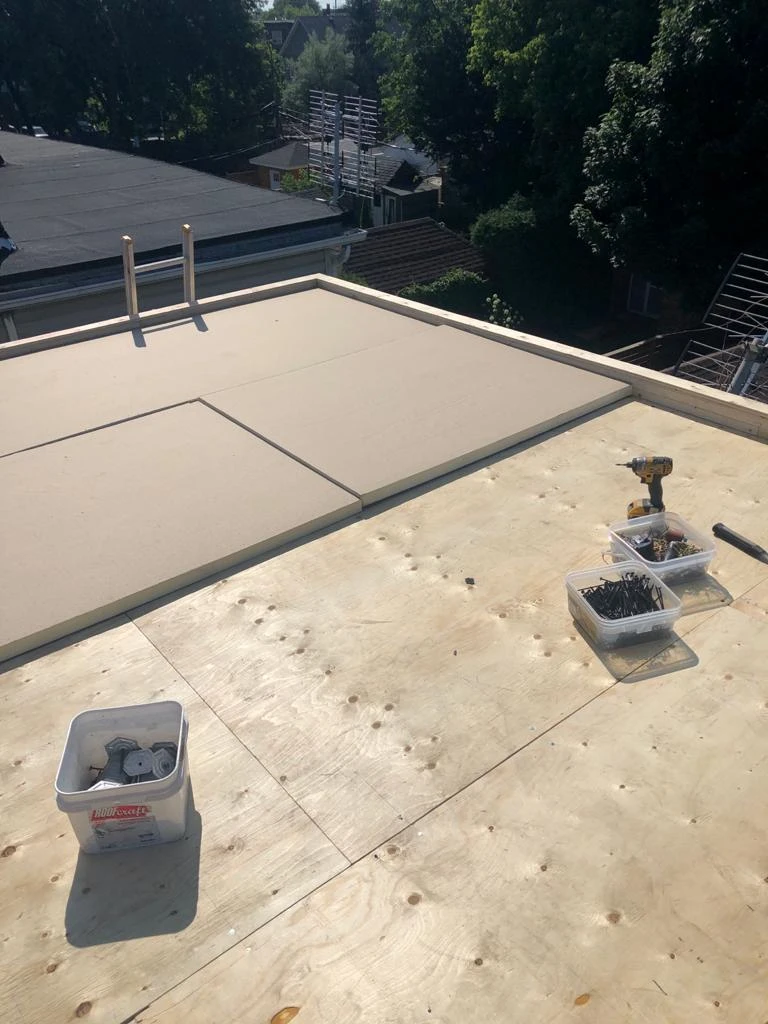
Over heated interior space, a vapour retarder goes down first, then rigid insulation, typically polyisocyanurate, often in two staggered layers so joints do not line up. Tapered insulation is added here if drainage needs correcting. A cover board over the insulation protects it and gives the membrane a stable substrate.
Membrane and flashing
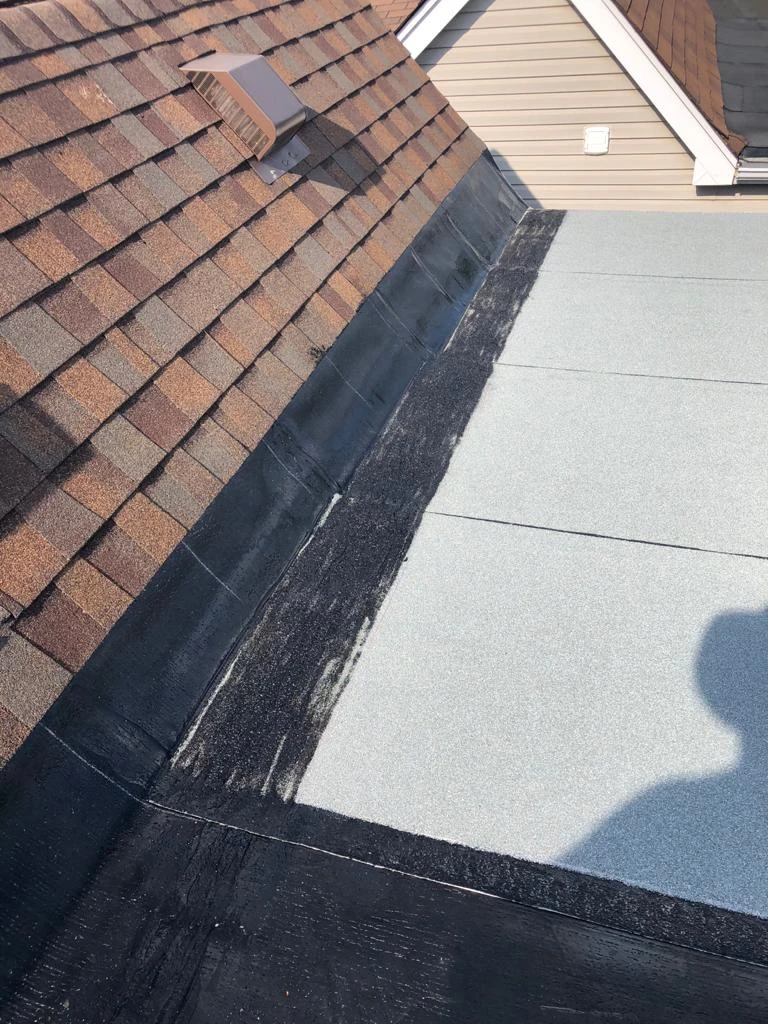
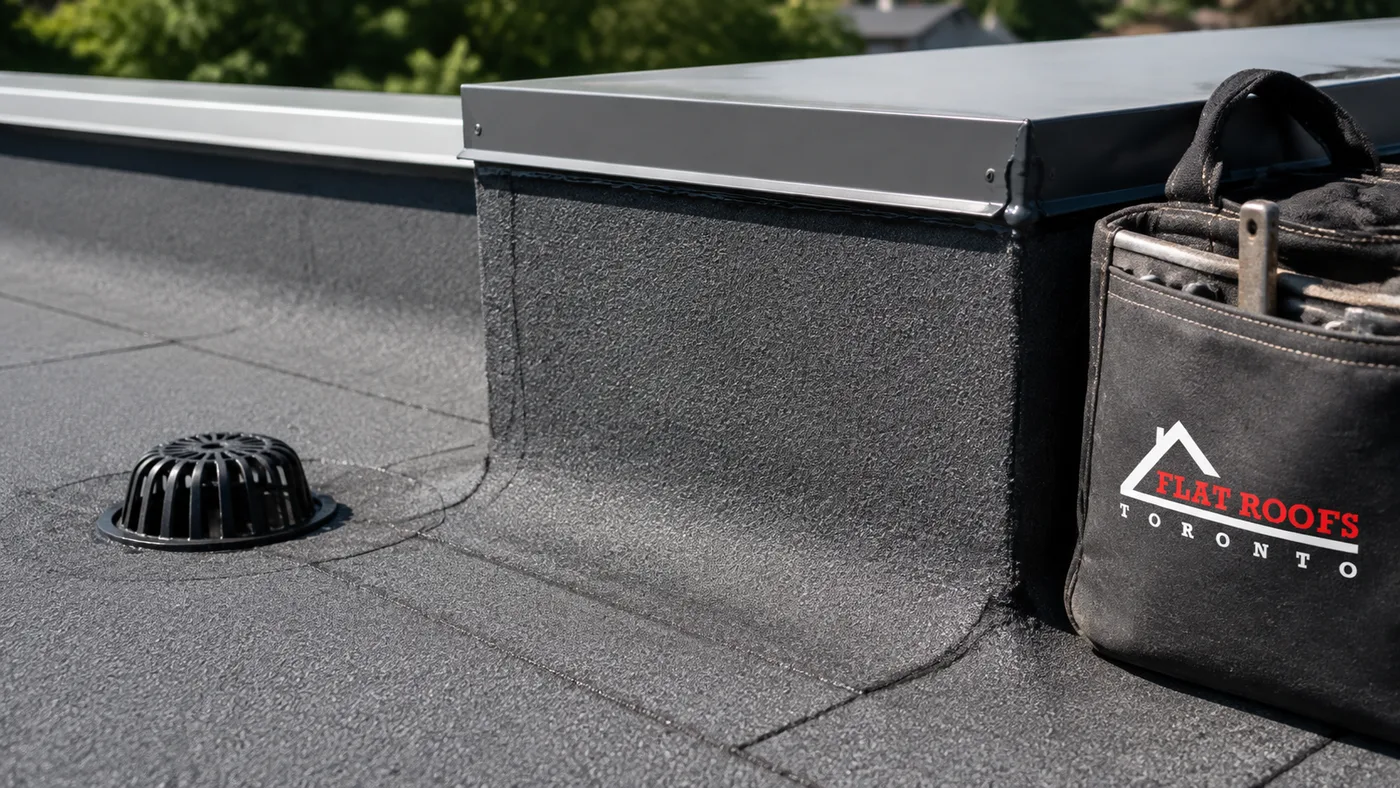
The base ply is installed, then the cap ply, with all seams lapped to manufacturer specification. Flashings at walls, curbs, vents, and parapets are formed and terminated properly, ideally with a termination bar and sealant rather than relying on adhesion alone. This detailing work is where most premature failures originate, and it is where experienced crews separate themselves.
Drainage, edge metal and cleanup
Drains are reset with new clamping rings and strainers, scuppers are lined, and new edge metal or drip edge is installed and fastened. The site is cleaned, magnets are run for fasteners, and the roof gets a final walk with the homeowner. If you are researching residential options generally, our overview of residential flat roof installation methods and assemblies covers how these layers work together in more detail.
Permits, Ontario Building Code and Insulation Requirements
For a straight replacement of roof covering on an existing residential building, a building permit is generally not required in Ontario when the work does not affect structure and does not change the assembly in a way that triggers code compliance review. That said, several common scenarios do require a permit through the City of Vaughan: replacing or altering structural deck members and joists, converting a roof to a walkable terrace or deck, adding new penetrations for mechanical equipment, or changing the roof structure as part of an addition.
The insulation question is where flat roof replacement in Vaughan gets more nuanced. Ontario Building Code supplementary standard SB-12 sets minimum effective thermal resistance values for roof assemblies in new construction and in substantial renovations. When you tear a roof back to the deck over heated living space, you are in a strong position to bring the assembly up to a modern R value, and in many cases the building department will expect it. Practically, that means aiming for an effective R value in the R-31 or higher range for a conditioned roof assembly, achieved with roughly five to six inches of polyisocyanurate depending on the product’s rated performance.
This is not a place to economise. Insulation on a flat roof does double duty. It reduces heating and cooling load, and it keeps the underside of the membrane assembly warm enough to limit condensation within the roof, which is a major cause of hidden deterioration in Ontario. A contractor who proposes leaving old, compressed, or moisture damaged insulation in place under a new membrane is building a failure into the roof from day one.
Ask any contractor quoting your project to state the insulation type, thickness, number of layers, and the resulting effective R value in writing. If a quote for a flat roof replacement in Vaughan is silent on insulation, it is not a comparable quote.
What Drives the Price Up or Down
Two houses on the same street can receive quotes that differ by forty percent for what looks like the same job. The table below shows the factors that typically account for that gap.
| Cost Factor | Typical Impact on Total | Notes |
|---|---|---|
| Number of existing layers to remove | Add $2 to $4 per sq ft per extra layer | Gravel surfaced built up roofs are the heaviest and costliest to dispose of |
| Structural deck repair | $12 to $25 per sq ft of area repaired | Usually unknown until tear off; hold a contingency |
| Tapered insulation for drainage correction | Add $3 to $7 per sq ft over the tapered area | Worth it wherever ponding has been observed |
| Full insulation upgrade to current R value | Add $4 to $8 per sq ft | Required over heated space in most substantial replacements |
| Difficult access or hoisting | Add 8 to 20 percent to labour | Tight side yards, upper terraces, no driveway staging |
| Parapets, curbs and multiple penetrations | Add 10 to 25 percent to labour | Detail work is slow and skill intensive |
| New drains, scuppers or edge metal | $400 to $1,200 per unit or run | Frequently omitted from low quotes |
Season matters as well. Demand across the GTA peaks from late spring through early autumn, and pricing follows demand. Late autumn and early winter work is possible with certain systems, but cold weather application windows are narrower for some adhesives and self adhered products, so scheduling a flat roof replacement in Vaughan for late summer often gets both better pricing and better installation conditions than a December emergency.
How to Compare Quotes Without Getting Burned
The cheapest quote for a flat roof replacement in Vaughan is usually cheap for a reason you can identify if you know where to look. Work through this list before signing anything.
- Scope of tear off: confirm the quote says down to deck, and states how many layers are included and what happens if more are found.
- Insulation specification: type, thickness, layers, and effective R value stated in writing.
- Membrane specification: manufacturer, product name, number of plies, and application method.
- Flashing detail: how wall and parapet terminations will be finished, and what metal is included.
- Drainage: whether existing drains are being reset with new hardware, and whether tapered insulation is included.
- Insurance and WSIB: a current certificate of liability insurance and WSIB clearance, provided before work starts, not after.
- Warranty terms: separate the manufacturer material warranty from the contractor workmanship warranty, and get both in writing with their durations.
- Disposal: confirm bin costs and debris removal are included rather than billed later.
Homeowners across York Region who want to see how these specifications translate into finished work can review completed projects in our project gallery, and those weighing a full replacement against targeted repair should read about our approach to flat roofing services for Vaughan homeowners before making a decision. If an active leak is causing interior damage right now, emergency roof repair should come first, with the replacement planned properly afterward rather than rushed.
Replacement Versus Repair: Making the Call
Not every failing roof needs a full flat roof replacement in Vaughan. The honest test is whether the problem is at the surface or inside the assembly. Surface problems, meaning a split seam, a failed flashing at one curb, a pinhole at a fastener, are repairable and can buy several more years at a fraction of replacement cost. Assembly problems, meaning wet or compressed insulation, widespread blistering, delamination between plies, or a deck that flexes underfoot, mean the roof is finished.
Age gives a useful frame. A two ply SBS roof installed properly should reach twenty five years or more. If a roof is under fifteen years old and leaking in one location, investigate and repair. If it is past twenty years, leaking in multiple locations, and showing surface granule loss and shrinkage at the flashings, money spent on repairs is money spent twice. A moisture scan or a few core cuts will settle the question definitively, and any contractor quoting a flat roof replacement in Vaughan should be willing to show you what they found rather than simply asserting that everything must go.
One further consideration: if you are already planning interior work below the roof, or thinking about adding a skylight, or if your attic and roof insulation is underperforming, sequence those projects together. Opening the roof once is far cheaper than opening it twice, and coordinating a replacement with attic and roof insulation improvements often produces a better thermal result than doing either job alone.
Protecting the Investment After Installation
A flat roof replacement in Vaughan is a twenty five year asset only if it is treated as one. The maintenance load is light but it is not zero.
Inspect twice a year, in spring after the freeze thaw season and in autumn before snow arrives. Look for standing water more than forty eight hours after rain, splits or blisters in the field of the membrane, lifted or open flashing edges, loose edge metal, and debris blocking drains or scuppers. Clear drains every autumn without fail, because a blocked drain on a flat roof can add serious weight quickly during a heavy rain event.
Keep foot traffic off the membrane except when necessary, and if mechanical equipment sits on the roof, install proper walk pads along service routes. Avoid mounting anything new to the roof without proper curb detailing and flashing, since every unflashed penetration is a future leak. Finally, keep the paperwork: warranty documents, the specification sheet, and dated photographs from the installation. If a warranty claim ever arises, that file is what makes it straightforward.
How much does a flat roof replacement in Vaughan cost in 2026?
Do I need a building permit for a flat roof replacement in Vaughan?
How long does the work take?
Which membrane lasts longest on a Toronto area flat roof?
Can a new membrane go over the old roof instead of tearing off?
What is the best time of year to schedule this work?
Book Your Flat Roof Replacement in Vaughan Assessment
If your low slope roof is leaking, ponding, or simply past its expected service life, the next step is a proper on site assessment rather than a phone estimate. Flat Roofs Toronto is a Toronto area flat roofing specialist serving homeowners throughout Vaughan and York Region, and every quote we write for a flat roof replacement in Vaughan states the tear off scope, insulation specification, membrane system, flashing details, and warranty terms in writing so you can compare it fairly against anything else on your table.
Call us today at (647) 333-3528 or request a free consultation to have your roof measured, assessed, and quoted with no obligation.
Flat Roofs Toronto serves Vaughan, Woodbridge, Maple, Thornhill, Concord and communities across the Greater Toronto Area with residential and commercial flat roofing.