If you own a home with a low-slope or flat section of roof north of Highway 7, you already know that flat roof repair in Richmond Hill is rarely a one-size-fits-all job. The town’s housing stock spans postwar bungalows with tacked-on rear additions, 1980s and 1990s subdivisions with flat-topped garages and porticos, larger estate lots with modern cube-style architecture, and a growing number of newer infill builds with full membrane roof decks. Each of those roof types fails in a different way, and each one calls for a different repair strategy, budget and timeline.
This guide explains what actually goes wrong on low-slope roofs in this part of York Region, what a competent approach to flat roof repair in Richmond Hill should include, what the work costs in 2026, and how to tell the difference between a patch that buys you another decade and a patch that is only postponing a full replacement. The goal is to give you enough technical grounding that you can read a quote critically instead of simply comparing bottom-line numbers.
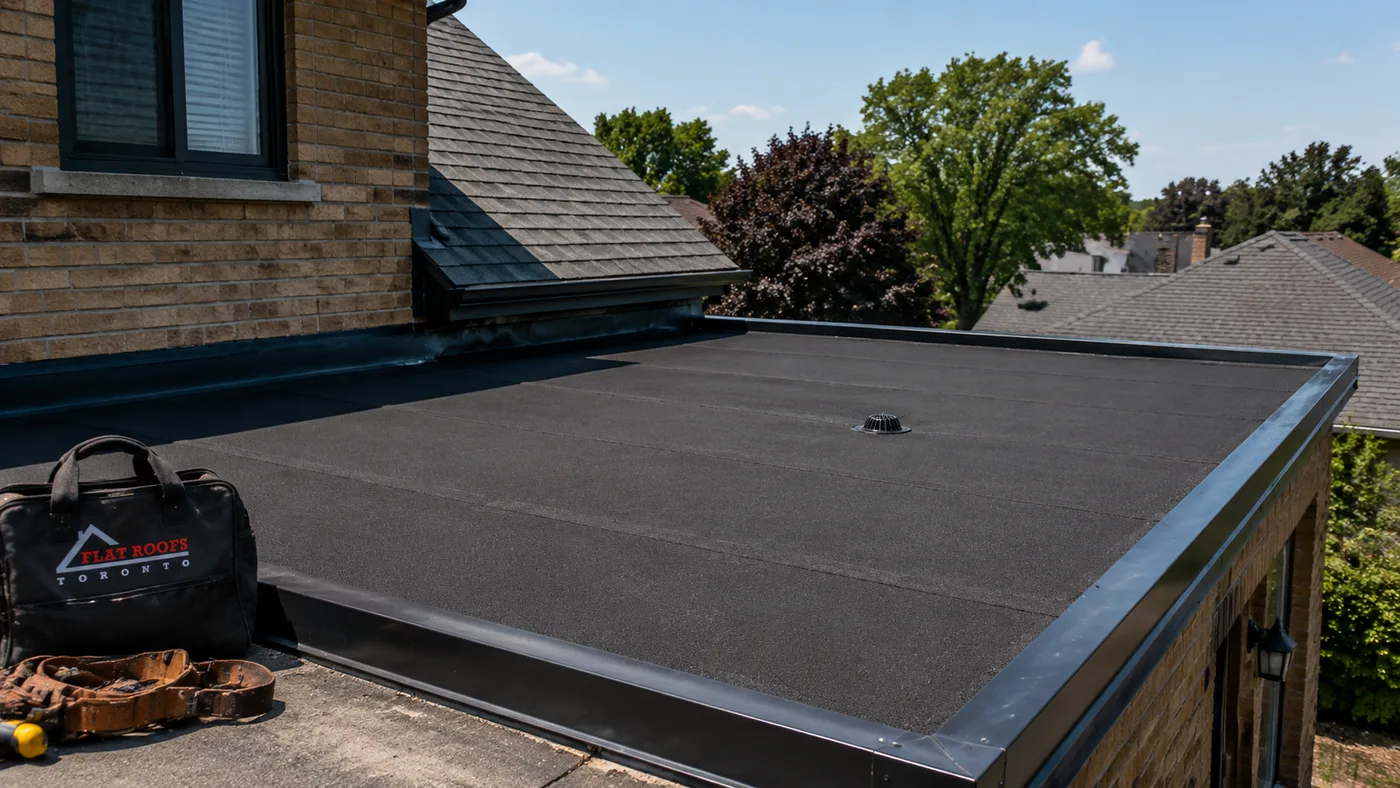
What Flat Roof Repair in Richmond Hill Actually Involves
Most homeowners searching for flat roof repair in Richmond Hill are reacting to a visible symptom: a ceiling stain, a drip during a thaw, bubbling drywall above a rear addition, or a contractor’s offhand comment during a gutter cleaning. The symptom almost never appears directly beneath the failure. Water travels along the underside of the deck, follows joists, and emerges at the lowest fastener or seam it can find, which is often several metres away from the actual breach.
A proper repair therefore starts with diagnosis, not with a bucket of sealant. On a residential low-slope roof, that diagnosis usually includes a walk of the entire membrane surface, a close inspection of every penetration and termination, a moisture check of the insulation layer where access allows, and an interior look at the ceiling cavity or attic space. Only after that does a roofer know whether the correct answer is a targeted seam repair, a section replacement, or a full tear-off.
The three most common outcomes of a residential assessment for flat roof repair in Richmond Hill look like this:
- Localised repair. One failed seam, one cracked boot, one open flashing termination. The surrounding membrane is sound and the insulation is dry. Cost is modest and the roof carries on.
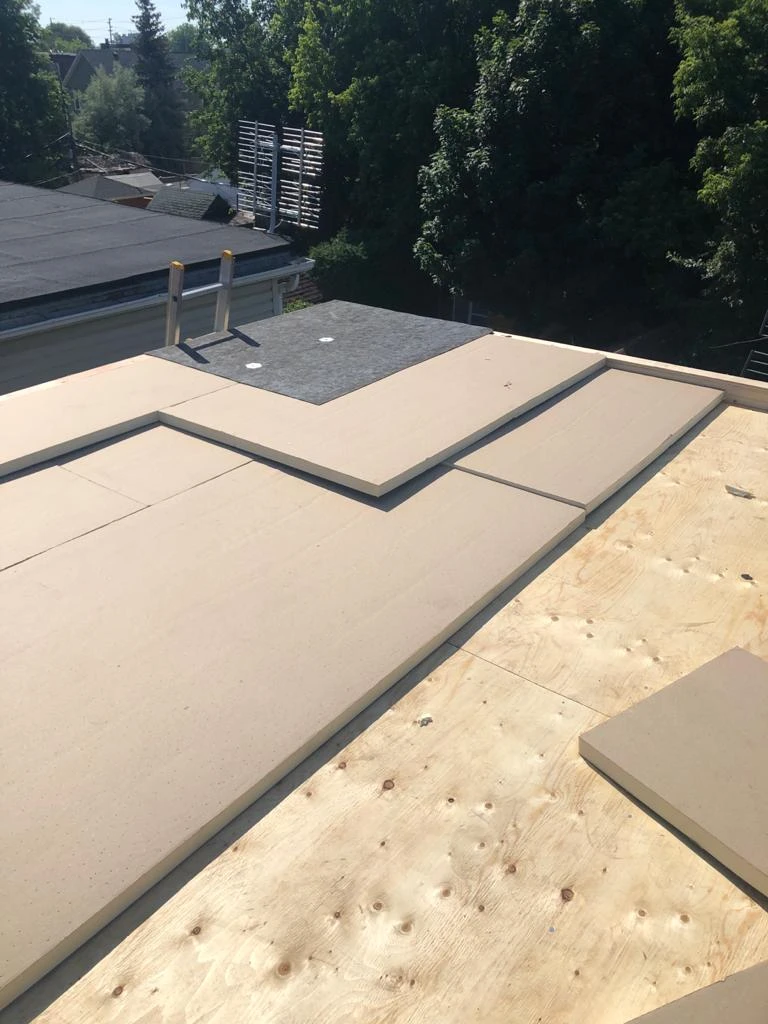
- Section replacement. Water has tracked under the membrane and saturated the insulation across part of the roof. The wet area is cut out, the deck is dried or replaced, new insulation goes in, and a new membrane section is heat-welded or torch-applied and tied into the existing field.
- Full replacement. The membrane is at the end of its service life, has multiple failures, or has been patched so many times that the surface is a quilt of overlapping repairs. At this point repairs stop being economical.
An honest contractor will tell you which of the three you are looking at and will show you photographs to support the call. If a quote for flat roof repair in Richmond Hill arrives without any evidence of what was found, treat that as a warning sign rather than a convenience.
How Richmond Hill’s Housing Character Shapes Flat Roof Problems
Richmond Hill grew in distinct waves, and each wave left behind a different low-slope roofing profile. Understanding which era your house belongs to explains a great deal about how its roof is likely to fail.
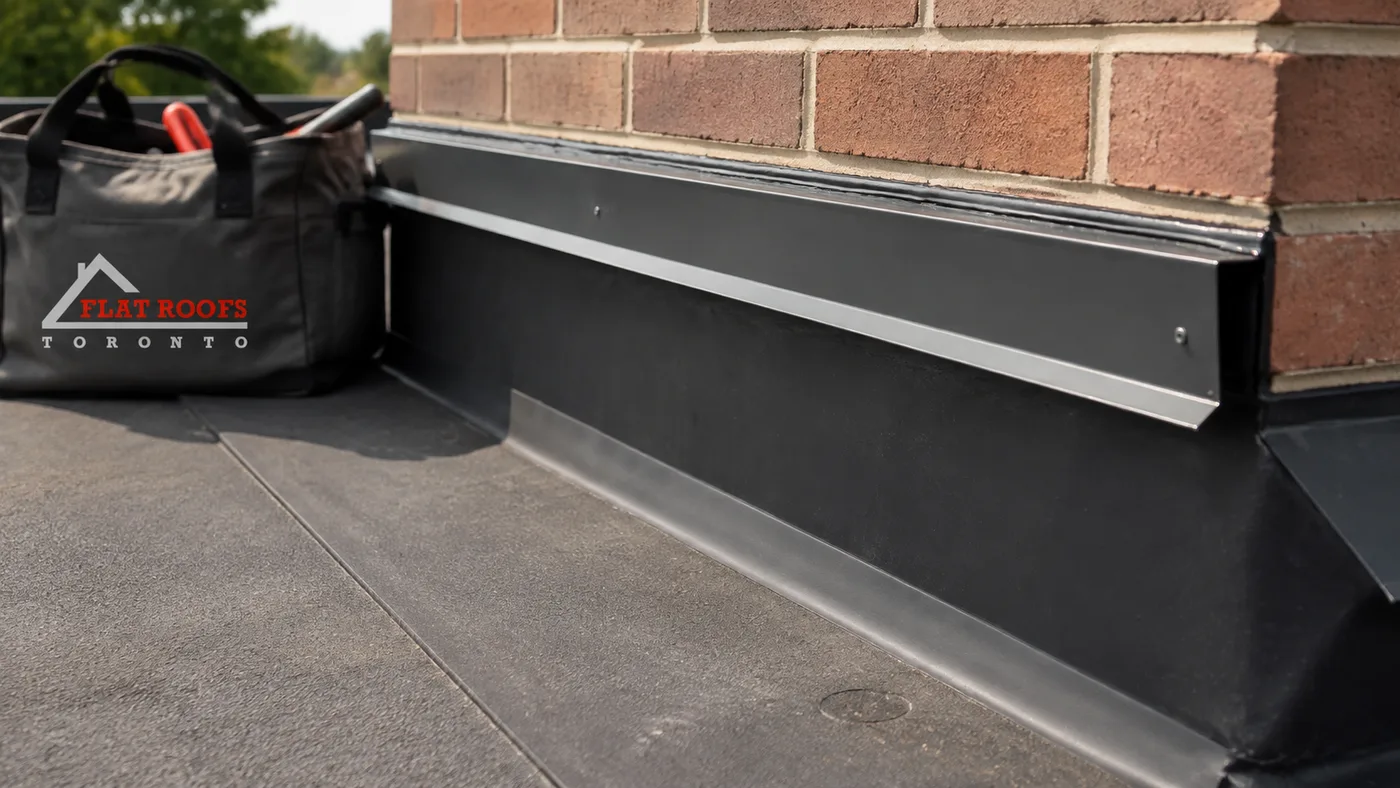
The older core of town has a stock of postwar bungalows and modest brick homes, many of which have had rear additions, sunrooms or carports added over the decades. Those additions are frequently the flat-roofed portion of an otherwise sloped house. Because they were built later than the main structure, the junction between the addition’s low-slope membrane and the original sloped roof or brick wall becomes the single most vulnerable point on the property. Counter-flashing at that junction is where a large share of flat roof repair in Richmond Hill work gets concentrated.
The subdivisions built through the 1980s and 1990s brought a different pattern: flat-topped garage roofs, entry porticos, bay window caps and small deck areas over living space. These are small roofs, often under 30 square metres, but they sit directly above finished interior space and they were commonly built with the cheapest available membrane. Many are now well past their intended service life, which is why subdivision-era homes generate a steady volume of flat roof repair in Richmond Hill every spring.
Newer estate homes and contemporary infill builds present the opposite challenge. Their flat roofs are large, architecturally deliberate, and often carry rooftop mechanical equipment, large skylights or terrace assemblies. The membrane is usually a modern single-ply system, but the number of penetrations is far higher, and each penetration is a potential leak. On these homes, ongoing maintenance matters more than the membrane quality itself, and flat roof repair in Richmond Hill tends to mean detail work around curbs and equipment rather than large-area membrane failure.
Why local climate makes low-slope roofs work harder
York Region sits far enough north of the lake that it does not get the same moderating effect Toronto’s waterfront neighbourhoods enjoy. Winters bring deeper frost, more freeze and thaw cycling, and heavier accumulation that lingers on flat surfaces instead of shedding. Summers push dark membrane surface temperatures well above ambient air temperature. That annual swing forces the membrane and the deck below it to expand and contract repeatedly, and movement is what eventually opens seams, splits laps and pulls flashings away from parapet walls. Thermal cycling, not rainfall, is the underlying driver behind most flat roof repair in Richmond Hill.
This is why the leaks people notice in February usually began as a small defect the previous summer. Ice damming on a low-slope roof does not behave the way it does on a shingled roof: instead of forming at an eave, it forms wherever drainage is blocked, and it holds standing water against a seam for weeks. If you want a broader look at how we approach flat roofing services for Richmond Hill homes and buildings, the same principles apply across every low-slope assembly we service in York Region.
The Most Common Flat Roof Failures We Find in Richmond Hill
Across residential low-slope roofs in the area, the same handful of defects account for the overwhelming majority of leaks. Recognising them helps you describe the problem accurately when you call for flat roof repair in Richmond Hill, and it helps you judge whether the scope you are quoted actually addresses the cause.
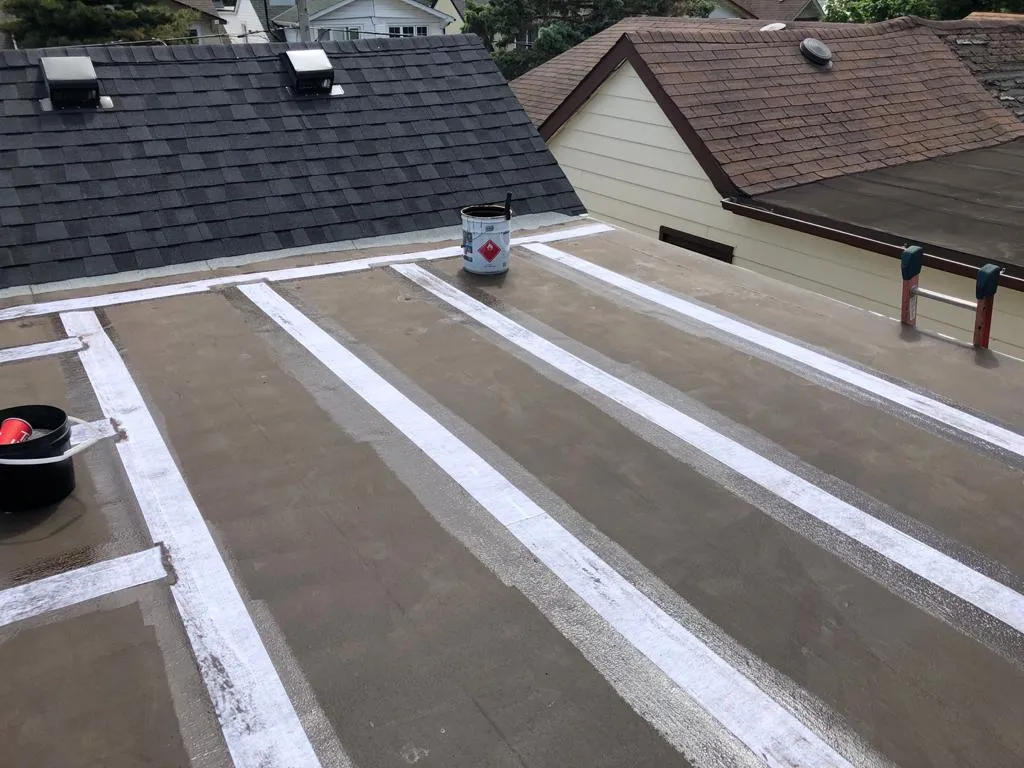
Open or split seams. Where two sheets of membrane overlap, the bond can fatigue. On torch-applied modified bitumen this shows as a lifted edge; on EPDM it often appears as a wrinkle that has separated. Seams are the number one cause of residential flat roof repair calls.
Failed flashing and terminations. Anywhere the membrane stops, it has to be sealed to something else: a parapet, a brick wall, a curb, a drain. Terminations rely on metal counter-flashing and sealant, and sealant does not last as long as membrane. Expect termination maintenance every eight to twelve years even on a healthy roof.
Ponding water. Flat roofs are never truly flat. They are built with a slight slope towards drains or scuppers. When insulation compresses, a deck sags, or a drain clogs, water sits. Ponding accelerates membrane degradation, adds structural load, and in winter becomes a block of ice that works seams open.
Penetration failures. Plumbing stacks, exhaust vents, skylight curbs, satellite mounts and mechanical curbs each break the membrane plane. The rubber boots and pitch pockets that seal them are typically the first components to fail on an otherwise sound roof.
Blisters and ridging. Trapped moisture or air between membrane layers expands with heat and forms raised bubbles. Small blisters are usually monitored rather than repaired. Large ones, or any blister that has split, need to be cut out and patched.
Mechanical damage. Foot traffic from other trades, dropped tools, dragged ladders and improperly secured equipment cause punctures. On homes with rooftop equipment, a walkway pad is a cheap investment.
What Flat Roof Repair Costs in Richmond Hill in 2026
Pricing for flat roof repair in Richmond Hill varies with access, roof height, membrane type and how much of the assembly below the membrane has been affected. The ranges below reflect typical 2026 residential pricing in York Region and the northern GTA. They assume a standard two-storey home with reasonable ladder or hoist access and no structural deck replacement unless noted.
| Repair Type | Typical 2026 Cost Range | Usual Time on Site | Expected Service Life |
|---|---|---|---|
| Diagnostic inspection and leak trace | $150 to $400 (often credited to the work) | 1 to 2 hours | Not applicable |
| Single seam or lap repair | $450 to $1,100 | Half day | 5 to 10 years |
| Vent boot or pipe penetration reseal | $350 to $850 per penetration | 2 to 4 hours | 8 to 12 years |
| Wall or parapet flashing rebuild | $900 to $2,800 per elevation | 1 to 2 days | 10 to 15 years |
| Section replacement with wet insulation removal | $2,500 to $6,500 | 1 to 3 days | 15 to 20 years |
| Drain or scupper replacement and re-slope | $1,200 to $3,500 | 1 to 2 days | 15 to 20 years |
| Full low-slope replacement (small residential area) | $14 to $24 per square foot installed | 2 to 5 days | 20 to 30 years |
Two variables push these numbers around more than anything else. The first is access: a roof reachable from a driveway with a standard extension ladder costs less to service than one that requires staging over a landscaped side yard. The second is hidden saturation. A quote written before the membrane is opened is provisional by definition, and any contractor quoting flat roof repair in Richmond Hill should tell you clearly what happens to the price if wet insulation is found underneath.
Emergency and after-hours work carries a premium, typically 25 to 60 percent above scheduled rates, because it involves mobilising a crew outside normal sequencing. When active water is entering a house, that premium is usually worth paying. Our emergency roof repair service for active leaks exists for exactly those situations, where a temporary watertight seal now prevents a much larger interior restoration bill later.
Repair or Replace: How to Make the Decision
The most expensive mistake in low-slope roofing is repeatedly repairing a roof that should have been replaced three years ago. The second most expensive mistake is replacing a roof that had a decade of service left. Before committing to another round of flat roof repair in Richmond Hill, work through the factors in the table below.
| Factor | Points Towards Repair | Points Towards Replacement |
|---|---|---|
| Membrane age | Under 60 percent of rated life | Over 80 percent of rated life |
| Number of active leaks | One isolated location | Three or more separate locations |
| Insulation condition | Dry on core sampling | Saturated across more than 25 percent of area |
| Repair history | First or second repair | Multiple overlapping patches |
| Surface condition | Granules intact, no widespread cracking | Alligatoring, brittleness, exposed reinforcement |
| Drainage performance | Roof clears within 48 hours of rain | Persistent ponding after every rainfall |
| Planned time in the home | Selling within two years | Staying long term |
A useful rule of thumb: if the cost of a proposed repair exceeds roughly 30 percent of the cost of full replacement, and the membrane is already past the midpoint of its expected life, replacement is usually the better financial decision. Below that threshold, repair generally wins. Anyone recommending flat roof repair in Richmond Hill should be willing to work through that arithmetic with you rather than simply asserting a conclusion.
Membrane Types on Richmond Hill Homes and How Each One Fails
The correct method for flat roof repair in Richmond Hill depends entirely on what is already on the roof. Applying the wrong material to an existing membrane can void a warranty and create a new failure point within a season.
| Membrane System | Typical Service Life | Characteristic Failure Mode | Repair Approach |
|---|---|---|---|
| Two-ply modified bitumen (torch applied) | 20 to 30 years | Seam lift, granule loss, flashing separation | Torch-welded patch with matching cap sheet |
| EPDM rubber (single-ply) | 20 to 25 years | Seam adhesive failure, shrinkage at terminations | Cleaned and primed cover tape or new sheet section |
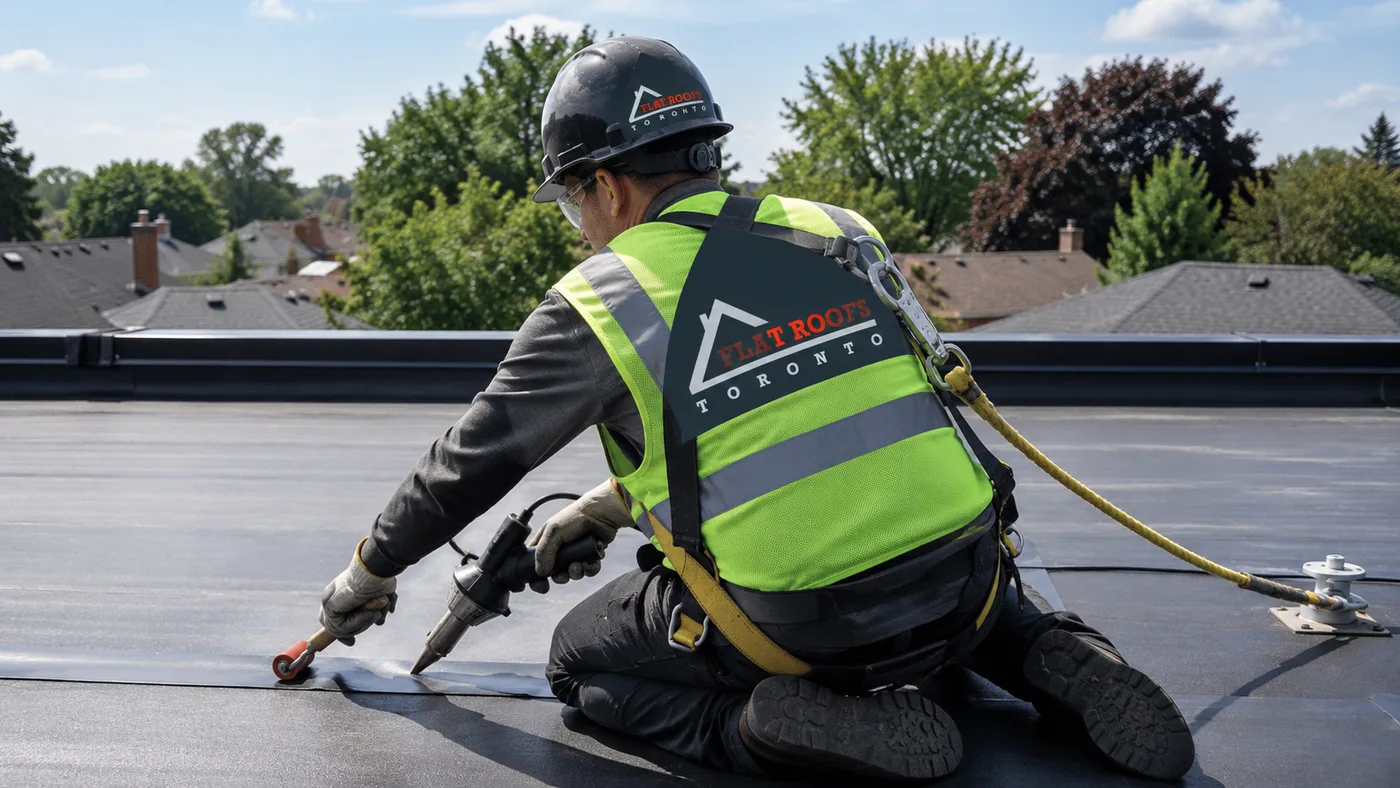
| TPO (heat-welded single-ply) | 20 to 30 years | Weld voids, puncture, edge detachment | Hot-air welded patch, weld tested with probe |
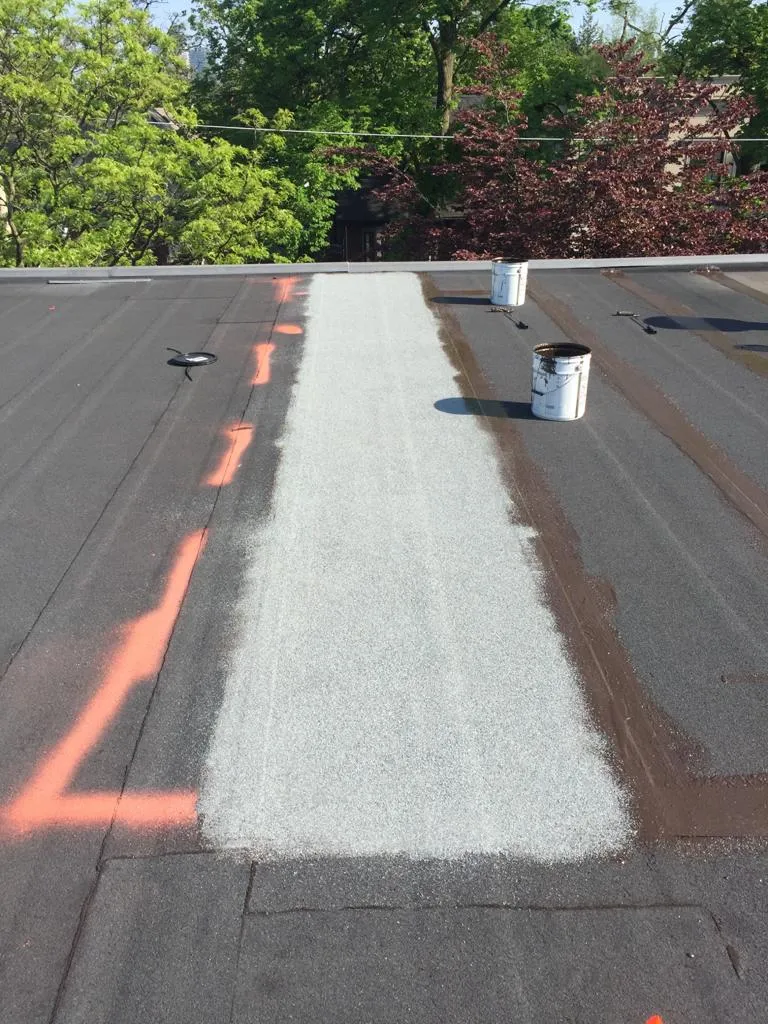
| Built-up roof with gravel ballast | 20 to 30 years | Blistering, ply separation, hidden saturation | Gravel removal, cut-out and re-ply of affected area |
| Liquid-applied or spray coating over aged membrane | 8 to 15 years | Thin spots, cracking at movement joints | Recoat after full surface preparation |
Identifying the system correctly matters. A torch is used on modified bitumen and never on EPDM or TPO. TPO welds require a hot-air gun and a probe test on every weld. EPDM repairs depend on surface cleaning and priming that many general contractors skip, which is why so many rubber roof patches fail within two winters. Asking which system you have is the fastest way to gauge whether a contractor quoting flat roof repair in Richmond Hill knows the trade.
Permits, Code and Practical Constraints in York Region
Straightforward flat roof repair in Richmond Hill does not normally require a building permit. Replacing a membrane like for like, resealing penetrations, rebuilding flashing and swapping a drain are all maintenance activities. Permits generally come into play when structural deck members are replaced, when the roof assembly’s insulation value is being changed as part of a larger renovation, or when the flat roof is being converted into an occupied terrace or a roof deck with guards.
Where the Ontario Building Code matters most for homeowners is in the details of the assembly. Low-slope roofs over conditioned space need a continuous air and vapour control strategy, adequate insulation, and either a properly vented cavity or a fully adhered compact assembly. A repair that reinstates the membrane but ignores a saturated insulation layer leaves an assembly that will keep condensing moisture and will fail again. If your roof also includes glazing, the curb detail matters just as much as the membrane, which is why skylight curbs and residential skylight installations should be inspected whenever adjacent membrane work is done.
Two practical constraints worth planning around: torch-applied work cannot be done safely in high wind or on wet substrate, and adhesive-based single-ply repairs have minimum temperature requirements that make deep winter work unreliable. Emergency stabilisation can happen in any weather. Permanent flat roof repair in Richmond Hill usually cannot.
Choosing a Contractor for Flat Roof Repair in Richmond Hill
Low-slope roofing is a different trade from shingle roofing. Many capable shingle crews have limited experience with membrane welding, and the results show up two winters later. When you are collecting quotes for flat roof repair in Richmond Hill, the following questions separate specialists from generalists.
- Which membrane is on my roof, and how do you know? A specialist identifies the system on sight and explains the compatible repair method.
- Did you check the insulation, not just the surface? Surface-only inspections miss saturation, which is the single biggest driver of repeat failure.
- What is the warranty on the repair itself? Workmanship warranties on a residential repair typically run two to five years. Anything vaguer than that is not a warranty.
- Are you carrying current WSIB coverage and liability insurance? Ask for the certificates rather than a verbal assurance.
- What happens if you open the roof and find more damage? The answer should be a defined unit rate for additional area, agreed before work starts.
- Can I see photographs of comparable work? Reviewing a contractor’s completed flat roofing project gallery tells you more about detailing standards than any brochure.
Be cautious with any quote that is dramatically below the others. On low-slope work, an unusually cheap number almost always means surface sealant over an unaddressed problem. That approach produces a dry ceiling for one season and a larger repair the following year.
Seasonal Timing and Maintenance That Prevents Repeat Repairs
The best window for planned flat roof repair in Richmond Hill runs from late April through October, when substrate temperatures allow proper adhesion and welding. Booking in that window also means you are not competing with the emergency queue that forms during the first heavy thaw of the year.
Between rounds of flat roof repair in Richmond Hill, a short maintenance routine dramatically extends membrane life:
- Clear drains, scuppers and gutters twice a year, in late autumn and again in spring.
- Walk the roof visually each spring and look for lifted seams, split boots and standing water that has not cleared.
- Keep overhanging branches trimmed back so debris does not accumulate and abrade the surface.
- Have any rooftop equipment serviced by trades who understand not to drag tools across the membrane.
- Address ceiling stains immediately rather than waiting to see whether they spread.
- Check attic or cavity insulation for dampness after a major storm, since a small breach can wet insulation long before it stains a ceiling.
Homeowners who also insulate properly tend to see fewer ice-related problems, because a warm, leaky ceiling plane is what drives melt water onto a cold membrane in the first place. Combining membrane work with attic insulation upgrades often resolves recurring winter leaks that no amount of surface repair could fix. For larger properties and multi-unit buildings, the same logic applies at greater scale, and commercial flat roof installation follows the same detailing discipline.
How much does flat roof repair in Richmond Hill cost?
How long does a flat roof repair last?
Can flat roof repair in Richmond Hill be done in winter?
Do I need a permit to repair a flat roof in Richmond Hill?
Why does my flat roof leak only during thaws and not during rain?
Should I repair or replace an older low-slope roof?
Book Your Flat Roof Repair in Richmond Hill Assessment
Flat Roofs Toronto is a Toronto-based low-slope roofing specialist serving Richmond Hill and the surrounding York Region communities. Every quote for flat roof repair in Richmond Hill starts with a full diagnostic walk of the membrane, the terminations and the insulation condition, followed by a written scope that states exactly what will be repaired, what it will cost, and what happens if hidden saturation is found once the roof is opened.
Call us today at (647) 333-3528 or request a free consultation. If water is entering your home right now, say so when you call so we can prioritise a temporary seal before scheduling permanent work.
Flat Roofs Toronto serves Richmond Hill, Vaughan, Markham, Aurora, Newmarket, Thornhill and the wider Greater Toronto Area with residential and commercial low-slope roofing, repair and maintenance.