
Flat roof repair in Oshawa is one of those jobs where waiting rarely saves money. A low-slope roof holds water instead of shedding it, so a seam that opens in April can soak insulation, stain drywall and rot sheathing well before the leak ever shows up on a ceiling. Homeowners across Durham Region deal with the same pattern every year: freeze and thaw cycles work at the membrane through winter, spring rain finds the weak point, and by midsummer the repair has grown from a simple patch into a section rebuild. This guide covers what flat roof repair in Oshawa actually involves in 2026, what it costs, how to tell a patch from a replacement, and how the local housing stock and climate shape the decision.
Why Flat Roof Repair in Oshawa Has Its Own Set of Rules
Oshawa sits on the north shore of Lake Ontario in Durham Region, and that location does real work on a roof. Lake moisture keeps humidity high through late autumn, and the city gets a mix of wet snow, ice pellets and rain during the same week in January more often than most homeowners expect. A sloped shingle roof handles that mix by shedding it. A flat roof, which in practice means anything under roughly a two in twelve pitch, has to hold the water on the surface until drains, scuppers or a slight taper move it off. Every hour water sits there is an hour it can find a pinhole.
The second factor is thermal movement. A dark membrane on a July afternoon in Oshawa can reach surface temperatures far above the air temperature, then drop below freezing on a clear February night. Over a season the membrane and the deck beneath it expand and contract at different rates, and the stress concentrates exactly where the roof changes direction: at parapets, curbs, drains and wall junctions. That is why the majority of flat roof repair in Oshawa is flashing and detail work rather than field membrane work. The flat middle of the roof usually outlives the edges by years.
The third factor is the housing itself. Oshawa’s older central areas are full of postwar bungalows and mid-century back-splits, many of which picked up flat-roofed rear additions, sunrooms and carport canopies in the decades since. Those additions are frequently the oldest and worst-detailed roofing on the property, tied into a sloped main roof at a junction that was never built to modern standards. Newer north-end subdivisions bring a different problem: flat-roofed porch canopies, garage bump-outs and second-storey overhangs that are small in area but complicated in detail, with a lot of edge for very little field. Larger estate-lot properties often carry a mix of both. In all three cases the repair work concentrates in the transitions.
The Flat Roof Problems That Come Up Most Often in Oshawa
Before spending money, it helps to know what is actually failing. Most calls for flat roof repair in Oshawa fall into a short list of recurring failures, and each has a characteristic look from the roof surface.
- Open or split seams. On modified bitumen and single-ply membranes, the seam between sheets is the weakest line on the roof. Heat cycling and foot traffic eventually work it open. Water travels laterally under the membrane from there, so the interior stain is often metres away from the actual breach.
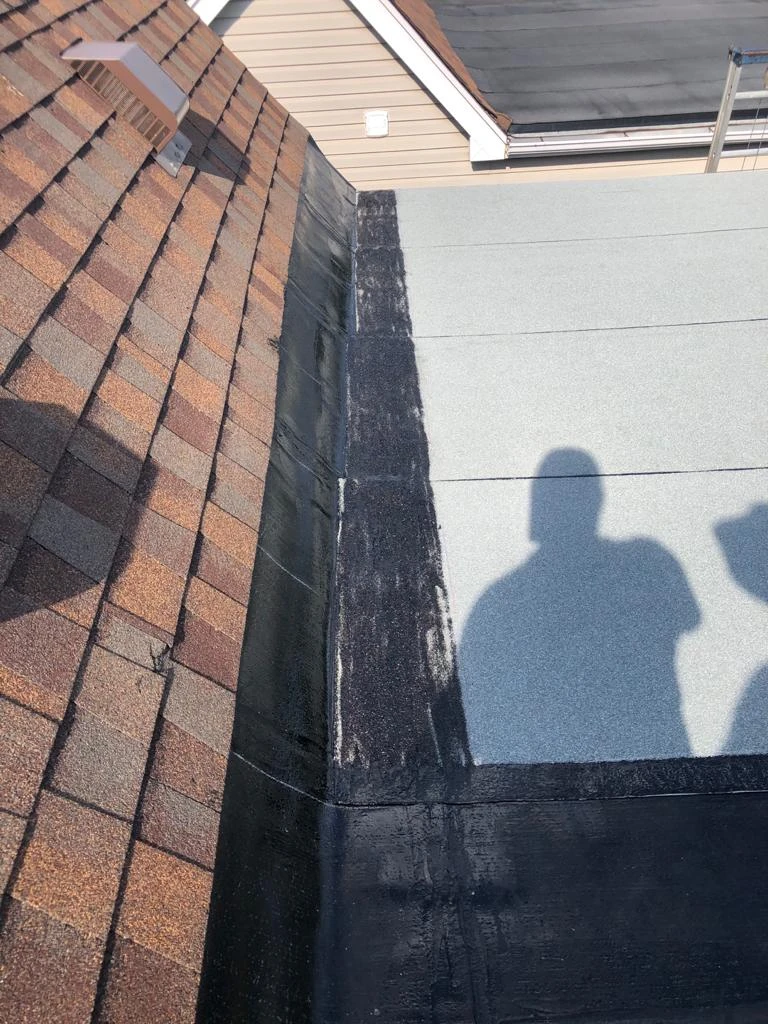
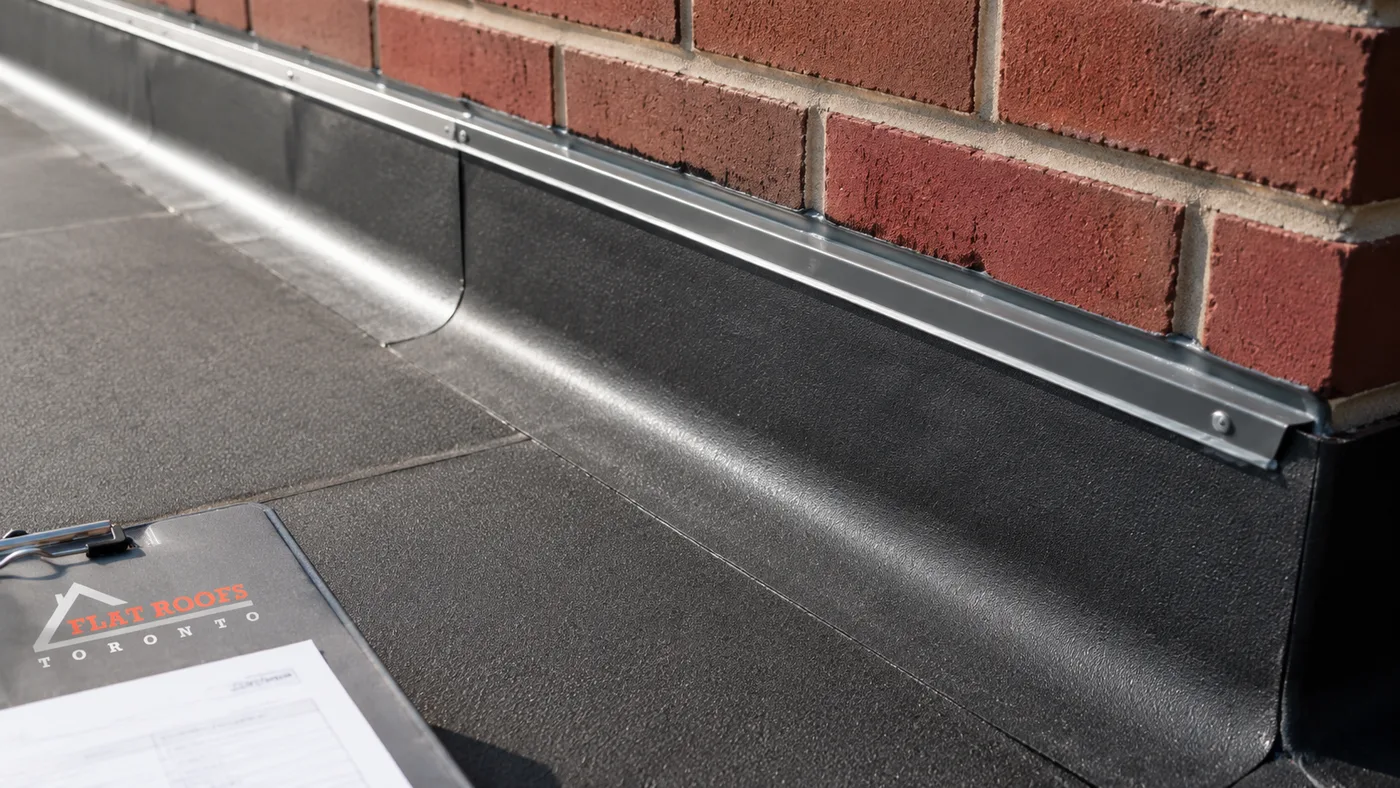
- Failed flashing at walls and parapets. Where the flat roof meets a brick wall or a parapet, the membrane turns up and is capped by metal or counterflashing. Mortar joints in older Oshawa brick homes deteriorate, the counterflashing loosens, and water runs behind the membrane.
- Ponding water. Any water still sitting on the roof more than 48 hours after rain counts as ponding. It accelerates membrane breakdown, adds weight and freezes into an ice lens in winter that levers seams apart.
- Blocked or undersized drains and scuppers. Leaves and granules build up in the drain sump, the strainer disappears under debris, and the roof holds water it was never designed to carry.
- Blisters and ridging. Trapped moisture or air under the membrane expands with heat. A blister is not an emergency on its own, but a blister that ruptures is an open hole.
- Curb and skylight leaks. Skylights, hatches, vents and mechanical curbs all interrupt the membrane. Sealant at these points has a much shorter service life than the membrane itself and is a routine maintenance item, not a permanent detail.
- Fastener backout and deck movement. On mechanically attached systems, fasteners can back out over years of deck movement and telegraph through the membrane as small raised points that eventually wear through.
| Problem | Typical cause | How it usually shows up inside | 2026 repair range |
|---|---|---|---|
| Open seam or lap | Thermal cycling, aged adhesive, foot traffic | Ceiling stain offset from the actual leak point | $350 to $900 |
| Failed wall or parapet flashing | Deteriorated mortar, loose counterflashing | Damp along an interior wall head, peeling paint | $500 to $1,800 |
| Ponding water | Deck deflection, insufficient taper, poor drainage | Slow, seasonal staining that worsens each year | $600 to $2,500 |
| Blocked drain or scupper | Debris, missing strainer, no maintenance | Overflow at edges, water entering at the perimeter | $250 to $700 |
| Skylight or curb leak | Aged sealant, undersized curb, poor flashing | Drip directly at the opening during heavy rain | $450 to $1,600 |
| Ruptured blister or puncture | Trapped moisture, dropped tools, hail | Fast, localised leak during any rainfall | $400 to $1,200 |
The ranges above assume safe access, a single storey or standard two-storey height, and a roof that is otherwise sound. Access complications, which are common on estate-lot homes with wide setbacks or on properties where the flat section sits behind a steep main roof, add to labour on every line item.
Flat Roofing Materials on Oshawa Homes and How Each One Fails
Knowing what is on your roof changes the repair conversation completely. A patch that is correct on modified bitumen will fail within a season on EPDM, because the systems bond differently. Any contractor quoting flat roof repair in Oshawa should identify the membrane before pricing the work, and you should be able to see that identification in writing.
Modified bitumen
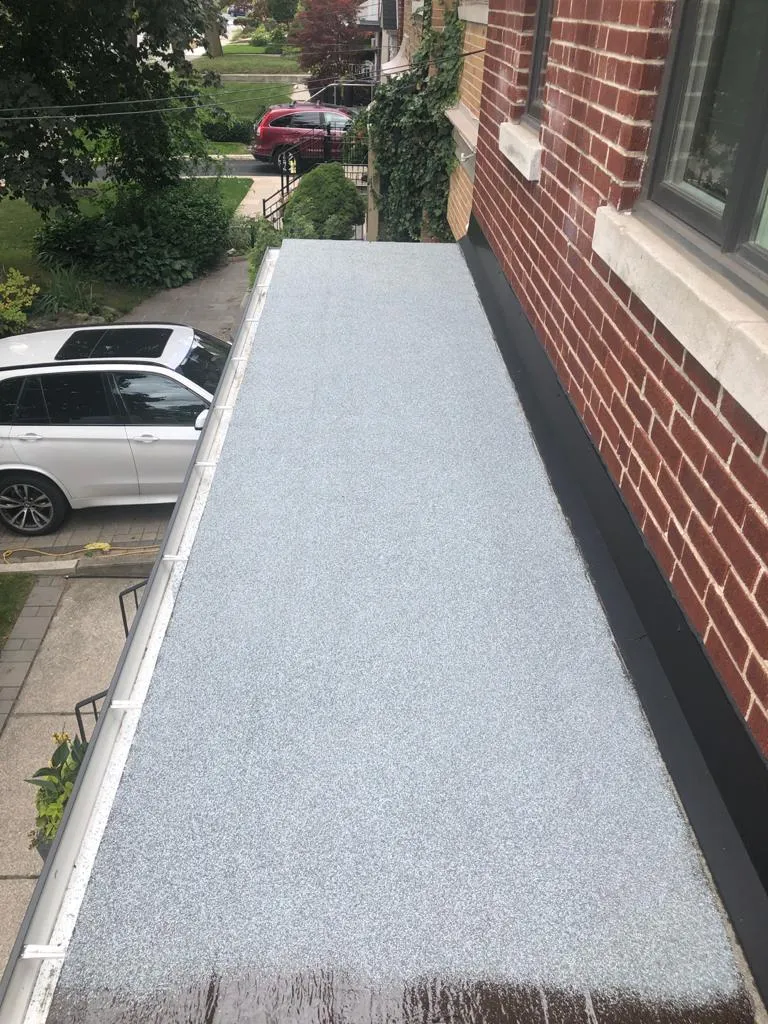
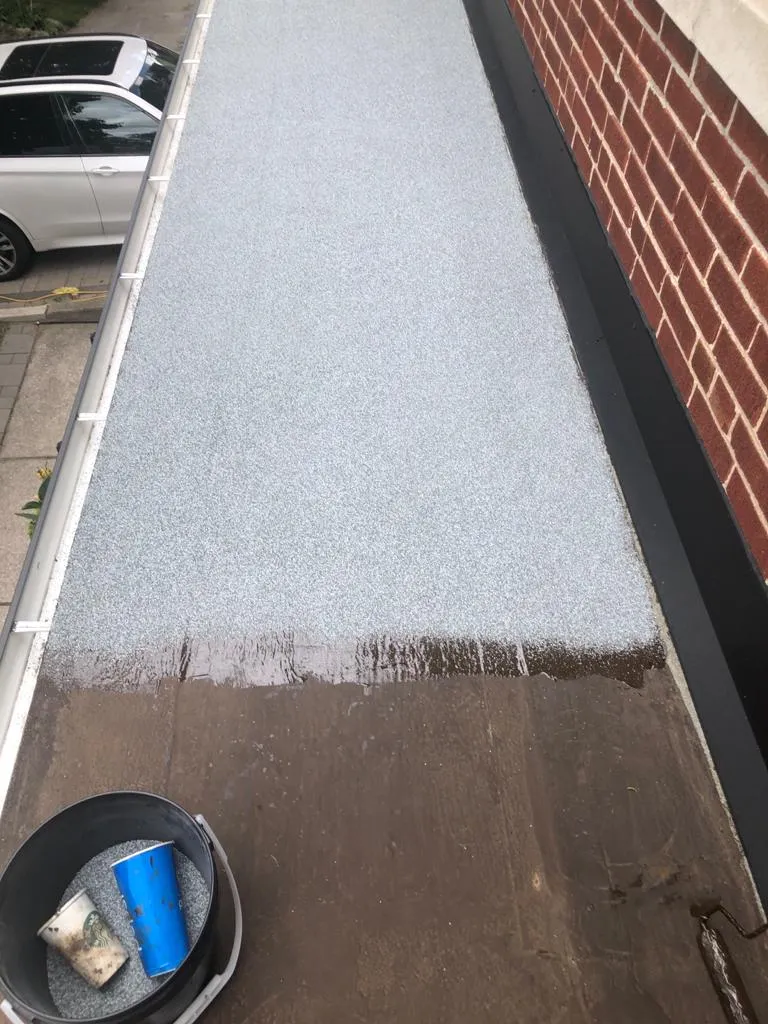
Two-ply torch-applied or self-adhered modified bitumen is the most common residential low-slope system across Durham Region. It repairs well because new plies can be heat-welded into the existing surface, provided the base sheet is dry and intact. Failures show up as open laps, alligatoring of the cap sheet surface and granule loss that exposes the asphalt to ultraviolet light.
EPDM rubber
EPDM is a single-ply black rubber membrane, usually fully adhered on residential work. It is durable and forgiving of movement, but the adhesive at seams ages faster than the sheet itself. Repairs need EPDM-compatible primers and cover tape. Asphalt-based patching compounds attack EPDM and will make the problem worse, which is one of the most common failed do-it-yourself repairs we see.
TPO and PVC
These are heat-welded thermoplastic single-ply membranes, more often specified on newer additions and on commercial work. Repairs are made by welding a patch of the same membrane with a hot-air gun, which requires the right equipment and a clean surface. Older TPO can lose weldability as it ages, which pushes the decision toward section replacement sooner than on other systems.
Built-up tar and gravel
Still present on some older Oshawa homes and garages. Multiple plies of felt and asphalt under a gravel ballast layer. Finding a leak means moving gravel, which makes diagnosis slower and repairs messier. When built-up roofs start leaking in multiple locations, replacement is usually the better economic call.
| Membrane | Typical service life | Repairability | 2026 installed cost per square foot |
|---|---|---|---|
| Modified bitumen, two-ply | 20 to 30 years | Very good, plies heat-welded in | $9 to $15 |
| EPDM rubber, fully adhered | 20 to 30 years | Good, needs compatible primer and tape | $8 to $14 |
| TPO, heat-welded | 20 to 30 years | Good when new, declines with age | $9 to $16 |
| PVC, heat-welded | 25 to 35 years | Good, welds reliably over a long life | $11 to $18 |
| Built-up tar and gravel | 15 to 25 years | Poor, gravel complicates diagnosis | $10 to $16 |
| Liquid-applied coating over sound membrane | 8 to 15 years | Good as a renewal, not a leak fix | $4 to $8 |
Costs above reflect full installation including tear-off and standard insulation on a straightforward residential deck. Small roof areas carry a higher effective cost per square foot because mobilisation, safety setup and disposal do not scale down. A 200 square foot porch canopy will not price at the same rate as a 1,200 square foot rear addition.
What Flat Roof Repair in Oshawa Costs in 2026
Pricing for flat roof repair in Oshawa depends on four things: the size and complexity of the failure, the membrane type, how the crew gets safe access to the roof, and whether the deck or insulation underneath is wet. That last one is the variable that most often turns an estimate into a larger number. If moisture has migrated into the insulation, patching over it traps the water and guarantees a repeat visit.
| Scope of work | What is included | 2026 price range | Typical time on site |
|---|---|---|---|
| Diagnostic inspection and report | Roof walk, moisture check, photos, written findings | $0 to $350, often credited to the repair | 1 to 2 hours |
| Emergency temporary seal | Stop-gap membrane or tarp to halt active water entry | $400 to $1,200 | Same day, 1 to 3 hours |
| Single seam or puncture repair | Clean, prime, patch with compatible material | $350 to $900 | Half day |
| Flashing rebuild at wall or parapet | Strip back, new base and counterflashing, reseal | $700 to $2,400 | 1 day |
| Drain rebuild or new scupper | Sump repair, new drain body, membrane tie-in | $900 to $2,800 | 1 day |
| Partial section replacement, 100 to 300 sq ft | Cut out wet area, replace insulation and membrane | $1,800 to $5,500 | 1 to 2 days |
| Full residential flat roof replacement | Tear-off, new insulation, membrane, all flashings | $9 to $18 per sq ft | 2 to 5 days |
Two notes on reading a quote. First, a repair price with no mention of what happens if wet insulation is found is an incomplete quote. Ask for the unit rate for wet insulation removal before work starts so there is no argument on day two. Second, be careful with prices that look far below the ranges here. Sealant smeared over a seam is not a repair, and it will cost more to remove and redo properly than the original job would have cost done right.
Repair or Replace: Making the Call on an Oshawa Flat Roof
The most common question homeowners ask about flat roof repair in Oshawa is whether the money is better spent on a replacement instead. There is no single rule, but a few thresholds hold up well in practice. Repair is usually the right answer when the membrane is under about 15 years old, the leaks are isolated to one or two identifiable points, the insulation below tests dry, and the surface still has reasonable flexibility. Replacement moves ahead when the membrane is near the end of its service life, when there are multiple active leaks in different areas, when a moisture scan shows widespread saturation, or when the repair cost approaches 30 to 40 percent of a replacement.
Deck condition is the deciding factor more often than membrane age. A plywood deck that has been wet for several seasons loses structural capacity, and no membrane installed over a soft deck will perform. If a foot press produces noticeable deflection between joists, expect deck work in the scope. On older Oshawa additions with plank decking, boards can be replaced individually, which sometimes keeps a replacement affordable when a full deck rebuild would not be.
Timing matters too. Torch-applied and self-adhered systems bond best in warm, dry conditions, so the practical residential window in Durham Region runs from late spring through early autumn. Adhesives and welds can be made to work in cooler weather with the right products and preparation, but a non-urgent replacement booked for July will generally go smoother than the same job in November. Emergency stabilisation, on the other hand, happens whenever it needs to happen.
Permits, Building Code and Insurance Considerations
For most straightforward flat roof repair in Oshawa, no building permit is required. Replacing a membrane like for like, redoing flashings, rebuilding a drain or patching a section are maintenance activities. A permit from the City of Oshawa generally becomes necessary when the work is structural: replacing roof joists, changing the deck framing, altering the roof structure to correct drainage, or converting a roof to a new use such as a walkable deck. Adding significant weight, for example a ballasted or green roof assembly, also triggers structural review. Confirm the requirement with the municipality before booking the work rather than after.
The Ontario Building Code sets specified snow and rain loads by location, and low-slope roofs must be designed to carry both the accumulated snow and the water that can pond if drains block. That is the technical reason drainage is treated as a safety item and not a convenience. It is also why correcting chronic ponding, rather than repeatedly patching the membrane that ponding is destroying, is the better long-term spend.
On insurance: sudden and accidental damage, such as a wind event that lifts a membrane edge or a tree limb that punctures the surface, is often covered. Gradual deterioration and deferred maintenance are typically not. Documentation is what separates the two claims. Keep dated photographs, inspection reports and repair invoices, and get written scope and photographs from any contractor who works on the roof. If a storm causes damage, photograph the condition before any temporary repair goes on, then stabilise the roof promptly, because most policies require the homeowner to prevent further loss.
How a Professional Flat Roof Repair Is Carried Out
A properly run flat roof repair in Oshawa follows a predictable sequence, and knowing it makes it easier to judge whether a contractor is doing thorough work or a quick cover-up.
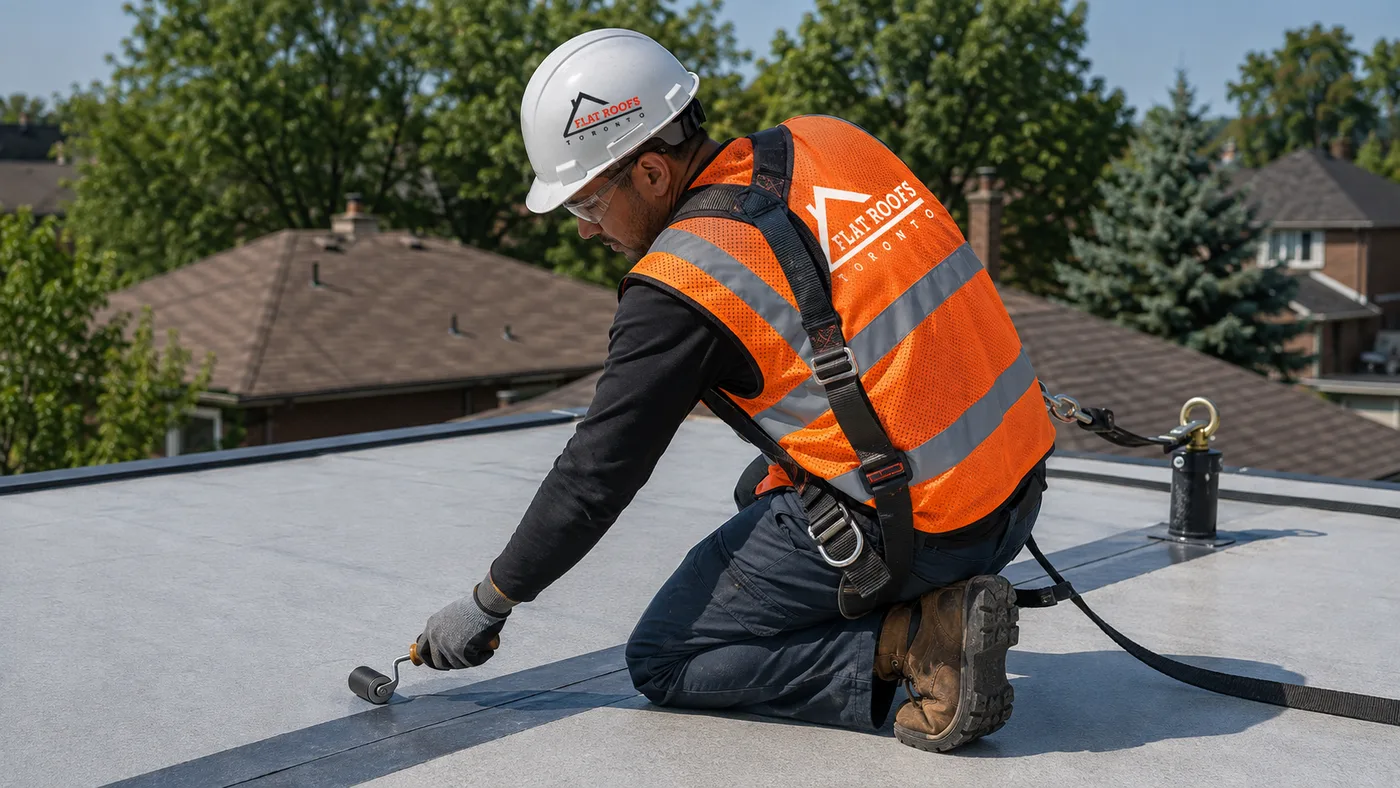
- Access and fall protection. Anchor points, harnesses and edge protection go up before anyone starts working. Ontario requires fall protection on low-slope roofs, and a crew that skips it is telling you something about the rest of their standards.
- Diagnosis. The roof is walked in full, not just at the reported leak. Seams, flashings, curbs and drains are checked, and suspected wet areas are probed or scanned. Water travels under membranes, so the entry point is rarely directly above the interior stain.
- Removal of failed material. Compromised membrane is cut back to sound material. Wet insulation is removed entirely. Anything left damp underneath will feed the same leak again.
- Deck assessment and repair. The exposed deck is checked for rot and deflection, and damaged sheathing or planks are replaced before anything goes back on.
- Rebuild in compatible layers. Insulation, base sheet and cap or single-ply patch are installed with the correct primers, adhesives or welds for the existing system, with laps extending well past the damaged area.
- Detail work and drainage check. Flashings, terminations and drains are finished last, then the roof is flood-tested or water-tested where practical to confirm the repair holds.
- Cleanup and documentation. Debris removed, photographs of the completed work provided, and the warranty terms stated in writing.
If you want to see the range of low-slope work carried out on homes like yours, the flat roofing services available to Oshawa homeowners cover repairs, section rebuilds and full replacements on residential and commercial low-slope roofs across the eastern GTA.
Emergency Situations and When Not to Wait
Not every problem can wait for a scheduled flat roof repair in Oshawa. Some conditions justify calling for emergency roof repair the same day rather than scheduling for next week. Active dripping into living space, water tracking near light fixtures or electrical panels, a visibly sagging ceiling, a membrane lifted or peeled back by wind, or standing water that has not drained several days after rain all fall into that category. Water near electrical service is a safety issue first and a roofing issue second, so shut off power to the affected circuit and keep the area clear.
Temporary stabilisation buys time and limits the damage, but it is not the repair. A proper fix follows once the roof is dry enough to work on and the full extent of the moisture is known. Homeowners sometimes leave a temporary seal in place through an entire season because the drip stopped. That is how a $700 repair becomes a $6,000 section rebuild, because the trapped moisture keeps working on the insulation and deck the whole time.
Preventive Maintenance That Keeps Repair Costs Down
The cheapest flat roof repair in Oshawa is the one you never need. Most low-slope roofs fail early because nobody looked at them. A flat roof is out of sight, so unlike a shingle roof it never prompts an inspection just by looking worn from the street. A simple annual routine changes the economics substantially.
- Twice yearly visual inspections, ideally in spring after the freeze and thaw season and in late autumn once leaves have fallen.
- Clear drains, scuppers and strainers at least twice a year, and after any significant storm. This is the single highest-value maintenance task on a flat roof.
- Check sealant at every penetration. Skylight curbs, vents and hatches use sealant that has a shorter life than the membrane and needs renewal on a cycle, not once at installation.
- Trim overhanging branches so debris load and abrasion drop.
- Look at the ceiling below during and after heavy rain. Early staining is far cheaper to act on than a saturated assembly.
- Keep traffic off the membrane. If the roof needs regular access for mechanical equipment, install proper walkway pads rather than accepting wear paths.
- Address attic and interior humidity. Moisture pushed up from inside condenses under the membrane and mimics a leak. Ventilation and insulation problems and roof problems are often the same problem.
An annual maintenance visit typically runs $250 to $600 for a residential low-slope roof in Durham Region, which is less than the cost of a single reactive repair. It also produces the photo record that makes an insurance claim straightforward if a storm event ever does occur.
Choosing a Contractor for Flat Roof Repair in Oshawa
Low-slope roofing is a different trade from shingle roofing. Many general roofers install shingles well and treat flat sections as an afterthought, which is exactly how mismatched patches and asphalt-on-EPDM failures happen. When you are hiring for flat roof repair in Oshawa, look for a contractor whose primary work is low-slope membrane systems. Ask which membrane they identified on your roof and how they know. Ask what happens if wet insulation is found. Ask for proof of WSIB coverage and liability insurance, and get the warranty terms in writing with the workmanship period stated separately from any manufacturer material warranty.
Written scope matters more than the headline price. A quote that says “repair leak” gives you nothing to hold anyone to. A quote that specifies the area, the membrane type, the layers being replaced, the flashing details being rebuilt and the disposal included is a document you can actually enforce. Photographs before and after should be standard, not something you have to ask for.
Frequently Asked Questions
How much does flat roof repair in Oshawa cost?
How long should a flat roof last in Durham Region?
Can flat roof repair in Oshawa be done in winter?
Do I need a permit to repair a flat roof in Oshawa?
Why is the ceiling stain nowhere near the roof leak?
Is ponding water on a flat roof always a problem?
Book Your Flat Roof Repair in Oshawa Today
Flat Roofs Toronto handles flat roof repair in Oshawa as a Toronto-area low-slope roofing specialist serving homeowners and property managers throughout Oshawa and the wider Durham Region. Our crews work exclusively on flat and low-slope systems, which means your roof is identified correctly, repaired with compatible materials and documented properly, whether the job is a single seam, a full flashing rebuild or a section replacement with new insulation.
Call us today at (647) 333-3528 or request a free consultation to have your roof inspected and get a written scope before the next heavy rain.
Flat Roofs Toronto serves Oshawa, Whitby, Ajax, Pickering and communities across Durham Region and the Greater Toronto Area.