
Autumn is a popular time to replace a flat roof. The summer rush has eased, the heat is gone, and owners who noticed a leak during summer storms want it solved before the cold arrives. A late-season flat roof installation can turn out every bit as well as one done in June, but only if the crew respects what cooler temperatures, heavy dew and short days do to roofing materials. Every membrane, adhesive and primer has limits set by its manufacturer, and a good contractor plans the job around them rather than hoping the weather cooperates.
This guide explains how temperature affects each common flat roof system, where to find the actual limits for your products, how shorter days change the way a job is run, and why booking early in the autumn gives you far more room to do it right.
Why Temperature Matters for a Late-Season Flat Roof Installation
Roofing materials are chemistry. Adhesives cure, solvents evaporate, bitumen softens and flows, thermoplastics melt and fuse. All of those reactions slow down in the cold. Some stop working reliably below a certain point, and some that seem fine on the day fail months later because they never bonded fully.
Temperature is not the only factor. Moisture is just as important in autumn. A roof deck that looks dry at noon can carry a thin film of dew or frost in the morning, and many autumn afternoons cool quickly enough for dew to form again before the crew packs up. Almost every roofing product requires a clean, dry substrate, so moisture often limits the working day more than the thermometer does.
The limits are specific to each product. That is why this guide does not give you a single universal minimum temperature for “flat roofing”: there is no such number. The figures that matter are the ones on the manufacturer’s current data sheets and installation instructions for the exact products going on your roof. If you are planning a flat roof replacement this autumn, ask your contractor which products they are using and what those documents say.
How Each Membrane Type Behaves in Cool Weather
| System | What cold affects | What to check on the data sheet | Common cold-weather practice |
|---|---|---|---|
| Torch-applied modified bitumen | Rolls stiffen, laps need more heat, moisture on the substrate | Minimum application temperature, roll storage conditions, primer requirements | Store rolls warm, unroll to relax before installing, dry the substrate first |
| Self-adhered modified bitumen | Adhesive tack drops sharply, laps may not seal | Minimum application and substrate temperatures, primer type, low-temperature versions | Use the recommended primer, roll laps firmly, install during the warmest hours |
| Cold-applied adhesives and primers | Slower solvent flash-off, longer cure times, thickening | Application temperature range, flash-off and cure times, storage temperature | Keep containers warm until use, allow extra time before closing layers |
| Heat-welded TPO or PVC | Weld settings change with air and membrane temperature, wind cools seams | Welding guidelines, adhesive limits for fully adhered systems | Test welds at the start of each day and when conditions change |
| EPDM with adhesives and tapes | Bonding adhesives and seam tapes lose tack in cold | Adhesive and primer temperature limits, low-temperature adhesives | Warm materials, protect seams from dew, follow extended cure guidance |
| Liquid-applied membranes | Cure slows, rain or dew before cure damages the film | Minimum temperature, dew point margin, cure times | Apply only when a dry curing window is forecast |
Torch-on and heat-welded systems
Heat-applied systems have an advantage in cool weather because the installer brings the heat. Torch-applied modified bitumen and heat-welded thermoplastic membranes are often the systems contractors prefer late in the year for that reason. They still have limits. Modified bitumen rolls that have sat outside on a cold night become stiff and can crack at the fold, so crews typically store them in a warm space and unroll them to relax before installation. Torching over frost or dew traps moisture in the assembly. With thermoplastics, a weld that is perfect at midday may be weak when the membrane is cold at 4 o’clock, which is why crews run test welds and adjust machine settings through the day.
Adhesives and primers
This is where cold weather causes the most trouble. Primers and bonding adhesives rely on solvents evaporating or chemical curing, both of which slow down in the cold. A primer that has not flashed off properly can prevent the membrane above from bonding. Adhesive left in a cold truck overnight thickens and does not spread correctly. Many manufacturers make low-temperature versions of their adhesives and primers for autumn and winter work; if your installation relies on adhesives, ask whether those are being used.
Self-adhered membranes
Self-adhered products are convenient and avoid open flame, which is a real advantage near wood framing or on tight urban lots. But the factory adhesive loses tack as temperatures fall. Most require a primer and firm rolling, and some manufacturers publish specific minimum temperatures for both air and substrate. When temperatures sit near the lower limit, laps may look sealed but separate later. For a late-season flat roof installation using self-adhered membranes, working in the warmest part of the day and checking laps carefully are essential.
Deck, Insulation and Flashing Details in Cooler Weather
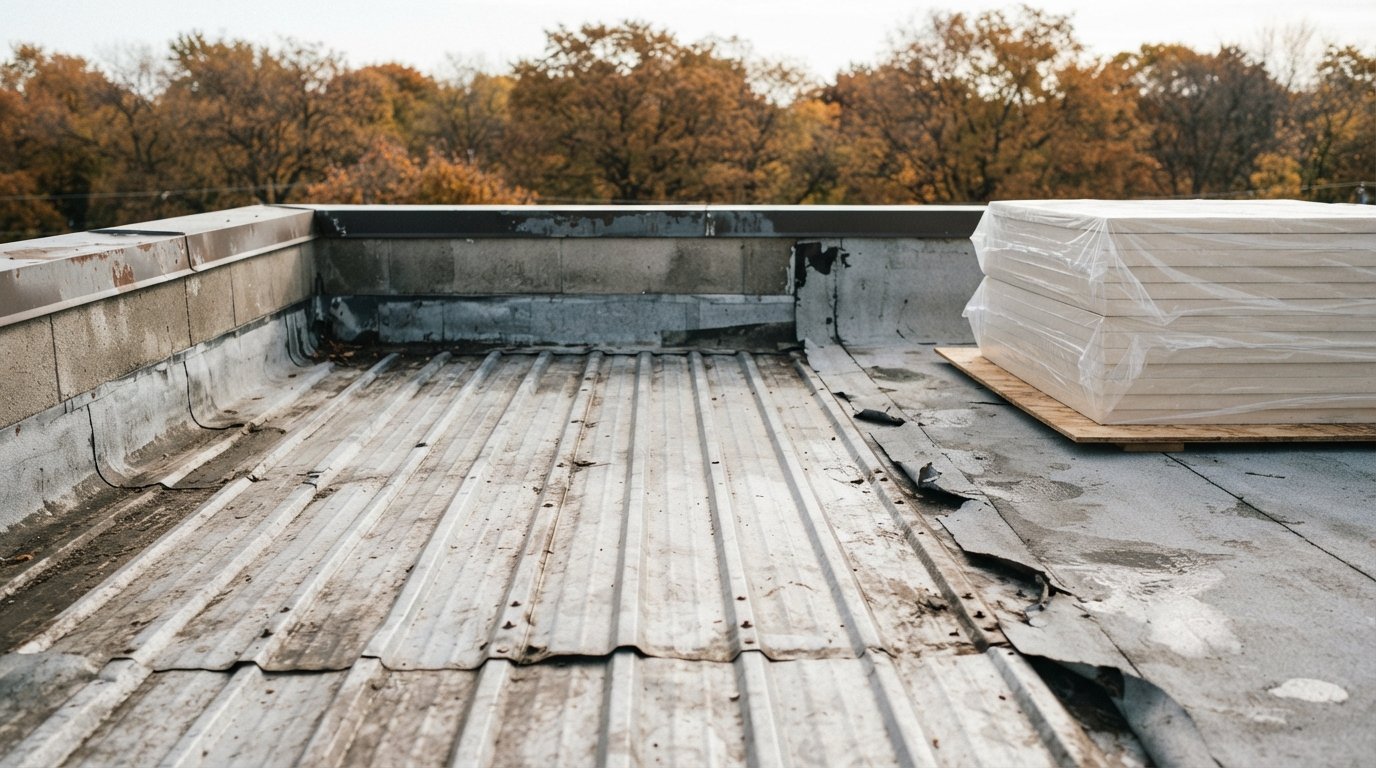
The membrane gets most of the attention, but the layers underneath are where a late-season flat roof installation most often goes wrong. Once the old roof is off, the deck is exposed to the same dew and frost as everything else.
The deck
Wood decks absorb moisture overnight and can feel dry on the surface while still damp just below it. Crews should check suspect boards before covering them, replace any soft or rotted sections found during tear-off, and never install a vapour retarder or insulation over a deck with visible frost or damp patches. Trapping that moisture under a new roof leads to the same problems as a leak, only slower.
Insulation
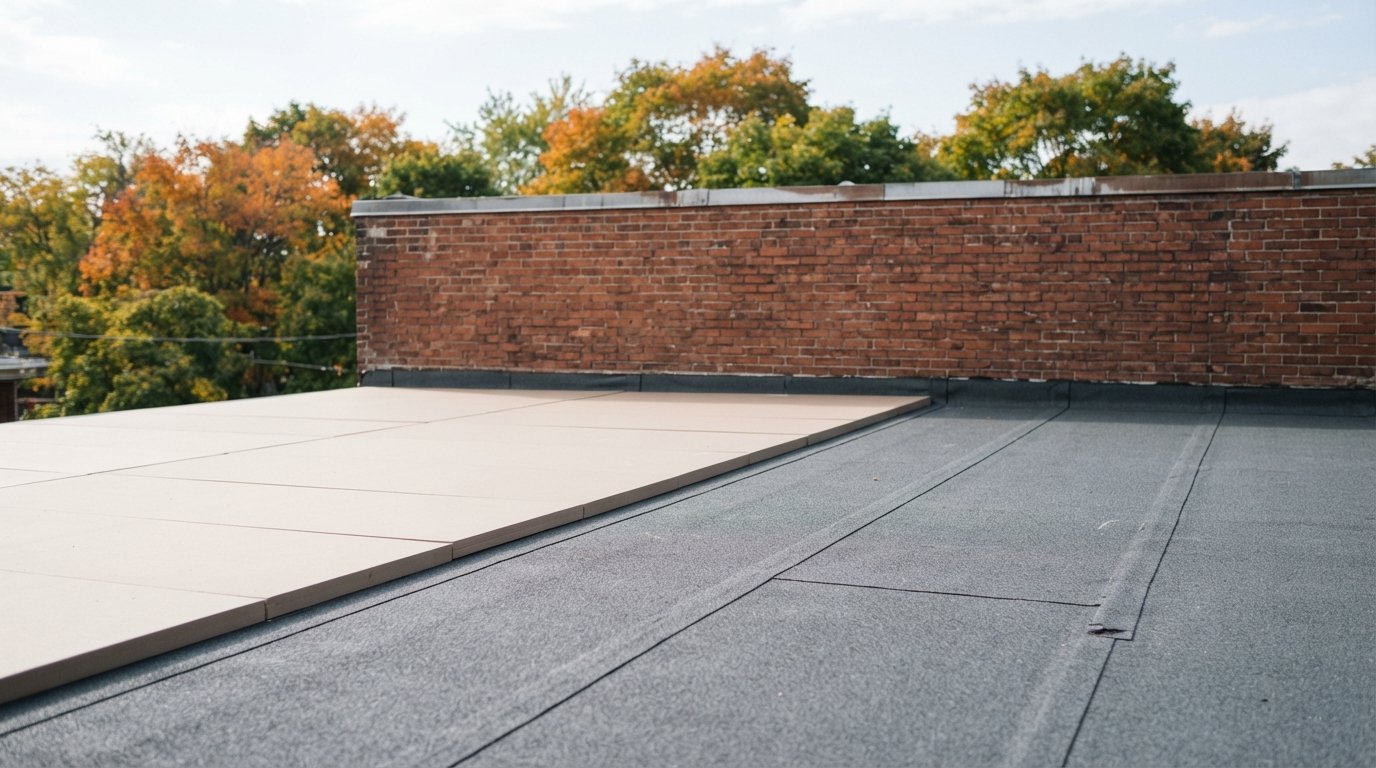
Rigid insulation boards must go down dry. Boards that were rained on or stored on the ground should be set aside. Adhesives used to attach insulation, including low-rise foam adhesives, have their own temperature and cure requirements on the manufacturer’s data sheet, and they may need longer before the next layer goes on.
Flashings
Parapets, curbs and walls are often shaded and stay colder than the open roof, so flashings are frequently the hardest part to install in autumn. A good crew plans flashing work for the warmest part of the day and gives vertical laps extra attention, since a cold, poorly bonded flashing is a leak waiting for the first thaw. On a late-season flat roof installation, it is worth asking your contractor how and when the flashings will be done.
Shorter Days Change How the Job Is Run
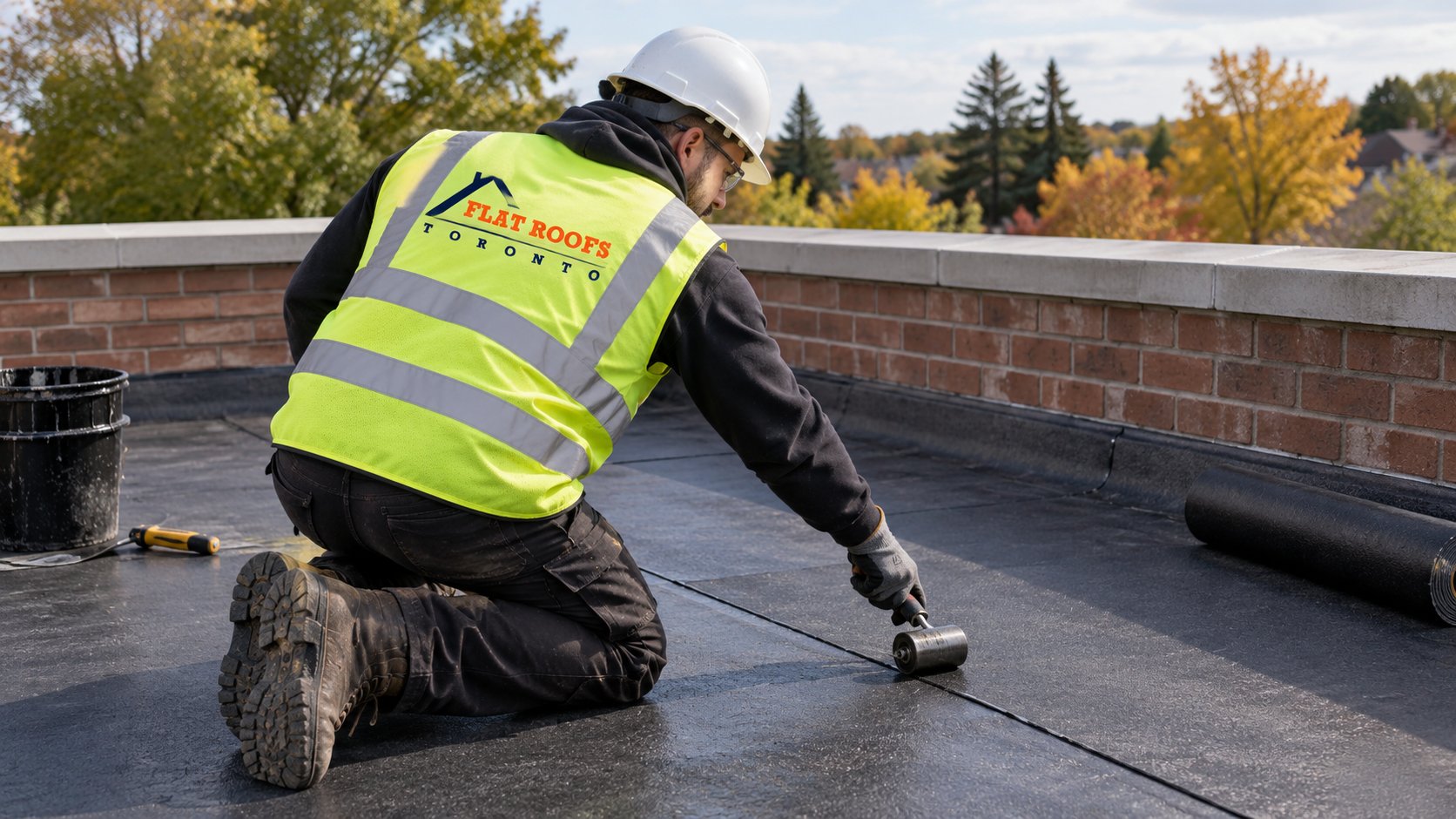
By late October in the GTA, usable daylight is noticeably shorter than in summer, and the warmest, driest part of the day is shorter still. A crew may lose the first hour to dew and the last hour to falling temperatures. That affects the way a good contractor schedules a late-season flat roof installation:
- Smaller sections each day. Only remove as much old roofing as can be fully replaced and sealed before the end of the day.
- Night seals every evening. Any exposed edge of new work is sealed to the existing roof or to the deck so rain overnight cannot get under it.
- Dry insulation only. Insulation that gets wet must be replaced, not covered. Materials are stored off the roof surface and covered.
- Forecast-driven decisions. Tear-off days are chosen around dry forecasts, and crews are willing to stop and seal up rather than push into rain.
- Buffer days. A job that would take three days in summer may be scheduled across four or five in November.
None of this is a sign of a slow crew. It is how a late-season flat roof installation should be managed. The contractor to worry about is the one who promises the same speed in November as in July.
Why Booking Early Autumn Matters
The most practical advice for anyone planning a late-season flat roof installation is simple: book early. September and early October generally offer the best combination of mild temperatures, drier mornings and longer days. By mid to late November, the number of workable days drops, and any weather delay can push the job into December, when conditions are hardest on the crew and the materials.
| Period | Typical conditions | What it means for your roof |
|---|---|---|
| Early to mid September | Mild days, long daylight, mostly dry mornings | Almost any system can be installed with normal scheduling |
| Late September to mid October | Cooler mornings, more dew, shortening days | Good installation window; crews adjust start times and daily sections |
| Late October to November | Cold mornings, frequent frost and rain, short days | Product limits matter more; heat-applied systems often preferred |
| December onward | Freezing temperatures, snow risk | Torch-applied modified bitumen and heat-welded TPO or PVC are installed through winter with cold-weather practices; adhesive and cold-applied systems are the most limited by temperature, so a full replacement may need to wait or be adapted |
These are general patterns, not promises; every autumn is different. The point is that each week you wait reduces the number of good installation days available. Contractors’ schedules also fill up as other owners realize the same thing, so waiting until the first cold snap to call often means a slot in November or a spring start.
If it gets too late
Sometimes a roof fails late in the season and replacement cannot safely wait, or conditions no longer allow a proper full installation. In that case, the sensible approach is often a targeted repair or temporary protection to get through winter, followed by a full replacement in spring. A reputable contractor will tell you when conditions are no longer suitable rather than install a roof that will not bond properly. If water is already coming in, our emergency flat roof repair service can stabilize things until the weather allows a proper replacement.
Good Practice Versus Red Flags
You do not need to be a roofer to judge whether a late-season job is being handled properly. These are the signs to look for.
| Good practice | Red flag |
|---|---|
| Contractor names the products and refers to their data sheets | “Temperature doesn’t matter with our system” |
| Rolls and adhesives stored somewhere warm and dry | Materials left on the roof or in an open truck bed overnight |
| Work starts after dew has cleared from the deck | Membrane going down over visible frost or damp surfaces |
| Only a section the crew can finish is opened each day | Whole roof torn off at once with a tarp over it |
| Night seals installed at the end of every day | Edges of new work left open overnight |
| Test welds or lap checks done as temperatures change | No checks after the morning setup |
| Contractor willing to reschedule for bad weather | Pressure to finish regardless of the forecast |
Warranty Terms and Documentation
Manufacturer warranties on roofing systems generally depend on the products being installed according to the manufacturer’s instructions, which include temperature and substrate requirements. If a system is installed outside those limits, coverage may be affected. The details vary by manufacturer and product, so read the manufacturer’s current warranty documents and ask your contractor how they will meet the installation requirements in cooler weather.
It is reasonable to ask for a short record of the job: dates, products used, weather conditions and photos of key stages such as the deck, insulation, vapour retarder and flashing details before they are covered. For an autumn installation, that record is especially useful if questions come up later.
Planning Checklist for an Autumn Replacement
- Get your inspection and quotes as soon as possible.
- Ask each contractor which membrane system they recommend and why it suits the time of year.
- Ask for the product names so you can look at the manufacturer’s data sheets yourself.
- Confirm how many days the job will take and how weather delays are handled.
- Agree on how the roof will be protected overnight and during rain.
- Clear access, parking and a material staging area in advance to save daylight.
- Check whether your project needs a building permit; requirements depend on the scope, so confirm with your municipality.
- Plan interior protection, such as covering belongings in rooms below, in case of dust from tear-off.
You can see examples of finished roofs on our flat roofing projects page, and our flat roofing systems guide compares the membranes in more detail.
Is it safe to replace a flat roof in October or November?
What is the minimum temperature for installing a flat roof?
Which roofing system works best in cool weather?
Can self-adhered membranes be installed in autumn?
What happens if the weather turns during my replacement?
When should I book an autumn roof replacement?
Book Your Late-Season Flat Roof Installation Now
The best autumn roofing days go quickly. Flat Roofs Toronto plans each replacement around the products’ published limits, the forecast and the shorter days, so your new roof bonds properly and is fully sealed before winter settles in.
Call us today at (647) 333-3528 or request a free estimate.
Serving homeowners and property owners across Toronto and the GTA.