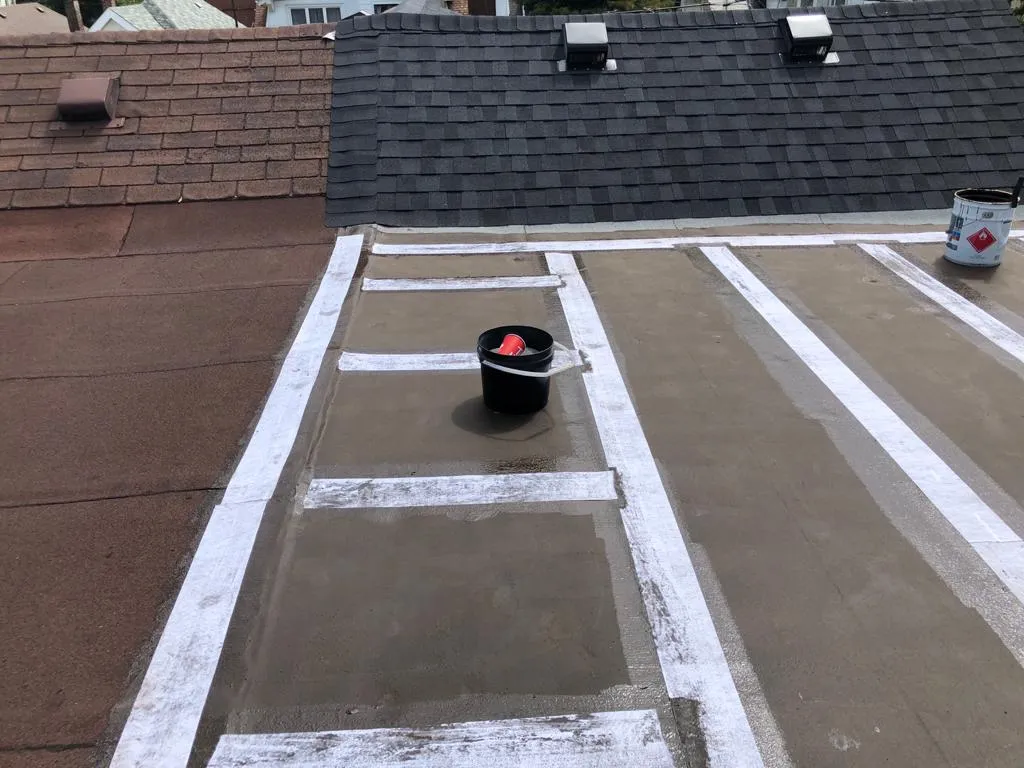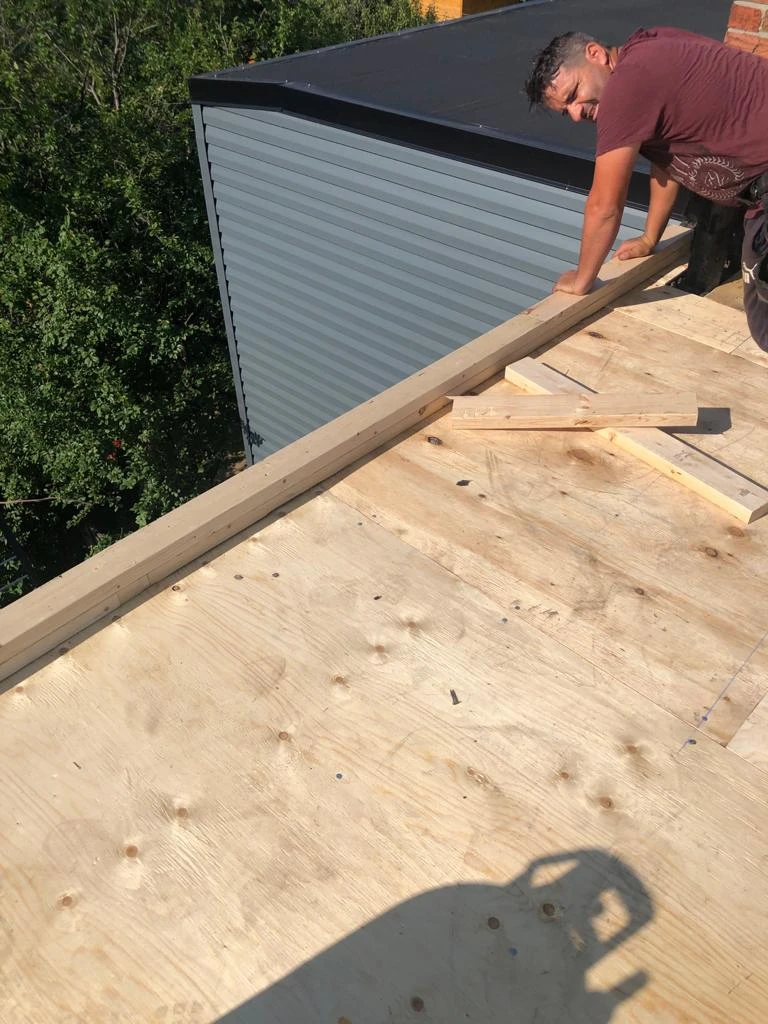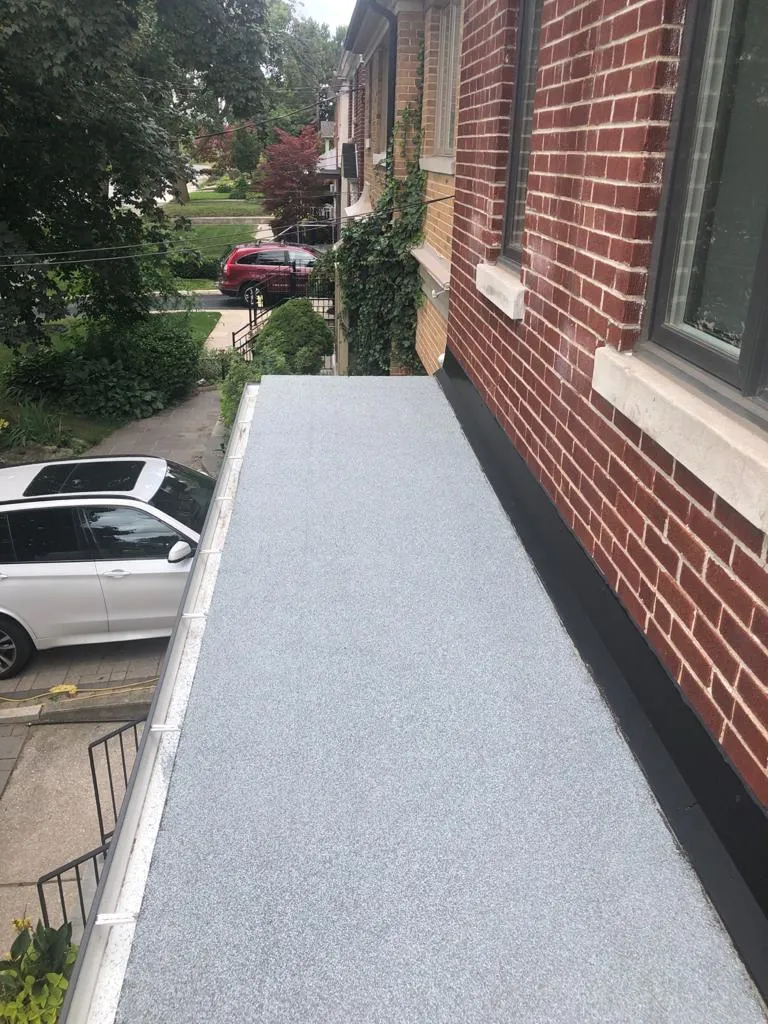

Flat roofs are far more common across Pickering than most homeowners expect. They sit over rear additions, attached garages, sunroom bump-outs, porch overhangs and the low-slope sections of the split-level and side-split homes built through the 1960s and 1970s. If you are researching flat roofing Pickering options because a ceiling stain appeared after a spring thaw, or because a home inspector flagged ponding water on your addition, this guide covers what actually matters: materials, realistic 2026 Ontario pricing, drainage, code requirements and how to read a contractor’s proposal without guessing.
Pickering sits on the north shore of Lake Ontario, which means its roofs deal with lake-effect moisture, freeze-thaw cycling from late autumn through March, and summer surface temperatures that can push a dark membrane well past 60 degrees Celsius. Those conditions punish weak seams and shallow drainage more than anything else, which is why flat roofing Pickering work is judged on details rather than on brand names. Everything below is written with that reality in mind, and with the practical differences between Pickering’s older brick homes, its newer north-end subdivisions and its rural estate lots on the fringes of Seaton and Claremont.
Why Flat Roofing Pickering Homes Need a Different Approach
A sloped shingle roof sheds water by gravity. A flat roof does not. Every low-slope assembly in Ontario is really a controlled drainage system with a waterproof skin over top, and that distinction drives every decision in a flat roofing Pickering project. A shingle roof can tolerate a slightly sloppy nail pattern. A membrane roof cannot tolerate a single unsealed seam, because water has time to sit and find it.
The second difference is thermal movement. Flat roofs in the Durham Region swing through an enormous temperature range across a single year. A membrane that is fastened too rigidly at the perimeter will eventually tear at its terminations. A membrane that is fully adhered with the right primer and flashing detail will not. When homeowners compare quotes for flat roofing Pickering work, the price gap between two proposals is usually hiding in exactly these details: perimeter termination, flashing height, and how the roof ties into the adjoining wall or shingle field.
The third difference is inspection. A homeowner can spot a missing shingle from the driveway. Nobody spots a pinhole in a membrane from ground level. That is why flat roofing Pickering maintenance is scheduled rather than reactive, and why a roof that gets looked at twice a year routinely outlives an identical roof that gets looked at only when the ceiling stains.
Where Flat Roofs Actually Appear on Pickering Homes
Pickering’s housing stock is genuinely mixed, and the type of flat roof you have usually tracks the era your home was built in. Identifying your assembly is the first step in scoping any flat roofing Pickering project accurately.
- Postwar and 1960s to 1970s bungalows and side-splits in the older south-end neighbourhoods frequently have a low-slope section over a rear extension, a carport conversion or a covered entry. Many of these are still on their second or third generation of built-up or modified bitumen roofing.
- Older brick homes near the lake often carry small flat sections over bay projections and rear mudrooms. These are small in area but high in detail count, which makes flashing quality more important than membrane brand.
- Newer north-end subdivisions built from the 1990s onward tend to use flat roofing over garage bump-outs, second-storey overhangs and the occasional contemporary-styled section. Membranes here are usually single-ply and easier to replace cleanly.
- Estate lots and rural properties on Pickering’s northern edges often include detached garages, workshops and additions with substantial low-slope areas, sometimes with limited access for materials.
- Modern infill and custom builds increasingly use full flat roofs for architectural reasons, often combined with roof drains rather than scuppers.
Knowing which of these categories your home falls into changes the scope of work substantially. A 300 square foot addition roof and a 1,400 square foot full flat roof are different projects with different crews, different disposal costs and different permit exposure. Homeowners comparing flat roofing Pickering estimates should confirm that every bidder has measured the same area and the same number of penetrations.
Flat Roofing Membrane Options Compared
Three systems account for the overwhelming majority of residential flat roofing Pickering installations. Each has a legitimate use case, and the right answer depends on roof size, sun exposure, foot traffic and budget.
Modified bitumen (Mod-Bit) is a two-ply torch-applied or self-adhered asphalt system. It is tough, forgiving on irregular decks and repairs easily, which makes it a sensible choice on older homes with awkward geometry. EPDM is a synthetic rubber single-ply, usually black, that handles cold extremely well and installs quickly on open areas. TPO is a white or light grey thermoplastic single-ply with heat-welded seams, which gives it excellent seam strength and meaningful summer heat reflection.
| System | Typical service life | 2026 installed cost (per sq ft) | Best suited to |
|---|---|---|---|
| 2-ply modified bitumen | 20 to 30 years | $11 to $16 | Older additions, complex layouts, decks with many penetrations |
| EPDM rubber (fully adhered) | 20 to 30 years | $10 to $15 | Open, simple rectangles; strong cold-weather performance |
| TPO (heat-welded seams) | 20 to 30 years | $11 to $17 | Sun-exposed roofs where summer heat gain matters |
| PVC single-ply | 25 to 35 years | $14 to $20 | Roofs near kitchen exhaust or chemical discharge |
| Built-up roofing (tar and gravel) | 15 to 25 years | $12 to $18 | Legacy repairs and matching existing assemblies |
The honest summary: on a well-prepared deck with proper drainage, all three mainstream systems will outperform their warranty if installed correctly, and all three will fail early if they are not. Workmanship outweighs product selection on residential flat roofing Pickering projects almost every time. If a quote leads with a brand name and says nothing about slope correction, flashing height or fastener pattern, treat it as incomplete.
What Flat Roofing Costs in Pickering in 2026
Pricing in Durham Region tracks the wider GTA market, with modest savings on access and staging compared with downtown Toronto work. The figures below are realistic ranges for flat roofing Pickering projects in 2026, including tear-off, disposal, new membrane, flashing and standard perimeter metal. They exclude structural repair, which is priced only after the deck is exposed.
| Project scope | Approximate area | 2026 price range | Typical duration |
|---|---|---|---|
| Small addition or porch roof | 200 to 400 sq ft | $2,800 to $6,000 | 1 day |
| Garage or rear extension roof | 400 to 700 sq ft | $5,500 to $11,000 | 1 to 2 days |
| Mid-size residential flat roof | 700 to 1,200 sq ft | $9,000 to $19,000 | 2 to 3 days |
| Full flat roof, larger home | 1,200 to 2,000 sq ft | $16,000 to $32,000 | 3 to 5 days |
| Targeted leak repair | Single area | $500 to $2,200 | Half day |
| Added tapered insulation package | Per roof | $4 to $9 per sq ft | Adds 1 day |
Three line items push a flat roofing Pickering quote toward the upper end of these ranges. The first is deck replacement, which is common on 1960s and 1970s roofs where plank sheathing has softened around a long-term leak. The second is added insulation to meet current energy expectations, particularly on additions that were never properly insulated to begin with. The third is tapered insulation to correct chronic ponding, which is the single most valuable upgrade on a roof that has never drained properly.
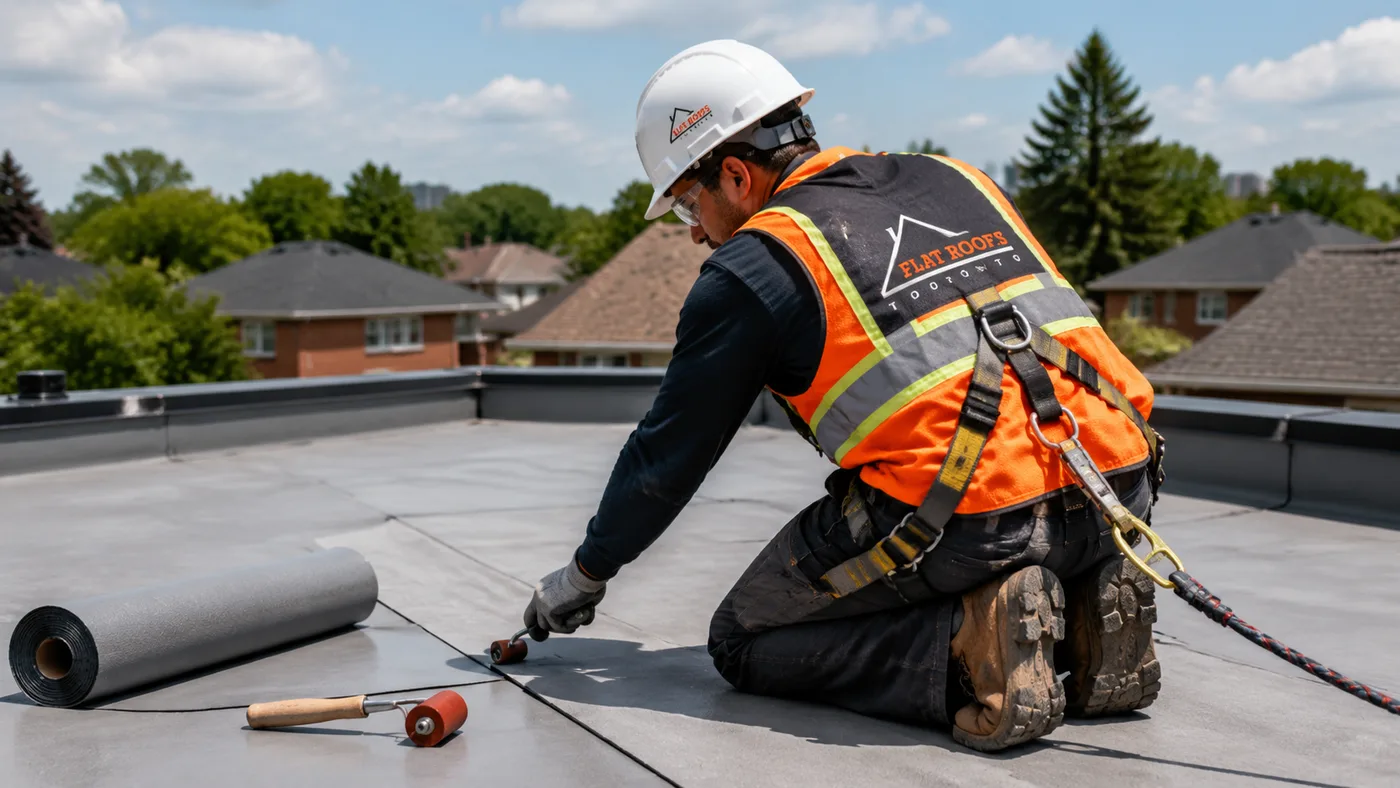
Drainage, Slope and the Ontario Building Code
Ontario Building Code requires that roofs be designed to drain, and in practice that means a low-slope residential roof should be built with a minimum slope of roughly 1:50, or about 2 percent. That works out to roughly 2 centimetres of fall per metre of run. Many older Pickering additions were framed dead level, and after decades of deflection they now hold water in the middle. Correcting that slope is often the highest-value part of a flat roofing Pickering replacement.
Standing water is not automatically an emergency. A shallow film that clears within 48 hours after rainfall is tolerable on most membranes. Persistent ponding is a different matter, because it accelerates ultraviolet and chemical degradation, magnifies freeze-thaw stress in winter and adds real weight. Roughly 25 millimetres of standing water across 1,000 square feet is over 900 kilograms of load the framing was probably never designed to carry indefinitely.
There are three practical fixes. Tapered insulation builds a positive slope into the assembly without touching the framing, which is usually the cleanest solution. Adding or relocating a scupper or roof drain improves the outlet where the slope is adequate but the water has nowhere to go. Structural re-framing is the most invasive and is reserved for decks that have deflected badly or where rot has compromised the joists. Any competent proposal for flat roofing Pickering replacement should name which of these three approaches it is using, and why.
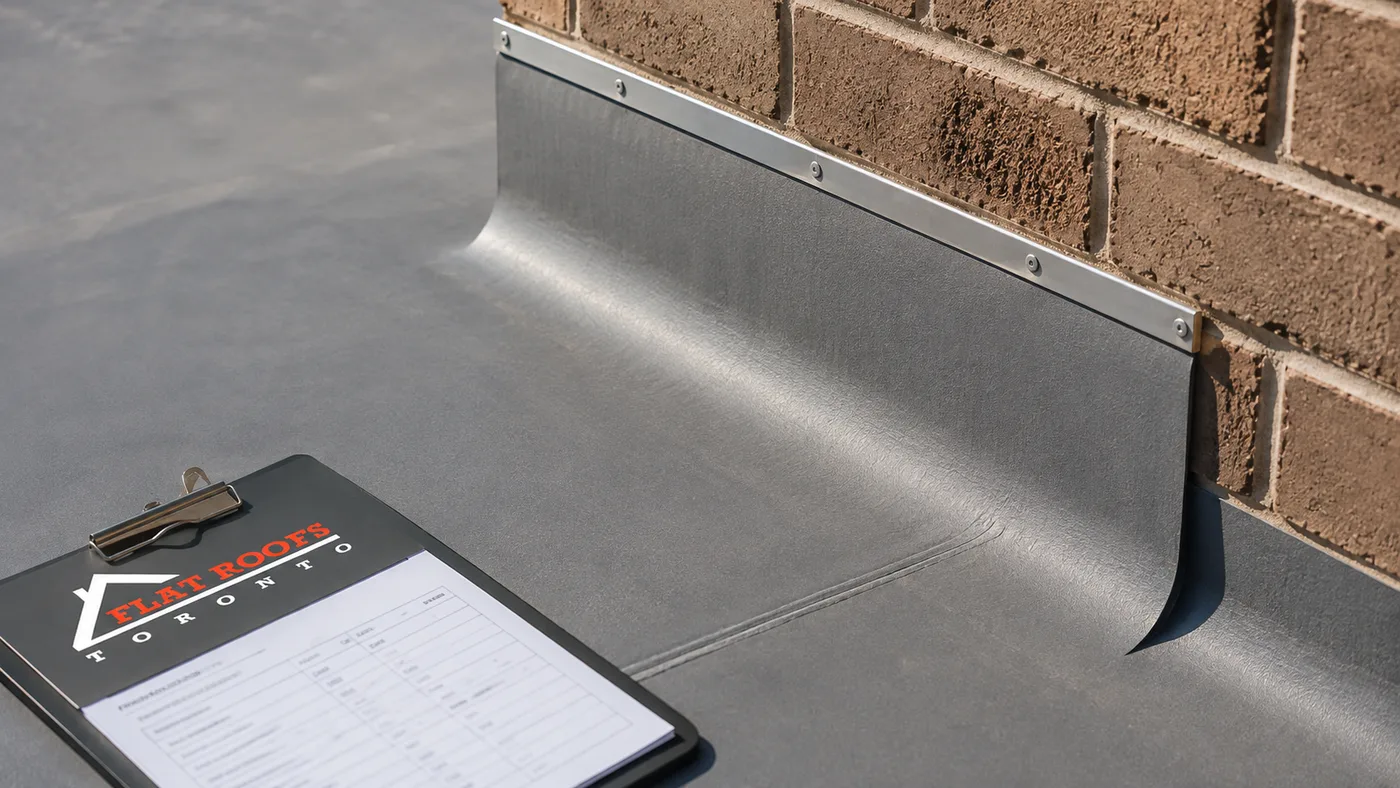
Perimeter details matter just as much. Flashing should extend a minimum of 200 millimetres up any adjoining vertical wall, be mechanically terminated, and be counterflashed or tucked into a reglet rather than surface-sealed with caulking alone. Caulking is a maintenance item, not a waterproofing strategy.
Insulation, Vapour Control and Winter Performance
A flat roof in Pickering is also an insulation assembly, and getting the layering wrong causes problems that look exactly like a leak. Warm interior air carries moisture upward. If it reaches a cold surface inside the roof assembly, it condenses, and the homeowner sees a stain that no amount of membrane patching will fix.
The conventional approach on residential flat roofing Pickering work is a warm roof assembly: deck, vapour barrier, rigid insulation, then membrane. This keeps the deck on the warm side of the insulation, which prevents interior moisture from condensing within the assembly. Nearly every modern flat roofing Pickering assembly is built this way, because it is markedly more reliable than trying to vent a shallow low-slope cavity, which rarely works well in Ontario winters because there is not enough cavity depth to move air.
Insulation depth is a budget decision with a long payback. Current Ontario energy expectations for roof assemblies sit around an effective RSI 8.67, which is roughly R-49 in imperial terms, though replacement work on an existing structure is often assessed against what is physically achievable. On a 1970s addition that was built with 90 millimetres of batt and no vapour control, upgrading during a membrane replacement is dramatically cheaper than doing it as a separate project later. If your low-slope area adjoins a heated attic space, it is also worth reviewing your attic insulation at the same time, since the two assemblies share the same air-leakage paths.
Ice damming is less common on flat roofs than on shingle roofs, but it is not absent. Where a low-slope section drains toward a shaded north elevation, meltwater refreezing at the scupper can back water up under the membrane termination. Heated drainage or a relocated outlet solves it permanently. Sealing the outlet does not.
Permits, Timelines and What a Replacement Week Looks Like
Straight replacement of an existing flat roof, meaning a like-for-like membrane change with no structural alteration, generally does not require a building permit in Ontario. A permit becomes necessary when the work involves structural framing changes, a new opening such as a skylight, a change in occupancy or use, or an addition. Verify with the City of Pickering’s building services before assuming, because scope creep during a tear-off can change the answer, and a contractor who tells you a permit is never required for anything is telling you something untrue.
A typical residential replacement follows a predictable sequence. Understanding it makes it much easier to evaluate whether a schedule you are quoted is realistic.
| Stage | What happens | Typical timing | Homeowner impact |
|---|---|---|---|
| Inspection and measurement | Roof survey, moisture check, drainage assessment, written scope | 45 to 90 minutes | None; access to interior stains helps |
| Scheduling and materials | Membrane and insulation ordered, disposal bin booked | 1 to 3 weeks | Driveway space usually needed |
| Tear-off and deck review | Old assembly removed, sheathing inspected and repaired | Day 1 | Noisiest stage; keep vehicles clear |
| Insulation and membrane | Vapour control, insulation, membrane and seams installed | Day 1 to 3 | Roof made watertight each evening |
| Flashing and metal | Perimeter metal, wall flashing, drain and scupper detailing | Final day | Minimal |
| Cleanup and walkthrough | Magnet sweep, debris removal, warranty documentation | Final day | Review paperwork before final payment |
Most flat roofing Pickering replacements at residential scale finish within one to five working days depending on area and complexity. Weather is the main variable. Membranes should not be installed onto a wet deck, and adhesives have minimum temperature thresholds, so a responsible crew will postpone rather than push through. A contractor willing to install over damp sheathing to hold a schedule is a contractor to decline.
Maintenance, Warning Signs and Getting Full Life From the Roof
Flat roofs reward attention, and flat roofing Pickering assemblies are no exception. A twice-yearly inspection, in late spring and again in late autumn, catches nearly every issue while it is still a minor repair. The most common failure points, in rough order of frequency, are seam separation, flashing terminations at walls and curbs, penetrations around vents and pipes, and blocked drains or scuppers.
Warning signs a homeowner can check without going onto the roof include interior ceiling staining that appears or worsens after rain, bubbling or blistering visible from an upper window, granule accumulation at downspout outlets on modified bitumen roofs, and any musty odour in a room directly under a flat section. On the roof itself, visible seam lifting, splits at the base of a wall flashing, and water still ponding more than two days after rainfall all warrant a professional look.
A well-maintained membrane installed by an experienced crew commonly reaches the upper end of its rated service life. A neglected one with blocked drainage rarely gets past fifteen years. The cost difference between those two outcomes is many thousands of dollars, and the maintenance itself is inexpensive. Homeowners who want to see the standard of finish to expect can review completed low-slope work in the project gallery.
If a leak develops during a storm or after high winds, do not wait for the next available appointment. Water tracking through a roof assembly damages insulation, drywall and framing well beyond the original entry point, and the repair cost climbs quickly. Emergency roof repair exists precisely to stop that spread.
How to Choose a Flat Roofing Contractor in Pickering
Low-slope roofing is a specialty, and flat roofing Pickering work in particular rewards crews who do it every week. Many capable shingle crews are not set up for membrane work, and the difference shows up at the seams and terminations rather than in the open field. When evaluating anyone offering flat roofing services for Pickering homeowners, work through a short checklist.
- Verify WSIB clearance and liability insurance in writing. Request the certificate directly rather than accepting a verbal assurance.
- Confirm low-slope experience specifically. Ask how many membrane roofs the crew completed last season, not how many roofs in total.
- Require a written scope. It should state membrane type and thickness, insulation type and depth, how slope will be achieved, flashing heights, and what happens if deck damage is discovered.
- Separate the warranties. Manufacturer material warranties and contractor workmanship warranties are different things. Ask for the term of each in writing.
- Check drainage is addressed explicitly. A quote that never mentions ponding or drainage on a roof that ponds is not a complete quote.
- Be cautious with unusually low bids. On flat roofing Pickering projects, a quote well below the others usually means a thinner membrane, no insulation upgrade, or flashing reused rather than replaced.
Homeowners planning a full replacement rather than a repair should also review what is included in a complete residential flat roof installation, since the scope of a proper installation is broader than most quotes make obvious. If the low-slope section is over a living space and you are considering adding natural light during the same project, coordinating with residential skylights at the membrane stage is far cleaner and cheaper than cutting a curb into a finished roof later.
Finally, ask who will actually be on your roof. Some companies sell the job and subcontract the labour to whichever crew is free that week. That is not automatically bad, but you are entitled to know, and it changes who stands behind the workmanship warranty when something needs attention in year four.
How much does flat roofing in Pickering cost in 2026?
How long does a flat roof last in the Durham Region climate?
Do I need a permit for flat roofing Pickering replacement work?
Is standing water on my flat roof a serious problem?
Can a flat roof be replaced in winter in Pickering?
Should I repair or fully replace my flat roof?
Book Your Flat Roofing Pickering Consultation Today
Whether you are dealing with an active leak over a rear addition, a garage roof that has ponded for years, or a low-slope section that has simply reached the end of its life, the right starting point is an honest inspection rather than a quote sight unseen. Flat Roofs Toronto is a Toronto-area low-slope roofing specialist serving Pickering homeowners, and every flat roofing Pickering assessment includes a drainage review, a moisture check and a written scope you can compare against any other proposal.
Call us today at (647) 333-3528 or request a free consultation to book an inspection at a time that works for you.
Flat Roofs Toronto proudly serves Pickering, Ajax, Whitby, Oshawa, Markham, Scarborough and communities throughout the Greater Toronto Area.