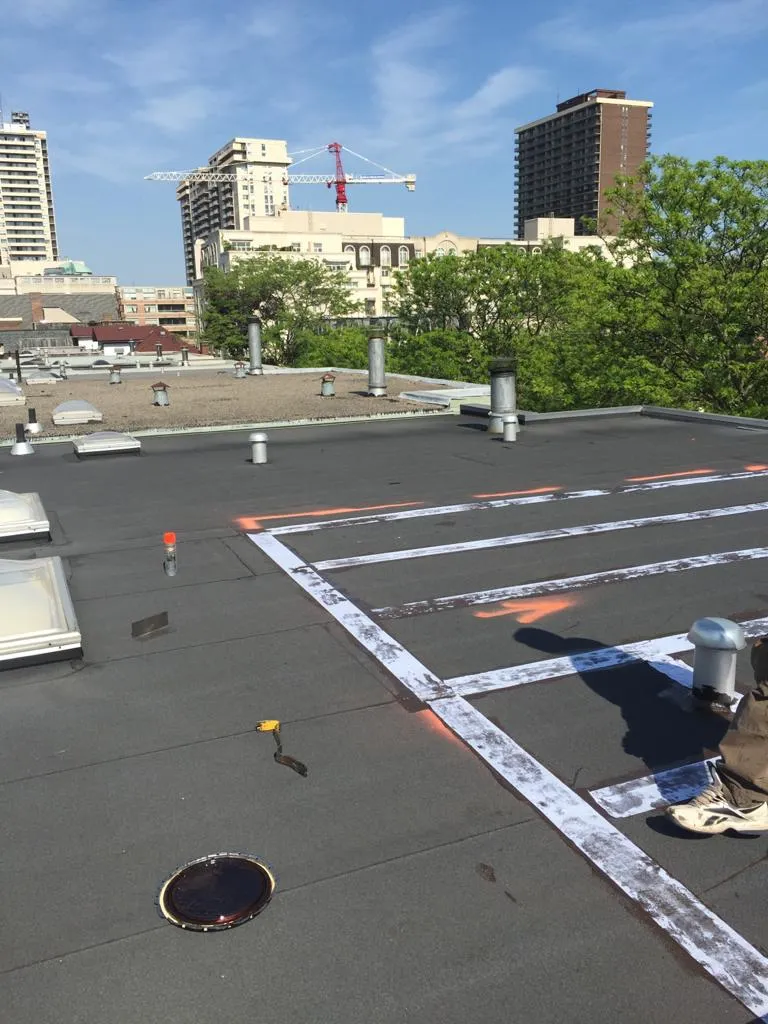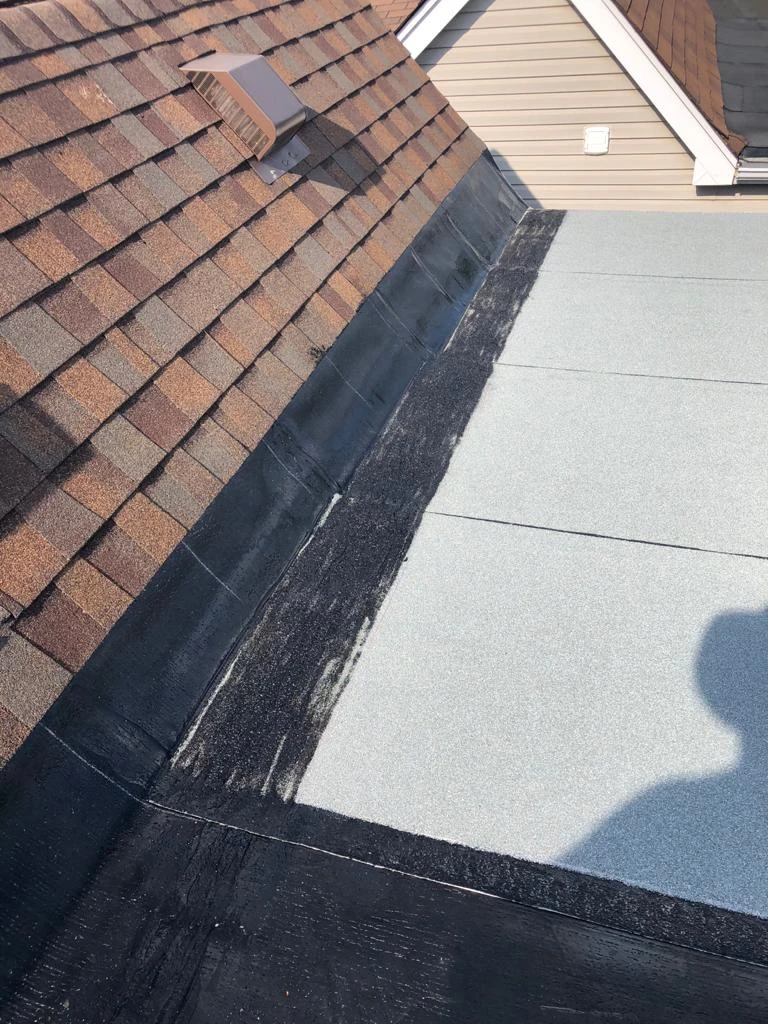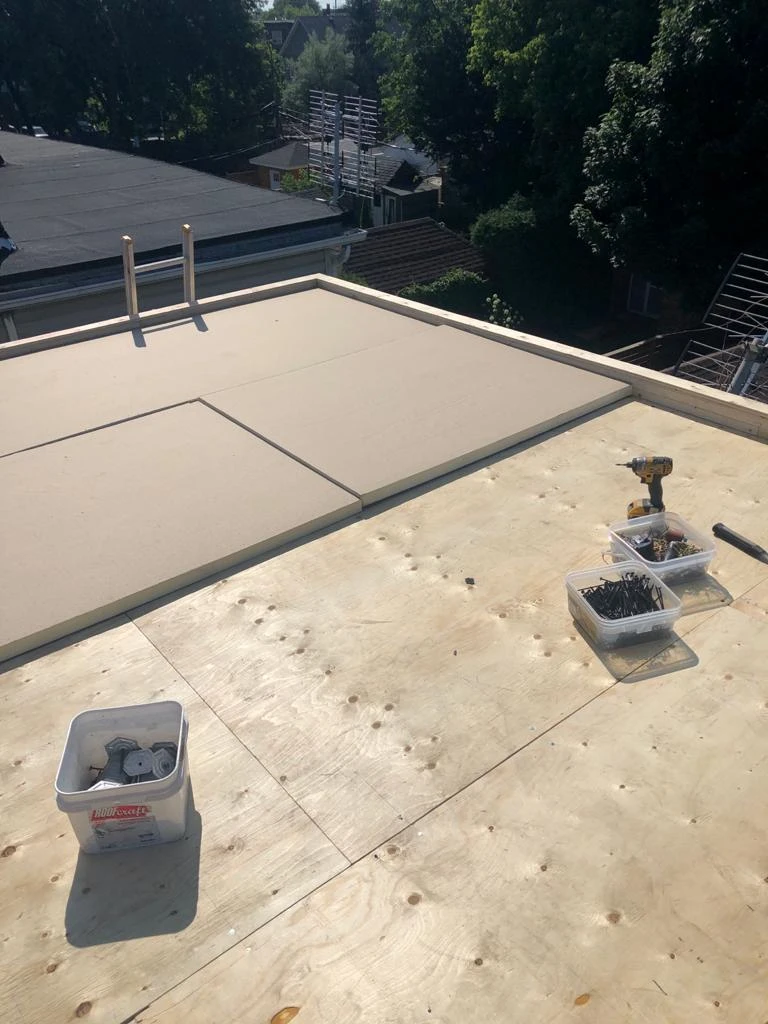

Vaughan has grown from a cluster of postwar villages into one of the largest municipalities in York Region, and its rooftops tell that story. In the older pockets you will find low-slope additions and rear extensions grafted onto brick bungalows built in the 1950s and 1960s. In the newer subdivisions and on the estate lots you will see contemporary builds where an entire upper storey, a garage bay or a covered terrace sits under a membrane rather than under shingles. Both situations put the same question in front of the owner: which system actually holds up in this climate? Flat roofing Vaughan properties need is not one product but a chain of decisions about membrane type, insulation, slope, drainage and flashing detail, and getting that chain right is what separates a roof that quietly works for twenty five years from one that starts leaking in its fifth winter.
This guide walks through the flat roofing Vaughan systems that actually perform in the Greater Toronto Area, realistic 2026 pricing, the code requirements that apply in Ontario, and the maintenance habits that protect the investment. It is written for homeowners and small commercial property owners who want to understand what they are buying before a contractor arrives with a quote.
Why Flat Roofing Vaughan Buildings Need a Different Approach Than Sloped Roofs
A sloped roof sheds water by gravity. Shingles overlap, gravity does the work, and small imperfections are forgiven because nothing sits still long enough to find them. A low-slope roof works on the opposite principle: it is a continuous waterproof surface that has to stay sealed at every seam, every penetration and every edge, because water will sit on it for hours after a storm. That difference explains almost everything about how flat roofing Vaughan crews approach the work.
The climate here is demanding in a specific way. Summer surface temperatures on a dark membrane can climb well past 70 degrees Celsius, while January nights routinely drop below minus 20. That swing of ninety degrees or more causes constant expansion and contraction across the whole roof plane. Add the many freeze and thaw cycles of an average GTA winter and any weak seam gets worked open a little more each season. Ice damming at parapets and scuppers, ponding water that never drains, and snow loads that concentrate in the lee of a taller wall all add pressure that a sloped roof never faces in the same way.
The practical consequence is that material quality matters less than detailing quality. Most modern membranes are good products. The failures that turn into service calls almost always trace back to the same handful of spots: a poorly terminated edge, a skylight curb that was flashed too low, a plumbing stack boot that was never resealed, or a drain that sits higher than the surrounding field. Any honest conversation about flat roofing Vaughan owners are considering should spend more time on those details than on brand names.
What Vaughan’s Building Stock Means for Flat Roofing Vaughan Projects
Vaughan is not one housing type. It spans small postwar bungalows in the older village cores, large 1980s and 1990s subdivisions, dense newer developments with tight lot coverage, estate properties on generous lots, and a substantial industrial and commercial belt near the major highway corridors. Each of those puts a different set of demands on a low-slope roof, which is why flat roofing Vaughan quotes vary so widely between two buildings that look similar from the street.
On the older brick homes, low-slope areas are usually secondary: a rear addition, a sunroom, a porch canopy or a flat-roofed garage. These are typically 200 to 700 square feet, often built on undersized joists with minimal insulation, and frequently sitting under a two-storey wall that dumps runoff straight onto them. The most common problem is the wall-to-roof junction, where old counterflashing was tucked into a mortar joint that has since eroded.
On newer builds, low-slope roofs are often architectural rather than incidental. A modern box-form home might have 1,500 square feet or more of membrane, integrated parapets, roof terraces and multiple penetrations for mechanical equipment and venting. These roofs are usually better insulated but far less forgiving, because the assembly is sealed tightly and any trapped moisture has nowhere to go. Getting the vapour control layer right matters enormously on this type of build.
Commercial and light industrial buildings in the employment lands present a third case: large uninterrupted fields of membrane, rooftop mechanical units, heavier foot traffic from service technicians, and a strong preference for systems that can be repaired without shutting anything down. If you are weighing options for a shop, plaza unit or warehouse, our commercial flat roof installation work covers those assemblies specifically. For houses, additions and garages, the detailing standards described in our residential flat roof installation service are the right starting point, and you can review the full range of our flat roofing services for Vaughan properties to see which category your building falls into.
The Main Flat Roofing Vaughan Systems Compared
Four systems account for the overwhelming majority of low-slope work in the GTA. Each has a legitimate place in flat roofing Vaughan projects, and the right answer depends on roof size, access, exposure and budget rather than on any single system being universally better.
Two-ply modified bitumen (SBS) is the workhorse of residential flat roofing Vaughan installations. A base sheet is mechanically fastened or adhered, then a granulated cap sheet is torch-applied or self-adhered over it. The redundancy of two full layers is its main strength: a puncture in the cap does not immediately become a leak. It handles foot traffic well, tolerates our temperature swings, and is straightforward to patch.
TPO is a single-ply thermoplastic membrane, heat-welded at the seams and usually white. It reflects a large share of solar heat, which lowers cooling load and reduces thermal stress on the assembly. Welded seams are strong and testable. It suits larger fields and newer homes where the owner wants the cooling benefit.
EPDM is a synthetic rubber membrane, typically black, joined with seam tape or adhesive. It is durable, stays flexible in extreme cold and is comparatively economical on large simple roofs. Its weaknesses are the seams and the black surface, which absorbs heat rather than reflecting it.
PVC is the premium single-ply option: heat-welded like TPO but with better resistance to grease, chemicals and ponding water. It is the usual choice above commercial kitchens and in any environment where exhaust residue lands on the roof.
| System | Typical Service Life | Relative Cost | Best Suited To | Main Weakness |
|---|---|---|---|---|
| Two-ply modified bitumen (SBS) | 20 to 30 years | Moderate | Homes, additions, garages, areas with foot traffic | Dark surface absorbs heat unless a reflective cap is used |
| TPO single-ply | 20 to 30 years | Moderate | Larger residential fields, new builds, cooling-sensitive homes | Weld quality is entirely installer dependent |
| EPDM rubber | 20 to 25 years | Lower to moderate | Large simple roofs with few penetrations | Taped seams age faster than welded seams |
| PVC single-ply | 25 to 35 years | Higher | Restaurants, commercial units, roofs with grease exposure | Highest material cost of the four |
| Built-up roof (tar and gravel) | 15 to 25 years | Moderate | Legacy commercial repairs and matching existing assemblies | Heavy, slow to install, difficult to inspect |
What Flat Roofing Costs in Vaughan in 2026
Pricing conversations go badly when they start with a per-square-foot number and no context. The honest answer is that a small, easily accessed garage roof and a 1,600 square foot second-storey membrane with six penetrations and a terrace are different products at different prices, even in the same material. The ranges below reflect what flat roofing Vaughan property owners can reasonably expect in 2026 for full tear-off and replacement, including disposal, on typical suburban access.
| Project Type | Typical Size | 2026 Installed Range | Usual Timeline |
|---|---|---|---|
| Garage or porch canopy, SBS two-ply | 200 to 400 sq ft | $3,500 to $7,000 | 1 day |
| Rear addition or sunroom, SBS two-ply | 400 to 800 sq ft | $6,500 to $13,500 | 1 to 2 days |
| Full residential low-slope roof, TPO or SBS | 1,000 to 1,800 sq ft | $14,000 to $30,000 | 2 to 4 days |
| Roof terrace or walkable deck assembly | 300 to 600 sq ft | $9,000 to $22,000 | 3 to 5 days |
| Small commercial or plaza unit, TPO or EPDM | 2,500 to 6,000 sq ft | $9 to $16 per sq ft | 4 to 8 days |
Several factors push a quote toward the upper end of its range. Removing two or more existing layers adds labour and disposal weight. Rotted or delaminated decking has to be replaced at cost once it is exposed. Upgrading insulation to meet current expectations adds material and height, which in turn affects flashing and door thresholds. Difficult access, meaning no driveway staging area or a rear roof reachable only through a narrow side yard, adds hours to every material movement. Parapet walls, curbs, skylights and mechanical penetrations each add detailing time.
Be cautious with quotes that come in far below the ranges above. On flat roofing Vaughan jobs, an unusually low price almost always means one of three things: a single-ply cap laid over an existing failing layer, no insulation upgrade, or a crew working without proper fall protection and WSIB coverage. Ask which of the three it is before signing anything.
Drainage, Slope and What the Ontario Building Code Requires
No low-slope roof is truly flat. Ontario Building Code requirements call for positive drainage on roof assemblies, and in practice that means designing in a minimum slope of roughly 2 per cent, or about 1 in 50, toward drains or scuppers. On a 20 foot run that is close to five inches of fall. Older Vaughan additions frequently have less than half that, either because the framing settled over decades or because the original slope was marginal to begin with. Correcting slope is one of the most common reasons flat roofing Vaughan replacements cost more than the owner first expected.
Ponding is the result, and it is the single most common precursor to failure. Water standing more than 48 hours after rainfall accelerates membrane degradation, concentrates dirt and biological growth, magnifies ultraviolet damage through the lens effect, and adds real dead load: one inch of standing water across 500 square feet is roughly 2,600 pounds. On an older roof framed to 1960s standards, that matters.
The fix is usually tapered insulation. Rigid polyisocyanurate is manufactured in tapered panels that build slope on top of an existing level deck, creating crickets and saddles that divert water to the drains without rebuilding the framing. It is a meaningful line item on a quote, generally $2 to $5 per square foot depending on how much correction is needed, and it is almost always the right money to spend.
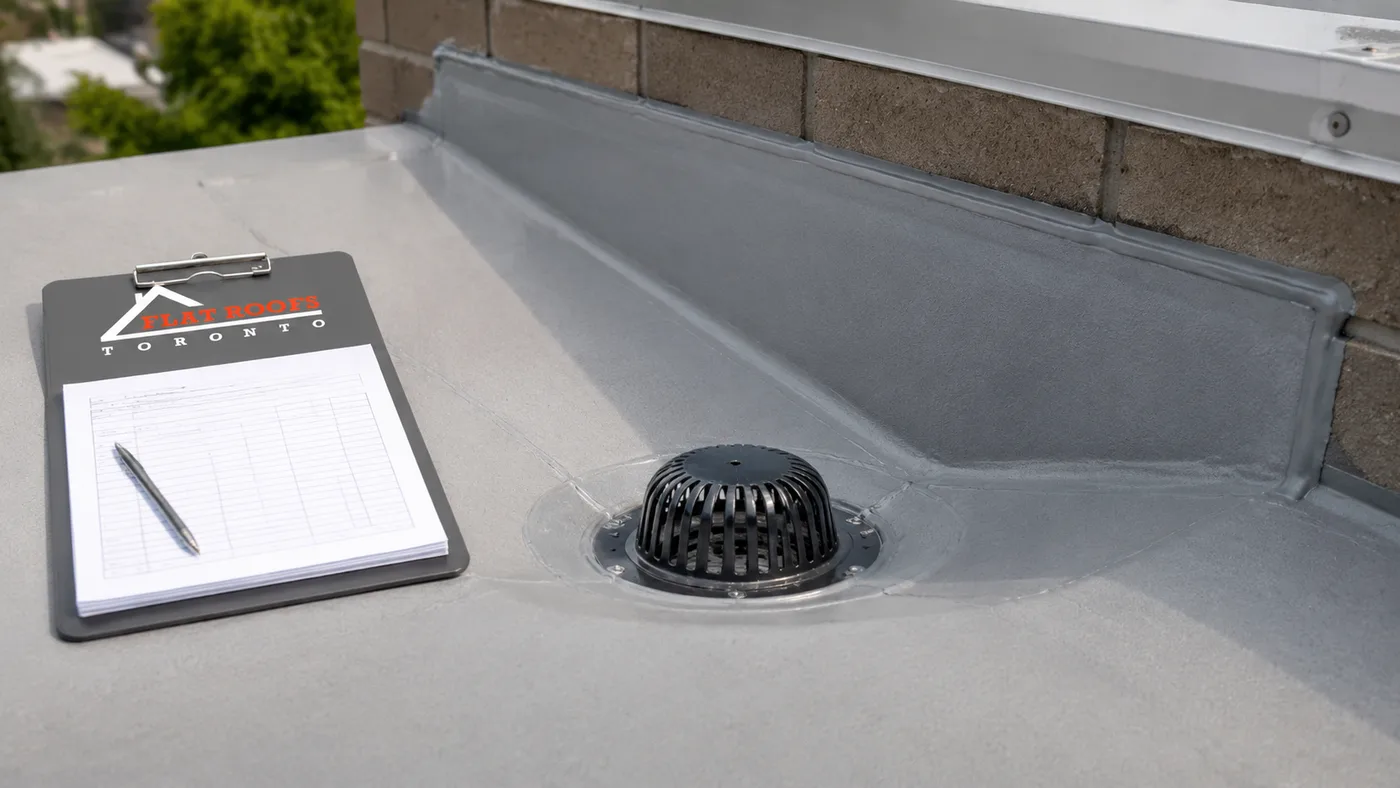
Drainage hardware matters just as much. Interior drains need proper strainers and clamping rings and should sit slightly below the finished surface, not level with it. Scuppers through a parapet must be sized for the roof area and kept clear. Where a roof discharges into a gutter, the drip edge and starter detail need to carry water past the fascia rather than behind it. On townhome and semi-detached configurations common in newer Vaughan developments, shared parapets and party walls need particular attention, because a failure on one side migrates to the other.
Insulation and Vapour Control in Flat Roofing Vaughan Assemblies
The membrane gets the attention, but on a low-slope assembly the insulation strategy determines whether the roof stays dry from the inside. Warm interior air carries moisture upward. If that vapour reaches a cold surface inside the assembly, it condenses. In a sealed low-slope roof there is often no ventilation path to carry it away, so it accumulates, saturates the insulation, and eventually rots the deck from beneath while the membrane above still looks perfectly intact.
The reliable approach for our climate is a conventional assembly with the insulation above the deck and a vapour retarder below it, so the deck stays warm and the dew point falls inside the insulation layer rather than against the wood. Current Ontario expectations for a residential roof assembly land around R-31 nominal, which typically means four to five inches of polyisocyanurate installed in two staggered layers so the board joints do not line up. Two layers matter: a single thick layer creates a continuous thermal bridge at every seam.
The insulation options that come up most often on a quote break down roughly as follows:
- No upgrade, existing older assembly: one to two inches of legacy insulation, roughly R-6 to R-12. Common on pre-1980 additions and a significant source of heat loss.
- Single-layer polyisocyanurate, three inches: about R-17 to R-18, adding roughly $2.50 to $4.00 per square foot. This is the minimum practical upgrade, though thermal bridging at the board seams limits real-world performance.
- Two-layer staggered polyisocyanurate, four and a half to five and a half inches: about R-26 to R-32, adding roughly $4.00 to $7.00 per square foot. This is the recommended standard on a full replacement.
- Tapered polyisocyanurate over a level deck: one to six inches depending on the run, adding roughly $2.00 to $5.00 per square foot. Corrects slope and adds thermal value in the same operation.
- Two-layer polyisocyanurate plus a cover board: five to six inches total, about R-28 to R-34, adding roughly $5.50 to $8.50 per square foot. The best option for puncture resistance under a single-ply membrane.
Cover boards deserve a specific mention. A half-inch high-density board between the insulation and the membrane costs a modest amount and noticeably improves resistance to hail, dropped tools and technicians walking around rooftop equipment. On any roof that will see regular foot traffic, it is worth including.
Where a low-slope roof adjoins a vented attic space over the main house, the two assemblies have to be separated properly or warm attic air will migrate under the membrane. That junction is worth checking whenever attic insulation work is being planned at the same time, since doing both together avoids paying twice for access. If the low-slope area includes glazing, the curb heights and flashing for residential skylights should be reworked during the roof replacement rather than left in place as an inherited weak point.
Permits, Timelines and What a Flat Roofing Vaughan Replacement Looks Like
Straight replacement of an existing low-slope roof, same footprint and same assembly type, generally does not require a building permit in Vaughan. Permits do come into play when structural framing changes, when a roof is converted into a walkable terrace, when a new opening is created, or when the work forms part of a larger addition. If a contractor tells you a structural change needs no permit, treat that as a warning rather than a convenience.
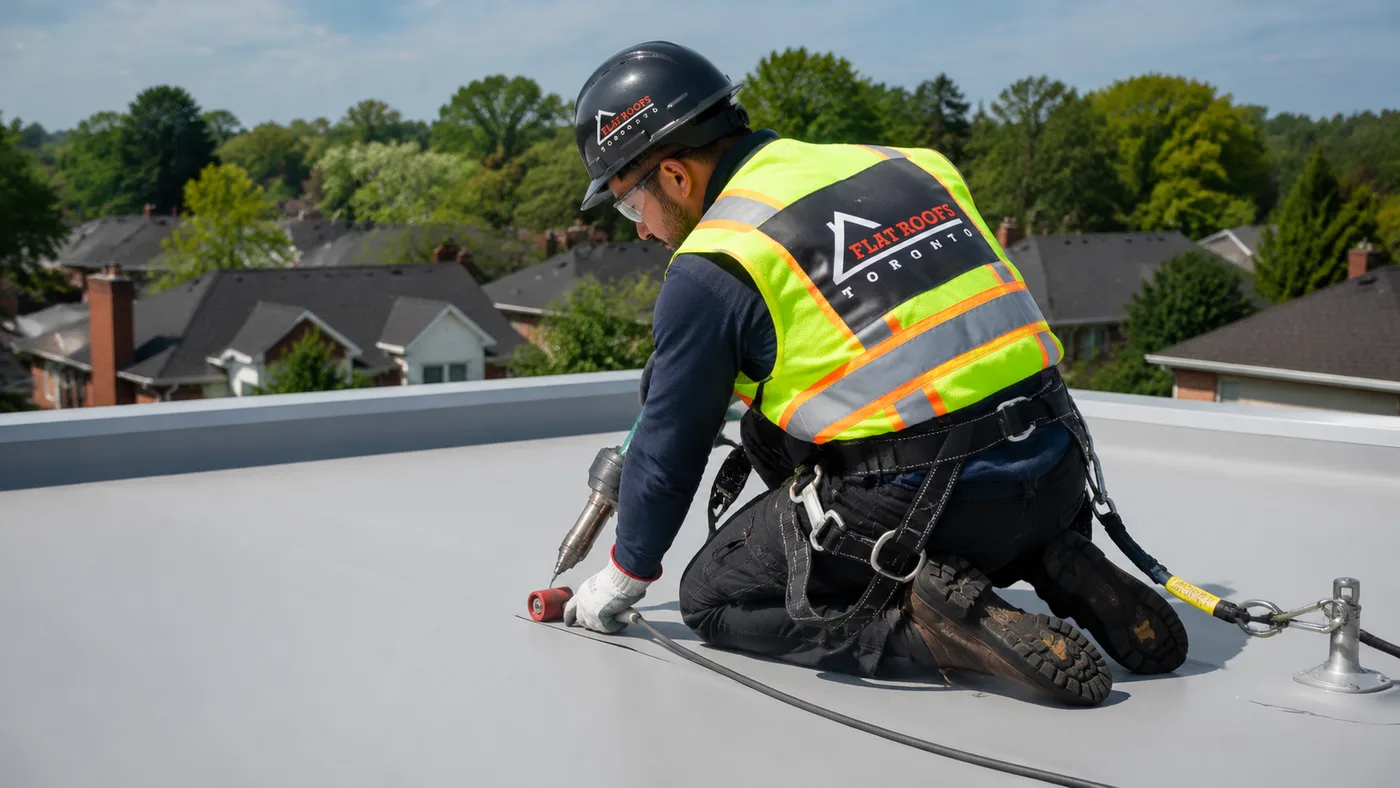
A typical residential replacement runs like this. Day one is setup and tear-off: protection over landscaping and walkways, a disposal bin staged, fall protection anchored, and the old assembly stripped back to the deck. Any rotted sheathing is identified and replaced the same day, and this is the point where an owner should walk the perimeter with the crew lead to see what was found. Day two is the vapour retarder, the insulation layers and any tapered work. Day three is membrane installation, flashings, edge metal and drain assemblies. On simple garage or addition roofs the whole sequence compresses into one long day.
Weather governs the schedule more than anything else. Adhesives and self-adhered membranes have minimum application temperatures, and no membrane should go down on a wet deck. Most flat roofing Vaughan work therefore happens between April and November, though torch-applied SBS can be installed in colder conditions when there is a genuine emergency. Summer bookings fill quickly, so a spring call for an August slot is usually realistic while a July call for a July slot is usually not.
Maintenance That Protects Your Flat Roofing Vaughan Investment
Low-slope roofs reward attention and punish neglect faster than sloped roofs do. A twice-yearly inspection, spring and autumn, catches nearly everything before it becomes an interior problem. The inspection itself is simple: clear the drains and scuppers, sweep debris out of low areas, check every seam and every penetration, look at the sealant on flashing terminations, and note any spot that held water more than two days after the last rain.
Seasonal habits matter too. In autumn, clear leaves before they mat over a drain. In winter, remove heavy snow accumulation from parapet corners where drifting concentrates load, but never chip ice with a metal tool on a membrane surface. In spring, look for winter damage at the wall junctions. In summer, check that heat has not caused blistering or seam lift.
| Task | Frequency | Why It Matters | Typical Cost if Hired Out |
|---|---|---|---|
| Clear drains, scuppers and debris | Twice yearly | Blocked drainage is the leading cause of ponding | $150 to $300 per visit |
| Full seam and flashing inspection | Annually | Catches seam lift and failed sealant early | $250 to $450 |
| Reseal penetrations and pipe boots | Every 3 to 5 years | Sealant is the shortest-lived component on the roof | $300 to $800 |
| Localized patch or seam repair | As needed | A small repair now prevents a deck replacement later | $400 to $1,500 |
| Reflective or protective recoating | Every 8 to 12 years | Extends membrane life and lowers surface temperature | $2.00 to $4.50 per sq ft |
Warranties come in two parts and both matter on flat roofing Vaughan replacements. The manufacturer warranty covers the membrane material, commonly 15 to 25 years, and usually requires that the system be installed by a certified applicator using compatible components throughout. The workmanship warranty covers the installation itself, and that is where most real claims land, since material defects are rare and installation errors are not. Ten years of workmanship coverage is a reasonable expectation on a full replacement. Keep your documentation and keep records of maintenance visits, because most manufacturer warranties can be voided by neglect.
Owners comparing contractors can look at completed low-slope projects in our project gallery to see how edge details, drains and curbs are finished, which is a more useful comparison than any brochure. If a leak is already active and water is entering the building, that is an emergency roof repair situation, and temporary stabilization should happen before any replacement is scheduled.
How long does a flat roof last in Vaughan?
What does flat roofing Vaughan homeowners install typically cost in 2026?
Can a new flat roof be installed over the existing one?
Do I need a permit for flat roofing Vaughan replacement work?
What time of year is best for a flat roof replacement?
Why is water pooling on my flat roof?
Book Your Flat Roofing Vaughan Consultation Today
Whether you are dealing with an aging addition roof on an older brick home or planning a full membrane replacement on a newer build, the right starting point is an on-site assessment rather than a phone estimate. Flat Roofs Toronto is a Toronto-based low-slope specialist serving Vaughan and the surrounding York Region communities, and our team can walk your roof, identify what is actually failing, and give you an itemized scope you can compare against any other quote for flat roofing Vaughan work.
Call us today at (647) 333-3528 or request a free consultation to get started.
Flat Roofs Toronto serves Vaughan, Woodbridge, Maple, Concord, Thornhill and communities across the Greater Toronto Area with residential and commercial low-slope roofing.