

Home / Commercial Flat Roof Skylights
Commercial Flat Roof Skylights
Commercial Flat Roof Skylight Installation and Replacement in Toronto
Unit skylights, domes and daylighting cut into commercial low-slope roofs, curbed and flashed by roofers. New installations, like-for-like replacements and leak repairs across Toronto and the GTA.
What you get from Flat Roofs Toronto
Roofer-Installed
Curb, flashing and membrane are one scope.
Occupied Buildings
Openings closed watertight the same day.
Free No-Obligation Quotes
Units, curbs and labour priced together.
24/7 Emergency Response
A leaking dome over a warehouse floor is urgent.
Daylight Is Free. Getting It In Without Leaks Is the Job
Commercial skylights earn their place twice over. They cut lighting load across a large floor plate during daylight hours, and on many buildings they are doing regulatory work as well, whether that is a smoke vent, a natural daylighting requirement or simply a warehouse that is unpleasant to work in without them. What they also are, unavoidably, is a grid of holes in a waterproof roof.
The engineering answer is the same as on a house, scaled up. Every unit sits on a curb that stands proud of the finished roof surface. The membrane runs up the outside of that curb and terminates above the water line. Metal counterflashing comes down over the membrane upstand. The unit is set on top and fixed down. Nothing relies on sealant to keep water out; sealant is there as the last line, not the first.
What changes at commercial scale is the number of them and what happens underneath. Thirty units on a warehouse roof is thirty flashing details, and a failure over an active production floor or a tenant's stock is a much more expensive event than a stain on a bedroom ceiling. That is the argument for having the roofer own the curb, the flashing and the membrane as a single scope of work.
What a commercial skylight scope covers
- Survey of existing units, curbs and flashing
- Structural check and framing of new openings
- Curbs built to clear ponding and drifted snow
- Membrane run up and terminated on each curb
- Metal counterflashing over the upstand
- Units set, fixed and made weathertight
- Fall protection considerations around openings
- Roof field made good and cleaned down
Signs Your Commercial Flat Roof Skylights Need Attention
On a large roof these are easy to miss until something drips onto stock.
- Water tracking down the inside of a curb after rain
- Cracked, crazed or heavily yellowed acrylic domes
- Condensation or fogging trapped between glazing layers
- Membrane lifting or splitting where it turns up the curb
- Counterflashing loose, corroded or missing
- Units so brittle they would not take a load
- Noticeably less daylight than the roof used to deliver
- Units original to a roof that has already been replaced
Commercial Skylight Types
What suits your roof depends on span, the daylight you want, and whether the unit is doing a code job as well as a lighting one.
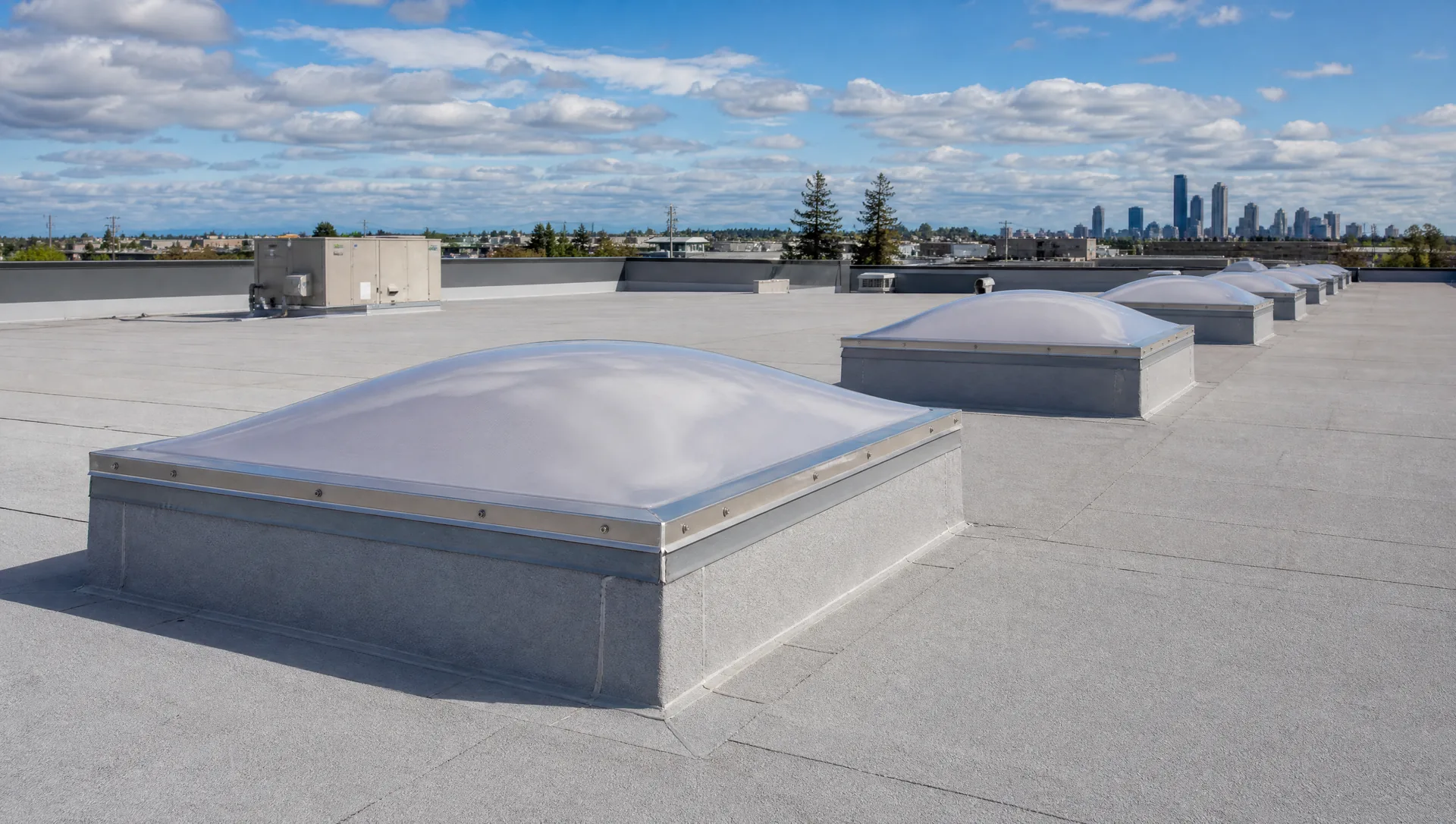
Most Common
Unit Skylights and Domes
Individual acrylic or polycarbonate domes on curbs, laid out on a grid across the roof. Economical per unit, self-shedding by shape, and easy to replace one at a time without disturbing the rest of the roof. The default on warehouse and industrial buildings for good reason.
- Replaceable individually
- Sheds water and snow by shape
Long Runs
Barrel Vault and Ridge Units
Continuous glazed runs rather than individual units, giving an even band of daylight along a bay instead of pools under each dome. More structure and more flashing length, so it is specified where the quality of the light actually matters to what happens below.
- Even daylight along a bay
- Fewer separate curb details per metre
High Performance
Insulated Glass Units
Glass rather than plastic, in a thermally broken frame. Far better thermal performance and clarity, far less yellowing over time, and a higher price. Worth it on offices, showrooms and any space where the view and the colour of the light are part of the point.
- Best thermal performance
- No yellowing over time
Code Driven
Smoke Vents and Access Hatches
Openings that exist for a reason other than daylight. They still need exactly the same curb and flashing discipline as a skylight, and they are frequently the ones nobody has looked at in fifteen years because they are not obviously part of the roof.
- Same curb and flashing detail
- Often the oldest openings on the roof
Two Things Owners Should Know Before Quoting Skylight Work
Replacing units and replacing the roof are cheapest together
Skylight units and roof membranes tend to reach the end of their lives at roughly the same time, because they were installed at the same time and they have taken the same weather. If you are inside a few years of a commercial roof replacement, replacing the units during that project costs a fraction of doing it as a separate mobilisation later, because the flashing work is happening anyway. Doing it the other way round, new units onto old membrane, means paying twice for the same detail.
Skylights are a fall hazard, and old ones are worse
An acrylic dome that has been in the Toronto sun for twenty years is brittle. It looks like a surface and it is not one. Anyone walking a roof for maintenance, and particularly anyone walking it in snow when the units are not visible, is at risk around them. If your roof has a lot of unit skylights and regular maintenance traffic, guarding or screening around the openings is worth discussing at the same time as the units themselves. We will raise it during the survey whether or not it is in the scope you asked us to price.
The membrane around the curb matters as much as the unit
A skylight is only ever as watertight as the roof it is flashed into, and each membrane terminates against a curb differently. Our flat roofing systems guide compares all six on seams, lifespan and fire behaviour, and the rest of what Flat Roofs Toronto does across the GTA sits on the home page.
How a Commercial Skylight Project Runs
Four stages, phased so no opening is ever left unprotected overnight.
1
Roof and Opening Survey
We count and assess the existing units, check curb heights and condition, and identify what is leaking versus what is simply old.
2
Scope and Written Quote
Units, curbs, flashing and phasing priced together, free and with no obligation.
3
Phased Installation
We take on only as many openings as can be closed watertight in a day, with the interior protected underneath.
4
Weathertight and Handover
Counterflashing set, roof field made good, site cleaned down, warranty documents handed over.
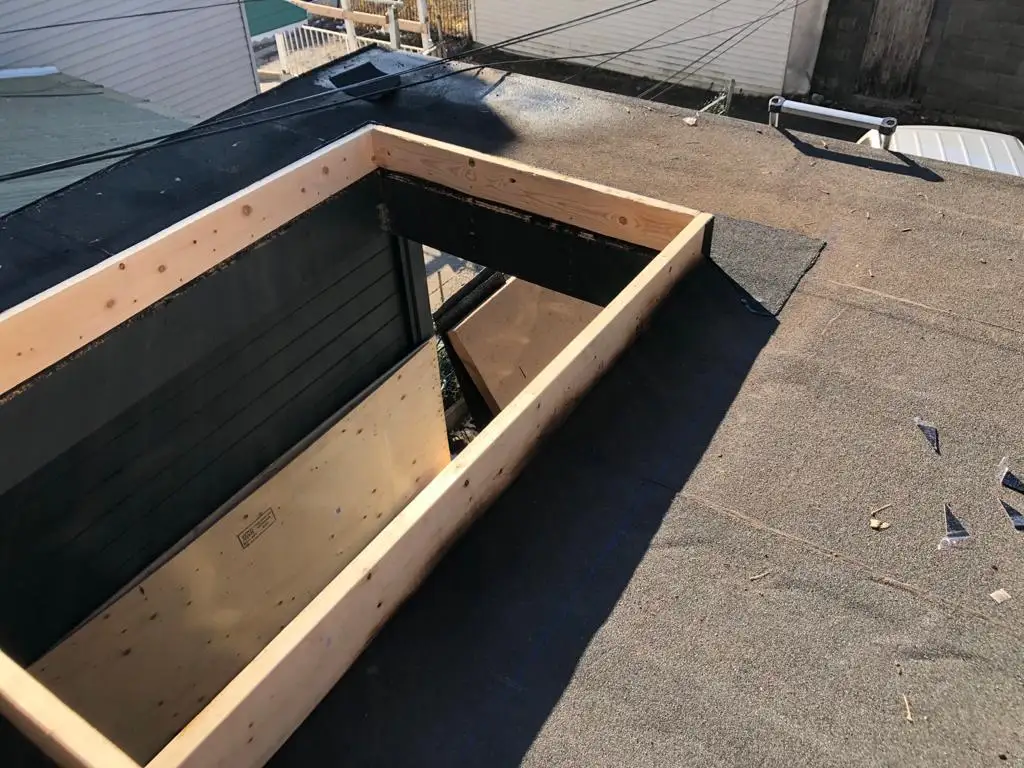
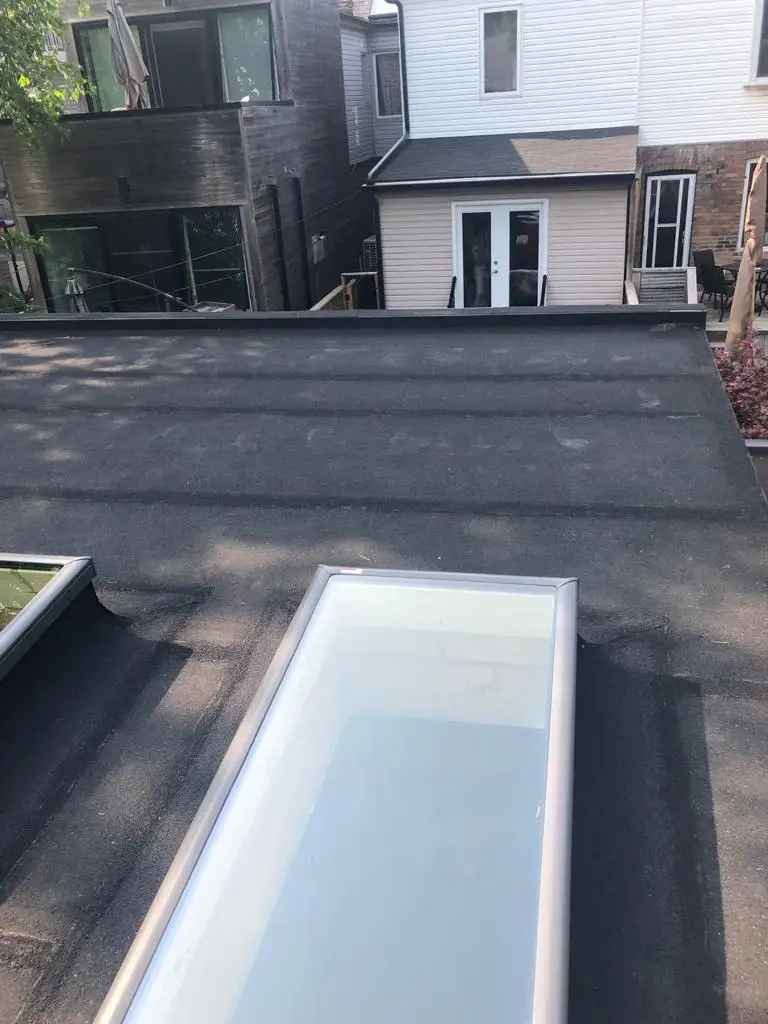
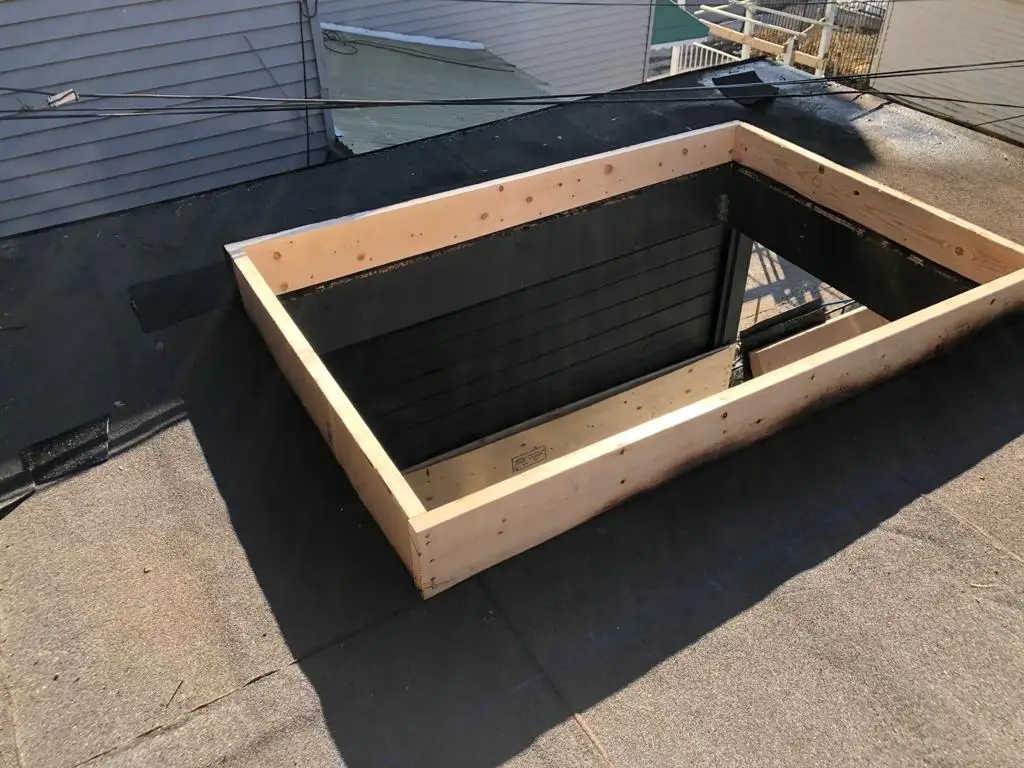
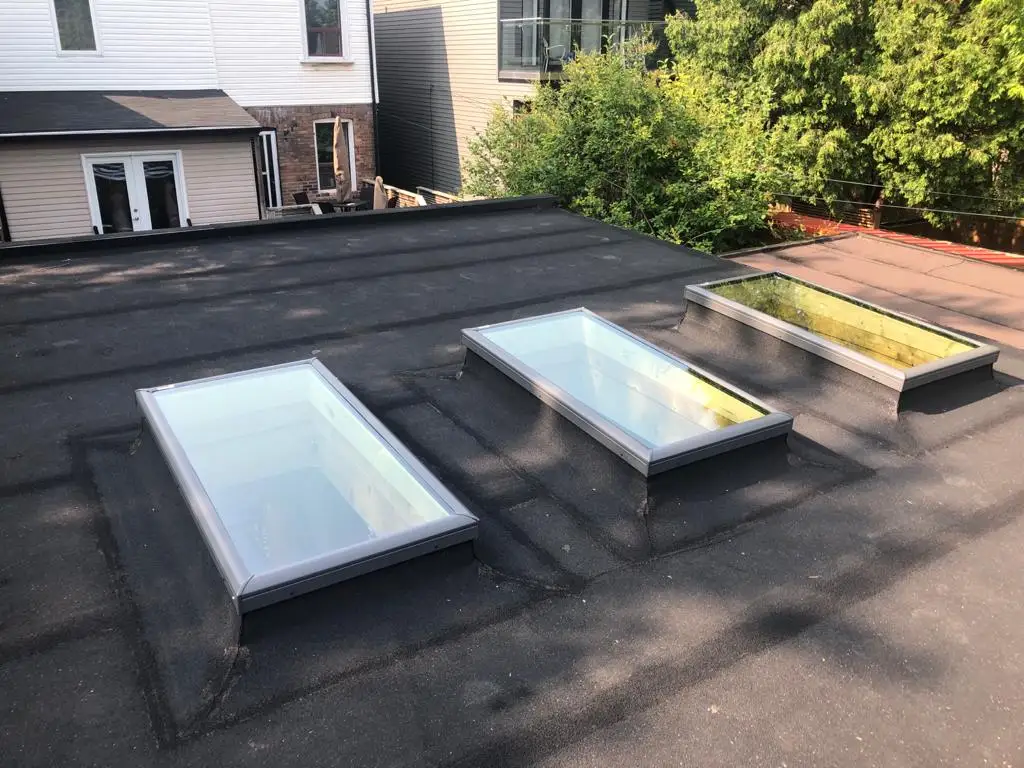
Skylight Units and Curbs, Photographed
Curb framing, flashing and finished units on real low-slope roofs.
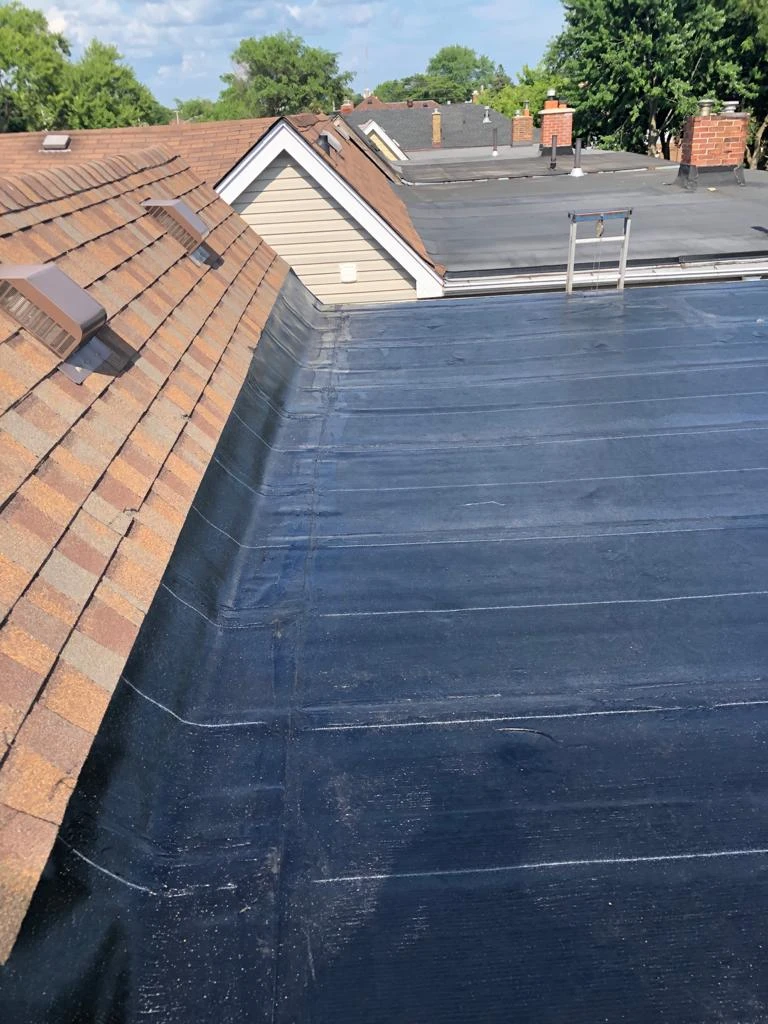
Lumbered Slope Build and Two-Ply System, Toronto
A lumbered slope framed over a flat roof deck to move water toward the drains, with a two-ply system installed over it.
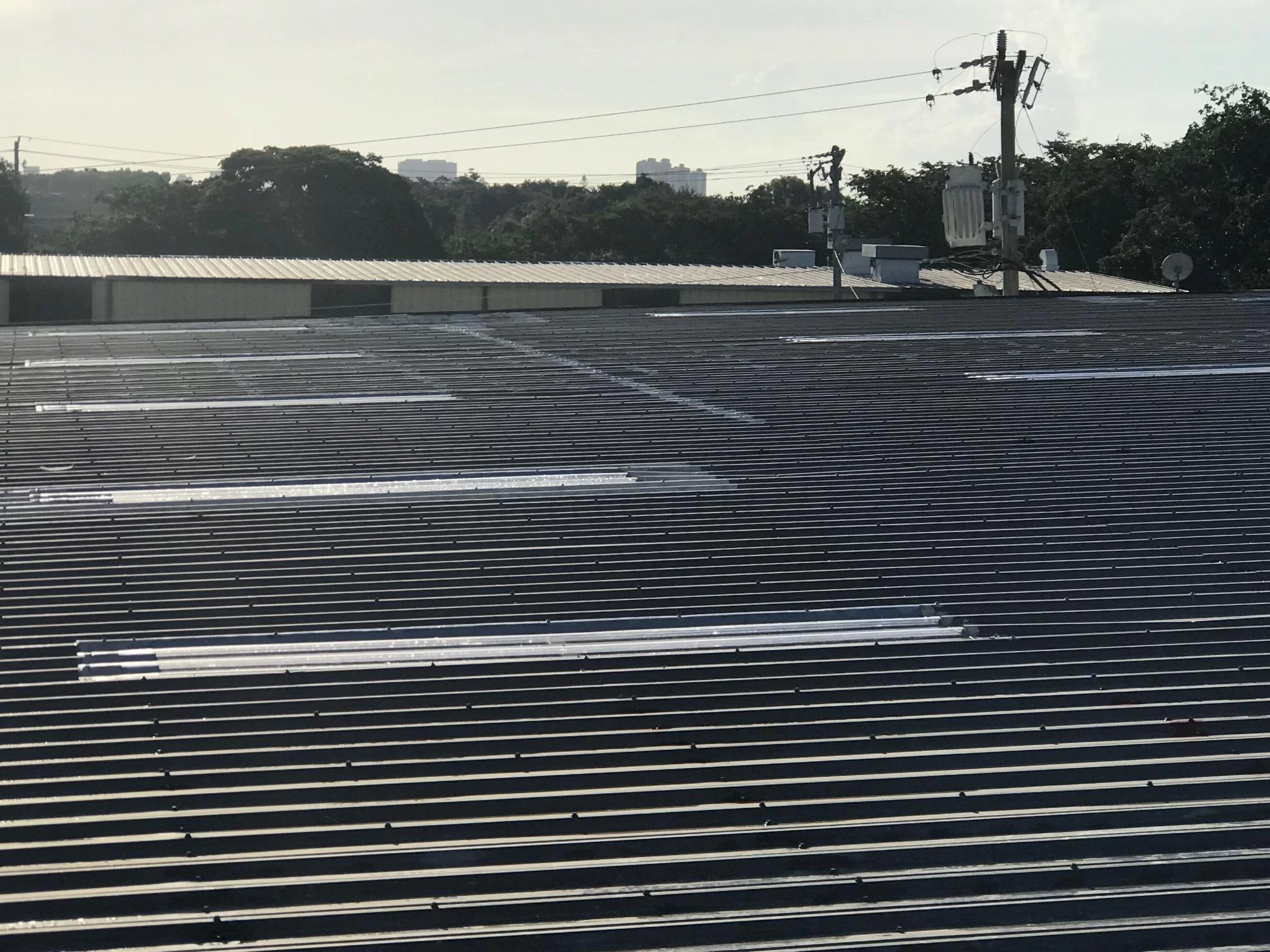
Flat Roof Application Detail, Toronto
A detail from a flat roof membrane application, showing the finished surface of the system.
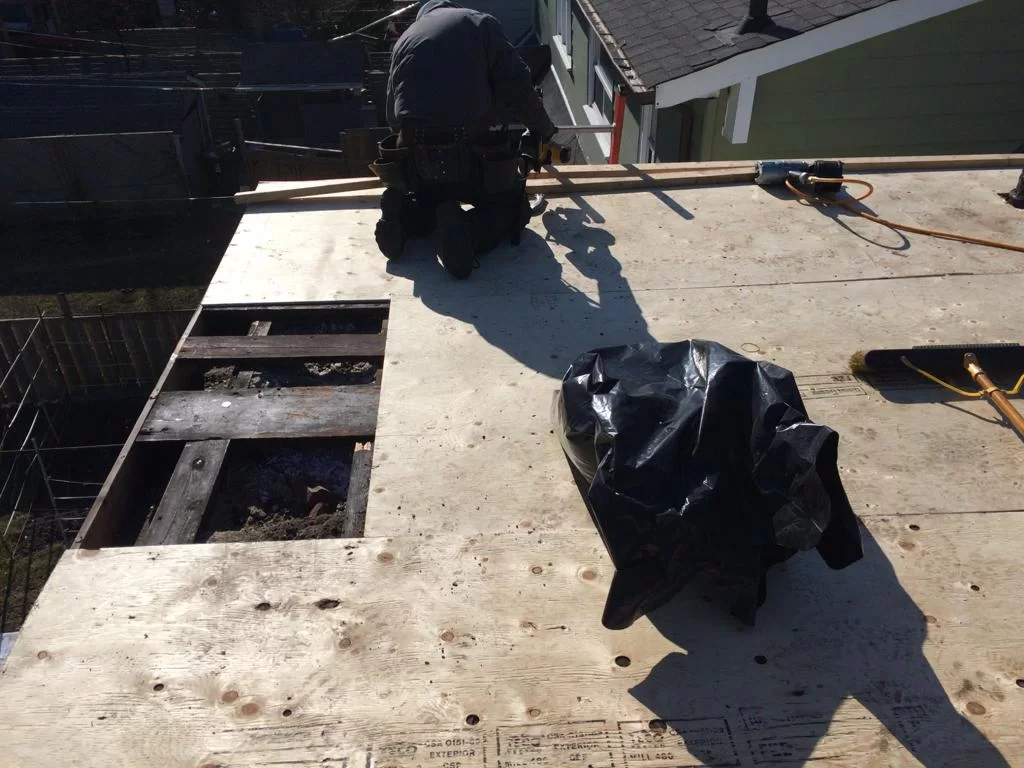
Attic Inspection and Blown-In Insulation, Toronto
Inspection of a flat roof attic space followed by blown-in insulation. The cavity is checked before any insulation is added.
What Drives Commercial Skylight Pricing
Unit cost is usually the smaller half. The opening, the curb and the flashing are where the labour sits, and on an occupied building the phasing costs money too. We quote it all together, free and in writing, after the survey.
- Unit type and glazing. Acrylic dome, polycarbonate multiwall and insulated glass are very different products at very different prices per opening.
- Quantity and layout. Thirty identical units on an open roof is efficient work. Six units scattered around rooftop equipment is not.
- New opening or replacement. Dropping a unit into a sound existing curb is the cheapest case. Cutting and framing a new structural opening is the most expensive.
- Curb condition. Curbs that are rotten, too short or badly detailed have to be rebuilt before a new unit goes on them.
- Roof interaction. Whether the surrounding membrane is being replaced at the same time, or has to be cut into and made good.
- Access and occupancy. Protection below, restricted hours, and phasing around a tenant or a production line all carry cost.
If the roof is due for replacement inside the next few years, ask us to price the units as part of that project. It is materially cheaper than doing them separately.
Commercial Skylight Questions
What facilities managers and building owners ask us about rooftop daylighting.
Can you replace skylights without replacing the roof?
Yes, provided the existing curbs are sound and tall enough and the membrane around them still has life in it. We remove the old units, repair or rebuild the curbs where needed, make good the flashing and set the new units. If the curbs are failing or the membrane is at the end of its service life, we will tell you, because new units on a dying roof is money spent twice.
How long do commercial skylights last?
Acrylic and polycarbonate domes typically give 15 to 25 years before UV makes them brittle and yellow. Insulated glass units in a good frame last longer, commonly 25 to 30 years, with the seals usually going before the glass. The curb and flashing, if correctly built, generally outlast whatever is sitting on them.
Do skylights actually save money on a warehouse?
On a large floor plate with daytime operations, the lighting saving is real and measurable. The trade-off is solar heat gain in summer and heat loss in winter, which is why glazing specification matters more than most people expect. Prismatic and diffusing glazing spreads light more evenly and cuts glare, which is often more useful on a working floor than raw brightness.
Are old skylights a safety issue for staff on the roof?
They can be. A twenty-year-old acrylic dome is brittle and will not hold a person's weight, and in winter drifted snow can hide the openings entirely. If your roof gets regular maintenance traffic, screening or guarding around the units is worth considering, and we will flag it during the survey.
Can you work around rooftop equipment and tenants?
Yes. That is normal commercial work for us. We phase openings so nothing is left unprotected overnight, protect the space underneath, and agree access and working hours before we start. The phasing plan forms part of the written quote.
What about smoke vents and roof hatches?
Same curb, same flashing discipline, different purpose. They are frequently the oldest and most neglected openings on a commercial roof precisely because nobody thinks of them as skylights. We survey them alongside the units and price any remedial work in the same scope.
Areas We Cover
Toronto and out through the GTA. Open the plan to find your area, or call and ask about somewhere we have not named.
Select a region on the plan
Free, No Obligation
Request a Free Quote
Tell us what the roof is doing and we will come and look at it. No charge, and no obligation to proceed.
Call Us
Office Hours
Open 7 days a week: 7:00am to 11:30pm
Emergencies
The line above is answered 24/7 for anything that cannot wait, including weekends and statutory holidays.
Related Flat Roofing Services
Three more places our crews spend their time. Every one of them touches the same roof.
Google Reviews
Commercial Skylight Reviews
These come straight from our Google Business Profile. We cannot edit them, reorder them or take one down, and the rating in the header is whatever Google is showing today.



Free, No Obligation
Get Your Commercial Flat Roof Skylights Surveyed
We will count them, assess the curbs and the flashing, and put a scope and a price in writing. Free, and with no obligation.