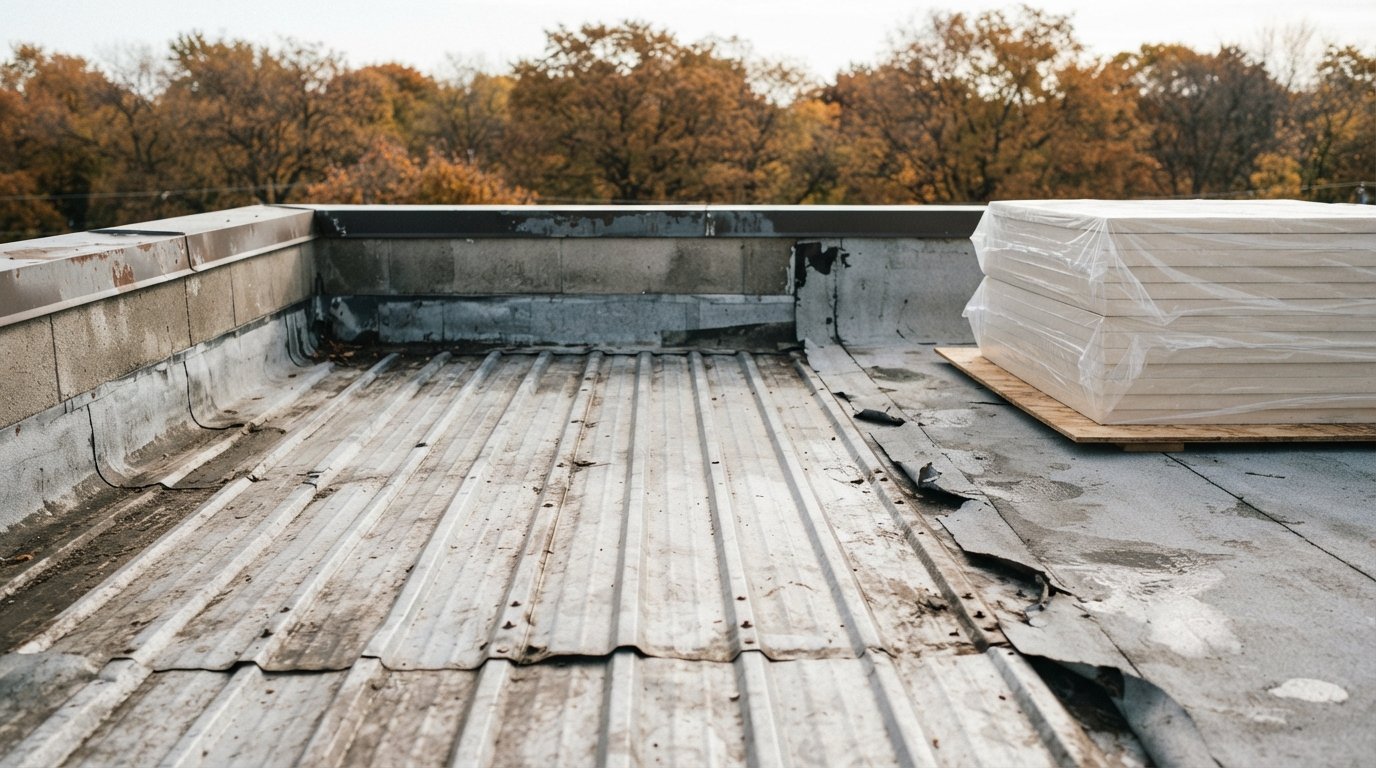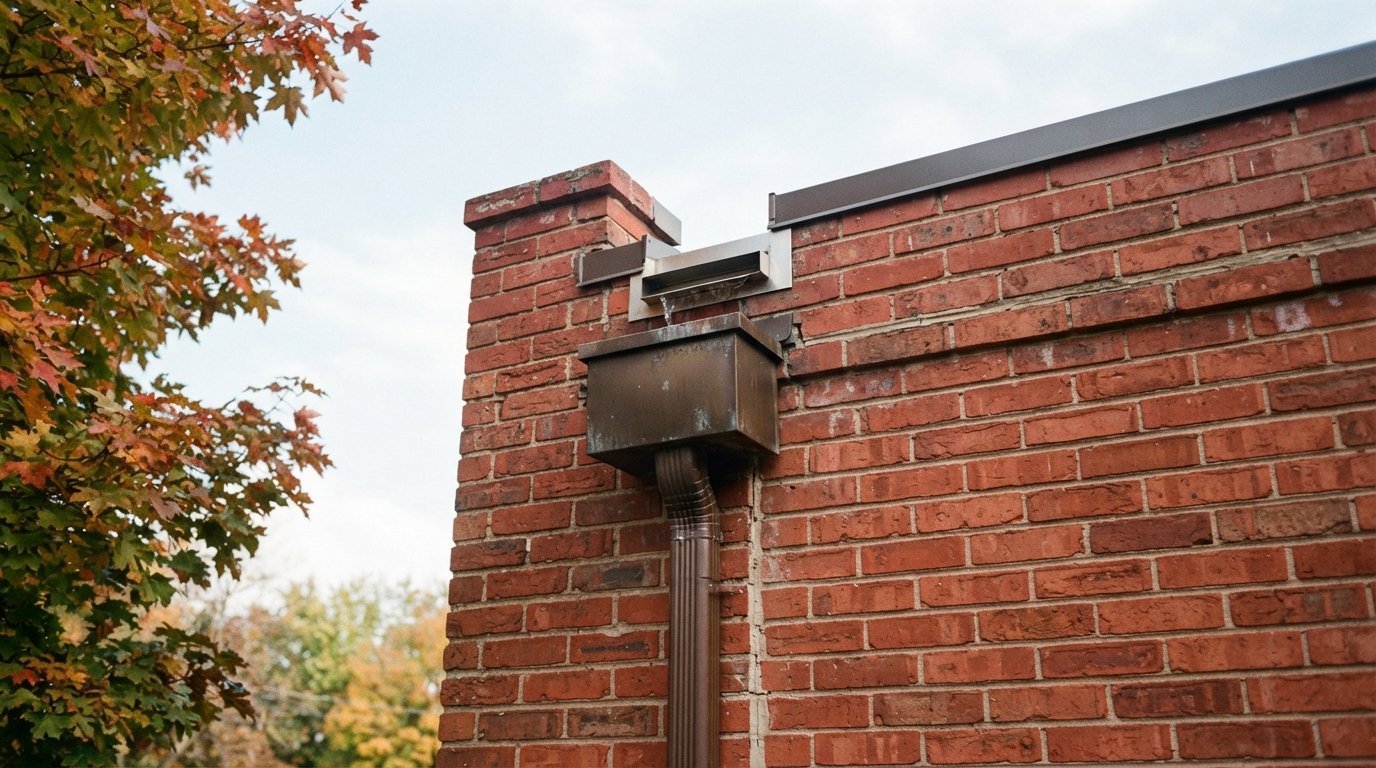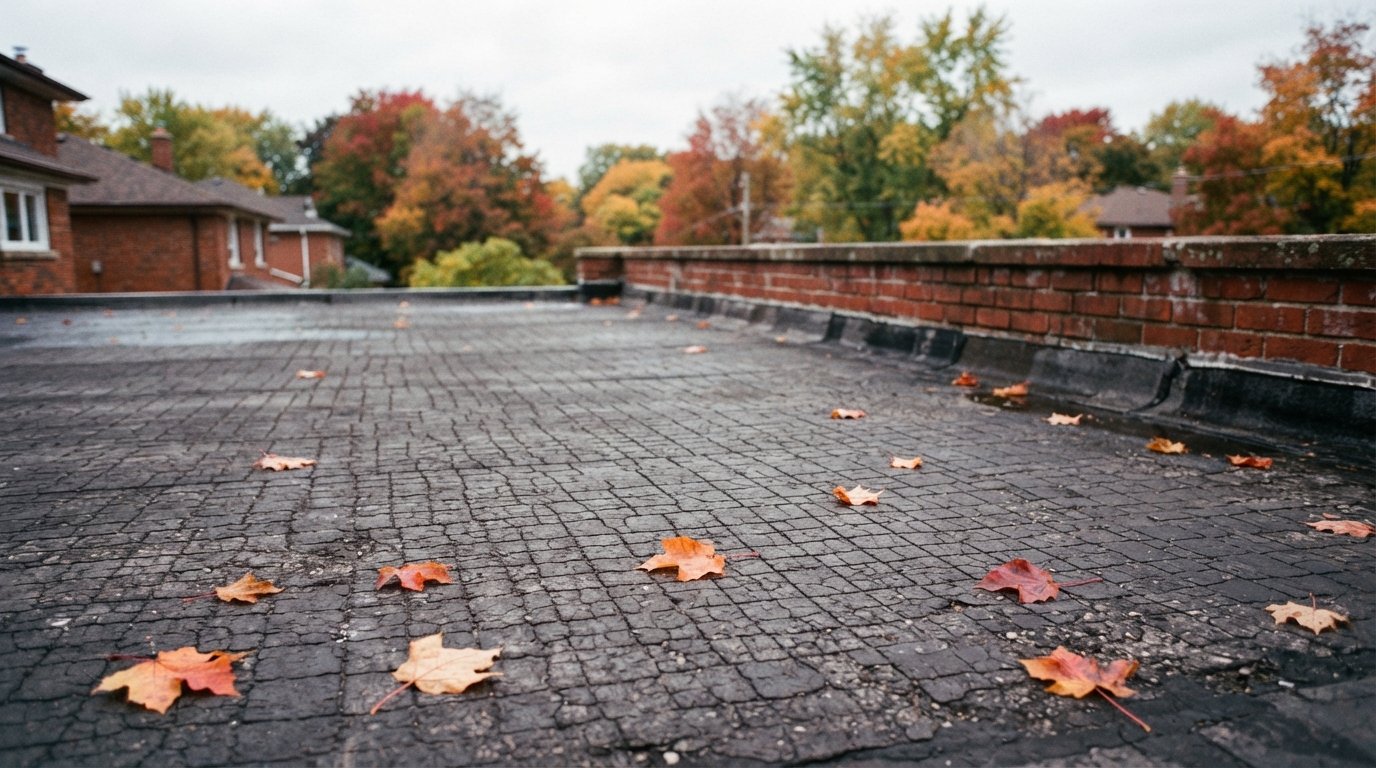
Raccoon roof damage tends to show up in autumn. As nights get colder, raccoons across the GTA look for a dry, sheltered den for the winter, and a flat roof gives them a quiet platform with plenty of weak spots to work on: plastic vents, soft membrane corners, loose soffits and roof hatches that do not quite close. A determined raccoon can pull a vent off, peel back a flashing or tear a hole through membrane in a night, and once it is inside the roof or attic space, rain follows it in.
Below we look at where raccoons usually break into flat roofs, why the animal has to be removed humanely before anything is sealed, how a proper membrane repair is done afterwards, and which guards actually stop the next raccoon from coming back.
Why Raccoon Roof Damage Peaks In Autumn
Raccoons do not hibernate, but they slow down in cold weather and spend long stretches in a den. In autumn they are fattening up and choosing where to spend the winter, and a roof cavity, an attic over an addition, or the space under a roof deck at a parapet is warm, dry and away from dogs. Spring is when mothers most often move into roofs to give birth, but in autumn family groups can still travel and den together, so you cannot assume there is only one animal.
Flat roofs are especially exposed because they are easy to walk on. A raccoon that climbs a downspout, a fence, a tree or a neighbouring garage can patrol the whole surface, testing every vent and corner. Warm air escaping at a vent or a poorly sealed hatch tells it where the space below is heated.
If water is already getting in through a tear, the roof needs a temporary seal from a roofer once the wildlife situation is understood. Our emergency flat roof repair team can make an opening weathertight in coordination with your wildlife company, so the animal is not trapped and the ceiling is not soaked in the meantime.
Where Raccoons Tear Into Flat Roofs
Raccoon roof damage is rarely random. The same locations come up again and again, and each needs a different repair.
| Location | What raccoons do | What the fix usually involves |
|---|---|---|
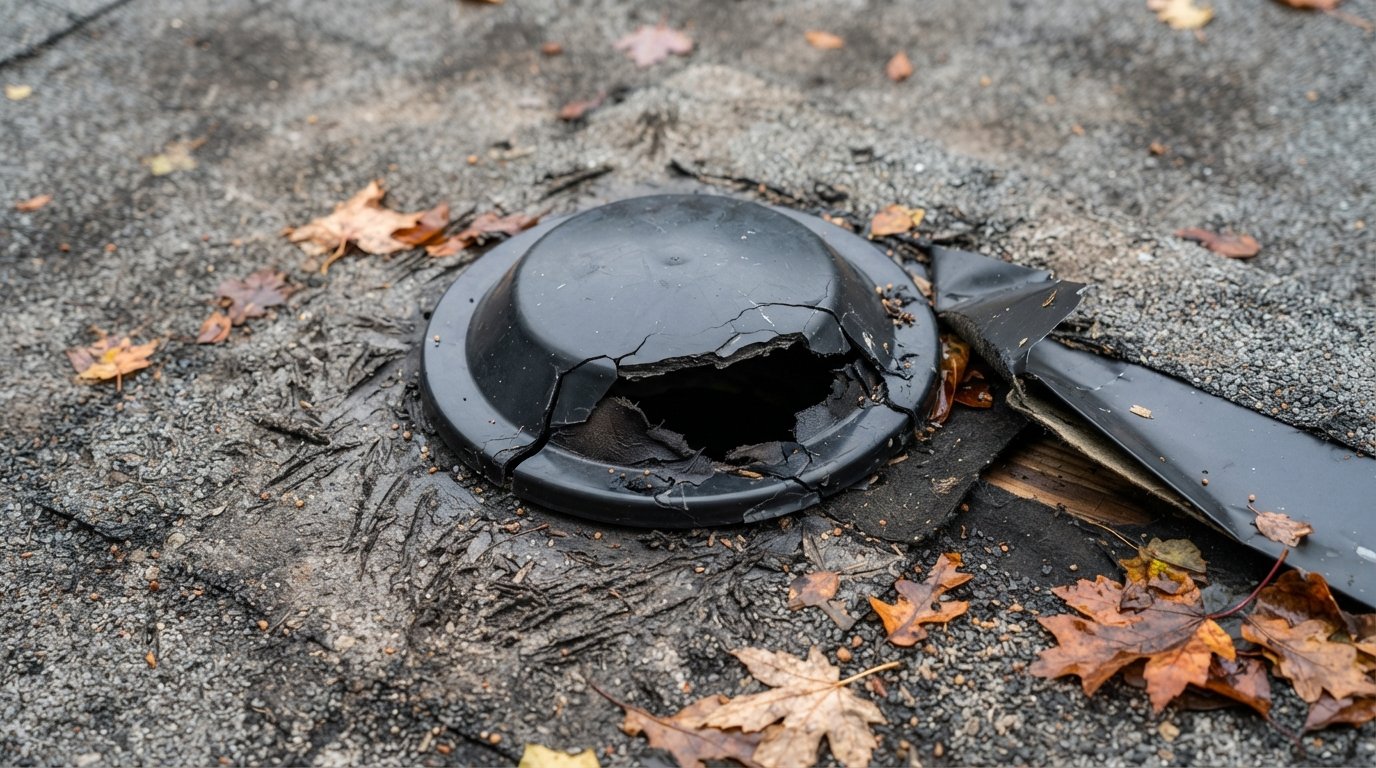
| Roof vents (box, mushroom, plastic stack covers) | Pull off or chew through plastic covers, pry up vent flanges | Metal vent, reflashed into membrane, heavy-gauge steel guard over it |
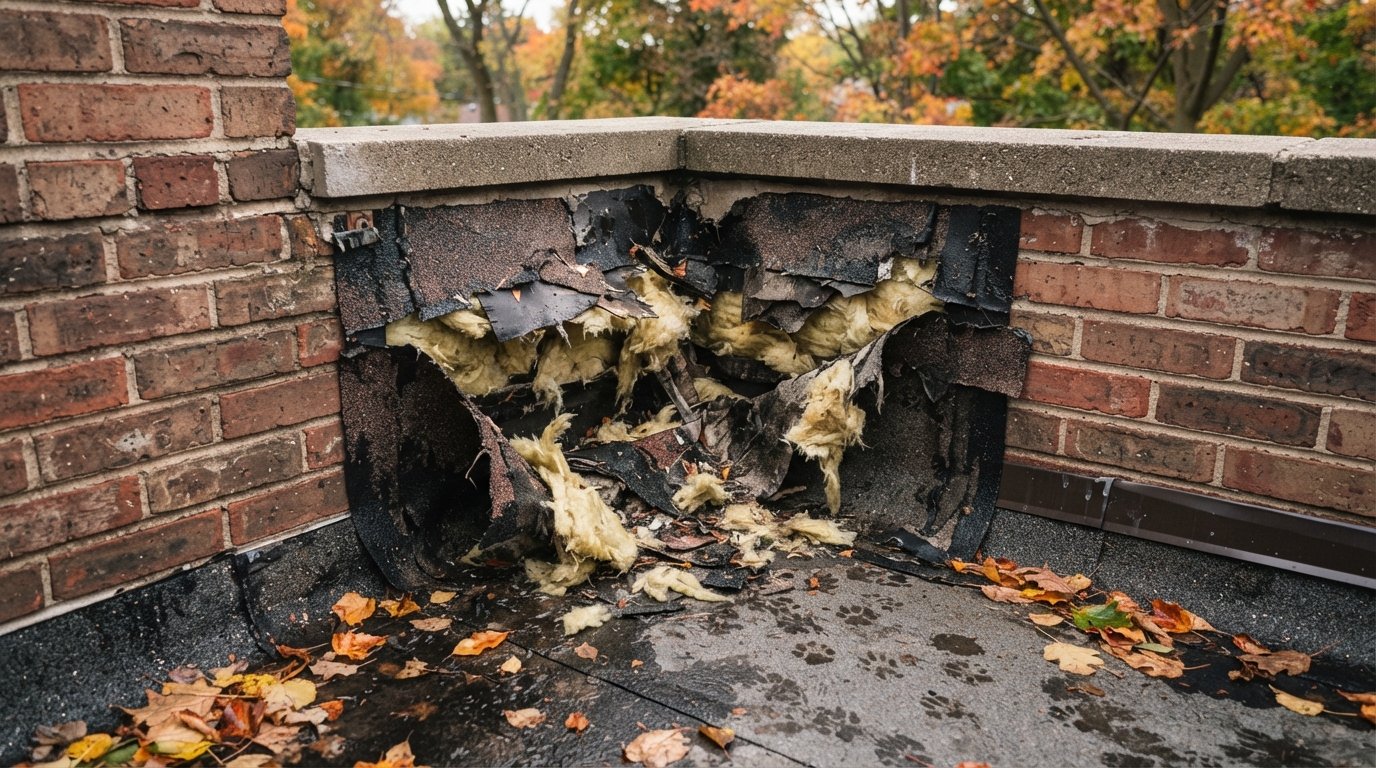
| Parapet corners and base flashings | Peel membrane back where it turns up the wall, dig into the corner | Membrane and insulation repair, reinforced corner, metal coping secured |
| Soffits and overhangs at roof edges | Push in vinyl or aluminium soffit, pull fascia away from the edge | New soffit and fascia, steel mesh behind the soffit where appropriate |
| Roof hatches | Lift loose lids, tear gaskets, enter around worn curbs | Repair or replace hatch, latch it properly, reflash the curb |
| Exhaust hoods and fan curbs | Pry off dampers and hoods, enter ductwork | Metal hood with guard, curb flashing repair |
| Junctions with a sloped roof | Pull up the bottom shingles or step flashing where the slope meets the flat roof | Rebuild the junction flashing, reinforce with metal |
Signs of raccoon roof damage include scratched membrane, chewed plastic, displaced vent caps, muddy prints on parapet caps, flattened gravel and droppings. Raccoons often use one spot on a flat roof as a latrine. Do not handle droppings; raccoon feces can carry parasites that are dangerous to people, so cleanup should be done by the wildlife company or a remediation contractor with proper protection.
Telling Raccoon Roof Damage Apart From Wind, Age Or Other Animals
Owners sometimes find a torn spot on the roof and are not sure what caused it. The cause matters, because it changes both the repair and, potentially, the insurance conversation.
- Raccoon roof damage is usually localised at a vent, corner, hatch or edge. The membrane is clawed or ripped in an irregular shape, insulation is often pulled out onto the roof surface, and there may be prints, droppings or flattened gravel nearby.
- Wind damage tends to start at the roof edge or a seam and lifts membrane in a straight line or a broad flap. There are no claw marks and insulation is rarely shredded.
- Ageing shows as widespread cracking, crazing, granule loss or open laps across large areas rather than one torn hole.
- Squirrels chew smaller, rounder holes, often at soffit corners and fascia joints, and leave tooth marks on wood and plastic.
- Birds tend to nest inside vents and exhaust hoods rather than tearing membrane, though nesting material can block airflow.
Raccoons sometimes return to damage that started for another reason. An old blister or open lap near a parapet gives them a starting point, so a roof in poor condition is more likely to be targeted than a well-maintained one.
Removal Comes First: Never Seal An Animal In
The most important rule in dealing with raccoon roof damage is the order of work. If a roofer patches the hole while an animal is inside, one of two things happens. The raccoon tears its way out through a new spot, often causing worse damage than the first, or it dies inside the roof, which creates odour, insects and a much more unpleasant repair. Sealing in dependent young is cruel and leads to the same outcome.
The right approach is to hire a qualified, insured wildlife control company that works within Ontario’s wildlife rules. Ontario places limits on how nuisance wildlife can be handled and where live-captured animals may be released, and the rules change from time to time, so rely on the company to explain current requirements rather than trapping and relocating a raccoon yourself. In Toronto, the City’s guidance points residents with raccoons in their homes toward private wildlife control; check the City’s current information if you are unsure.
A typical humane removal uses exclusion: a one-way door is installed over the active entry hole so animals can leave but cannot return. The wildlife company inspects for other entry points, may check for young, and monitors the door until the space is confirmed empty. Only then does permanent repair begin. During that period, the roofer may seal any other openings so the one-way door is the only way out.
The Right Sequence From Removal To Repair
| Step | Who does it | Why it matters |
|---|---|---|
| Inspect and confirm activity | Wildlife company, often with the roofer | Finds every opening, not just the obvious one |
| One-way door on the active entry | Wildlife company | Lets animals leave without being trapped inside |
| Temporary weatherproofing of other openings | Roofer | Stops rain getting in while exclusion runs |
| Confirm the space is empty | Wildlife company | Prevents sealing in an animal or young |
| Remove contaminated insulation, sanitise | Wildlife or remediation contractor | Soiled insulation holds odour and health risks |
| Permanent membrane, deck and flashing repair | Roofer | Restores the roof properly, not with a cement patch |
| Install heavy-gauge guards and deterrents | Roofer and wildlife company | Stops the next raccoon from repeating the damage |
Some wildlife companies carry out minor repairs themselves, and that can be fine for a soffit panel. For anything involving the membrane, the flashing or the deck, the repair should be made by a roofer who knows the roofing system, because a quick tar patch over a raccoon hole on a flat roof often leaks by spring.
Repairing The Membrane And Deck Properly
Once the space is empty and clean, the roofer cuts back to sound material. A raccoon hole usually looks smaller on the surface than it is underneath: the animal shreds insulation, and rain that came in through the opening may have soaked the area around it. Wet or soiled insulation should be removed and replaced, and any rotted or softened wood deck boards should be replaced before new roofing goes on.
The repair method depends on the membrane:
- Modified bitumen: new insulation or deck as needed, a base ply patch extended well beyond the damaged area, and a cap sheet patch with offset laps.
- EPDM: cleaning and priming the surrounding membrane, then a patch with appropriate seam tape or cover strip, rounded corners and pressure-rolled edges.
- TPO or PVC: a heat-welded patch of matching membrane, with seams probed after welding.
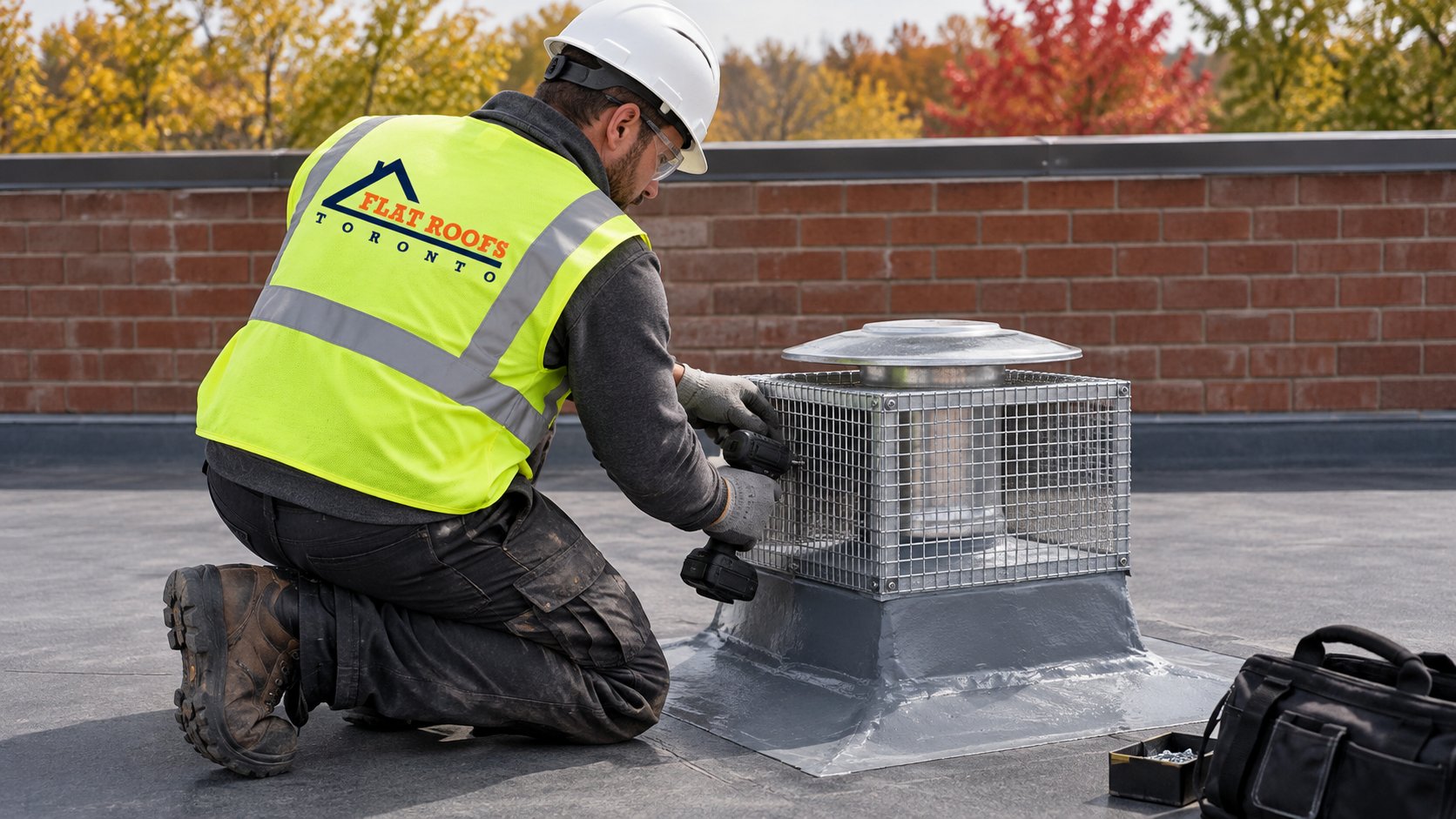
At vents and parapet corners, the repair should restore the flashing detail, not just cover the hole. A vent that was pulled off is replaced and reflashed, ideally with a metal unit rather than a plastic one. A torn parapet corner gets a properly formed corner patch or reinforcement, with the coping above secured so it cannot be lifted. If the roof is near the end of its life and the damage is widespread, this is a fair moment to compare repair against flat roof replacement.
Guards And Deterrents That Actually Work
Raccoons are strong and patient. Lightweight window screen, thin aluminium mesh, plastic vent covers and spray foam do not stop them. Guards that hold up share a few traits:
- Heavy-gauge galvanised steel mesh or perforated steel sized so a paw cannot get a grip through it.
- Mechanical fastening with screws into solid material, not adhesive or a few staples. Any fastener through the membrane must be sealed as part of the flashing detail.
- Metal vents and hoods in place of plastic, with built-in or add-on guards.
- Secured roof hatches with a working latch and an intact gasket.
- Metal reinforcement at parapet corners where raccoons have dug before.
Deterrence on the ground helps too. Cut back tree limbs that overhang the roof, so they are no longer a bridge. Keep garbage, compost and pet food secured. Downspouts that raccoons climb can sometimes be fitted with a smooth metal collar, as long as it does not interfere with drainage. A wildlife company can advise on the approach that suits your property.
Follow-up after the repair
Raccoons that lose a den often test the same roof again within weeks. A short follow-up visit, or a look from a safe vantage point, after the first few weeks and again after the coldest part of winter, shows whether guards have been pulled at, whether new scratching has started at another vent, and whether the repaired area is holding. Fresh raccoon roof damage found early is a small fix; found in spring after months of rain and freeze-thaw, it is not.
Costs, Insurance And What To Expect
Raccoon roof damage usually means two separate bills: the wildlife company’s removal and exclusion work, and the roofer’s repair. Costs vary with access, roof type, how far the damage spreads and how much insulation must be replaced. The ranges below cover the roofing side only and are rough GTA estimates, not quotes.
| Roofing work | Typical scope | Typical estimate range (CAD) |
|---|---|---|
| Temporary weatherproofing | Seal openings other than the exclusion door | Often $200 to $600 |
| Membrane patch at a tear | Cut back, patch base and cap or weld a patch | Often $400 to $1,200 |
| Vent replacement with guard | Metal vent, reflashing, steel guard | Often $300 to $800 per vent |
| Parapet corner rebuild | Insulation, flashing, reinforcement, coping | Commonly $700 to $2,000 |
| Insulation and deck replacement | Remove soiled insulation, replace deck boards, new roofing over the area | Often $1,500 to $4,500 or more |
Home insurance policies differ on wildlife damage. Some exclude damage caused by animals, some cover sudden damage but not gradual damage, and some cover the resulting water damage but not the entry point. Read your policy and call your insurer before work starts. Photos of the damage before repair, and the wildlife company’s report, make that conversation easier.
On commercial buildings and plazas, the same principles apply, with the added need to coordinate with tenants and any rooftop equipment contractors. Our commercial flat roofing team handles that kind of repair on larger roofs.
Can a roofer just patch the hole the raccoon made?
How do I know if raccoons are on my flat roof?
Can I trap and relocate the raccoon myself?
What stops raccoons from coming back?
Does home insurance cover raccoon roof damage?
Is autumn a good time to repair raccoon damage?
Fix Raccoon Roof Damage The Right Way, In The Right Order
Humane removal first, then a proper roofing repair and guards that last. Flat Roofs Toronto works alongside your wildlife control company to weatherproof openings, repair torn membrane and flashings, replace damaged vents and install heavy-gauge guards on flat roofs across the GTA.
Call us today at (647) 333-3528 or request a free estimate.
Repairing raccoon damage on house and commercial flat roofs throughout Toronto and the GTA.