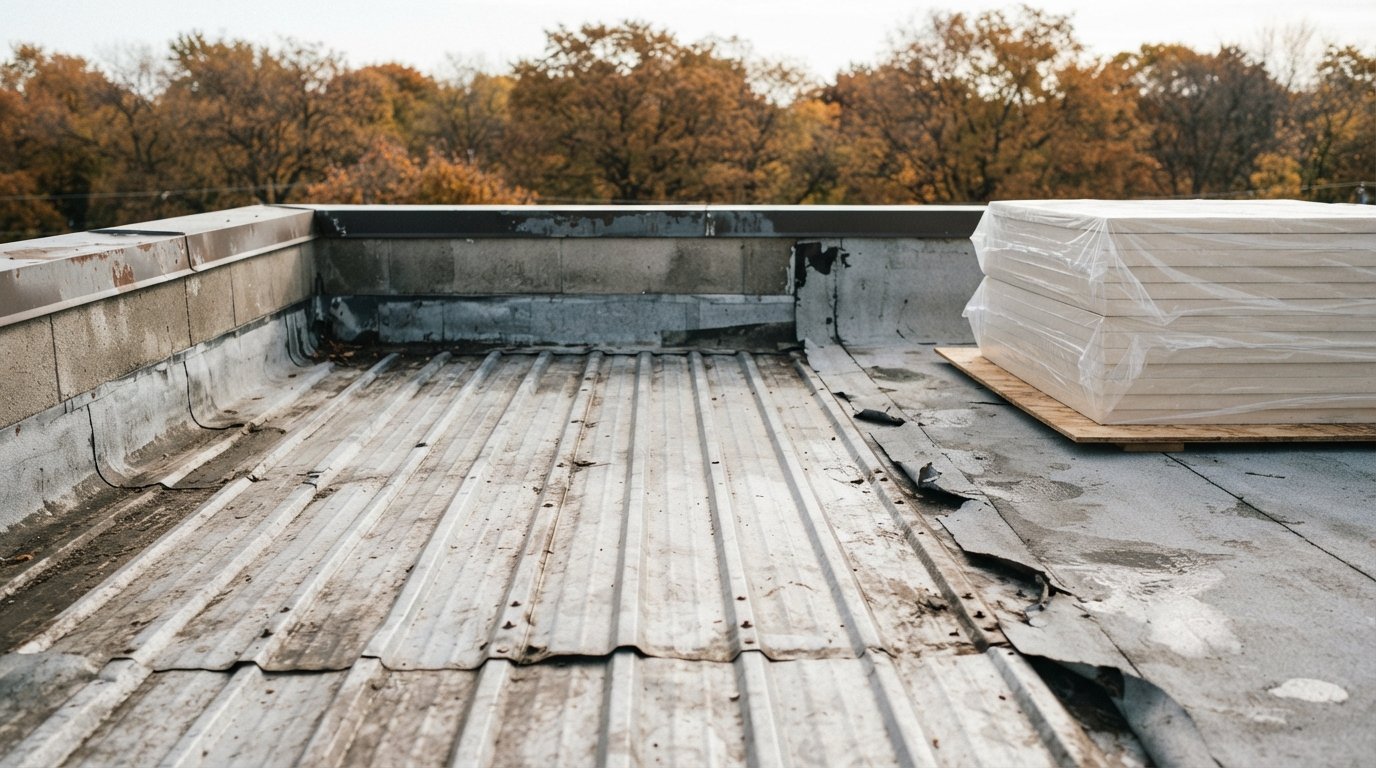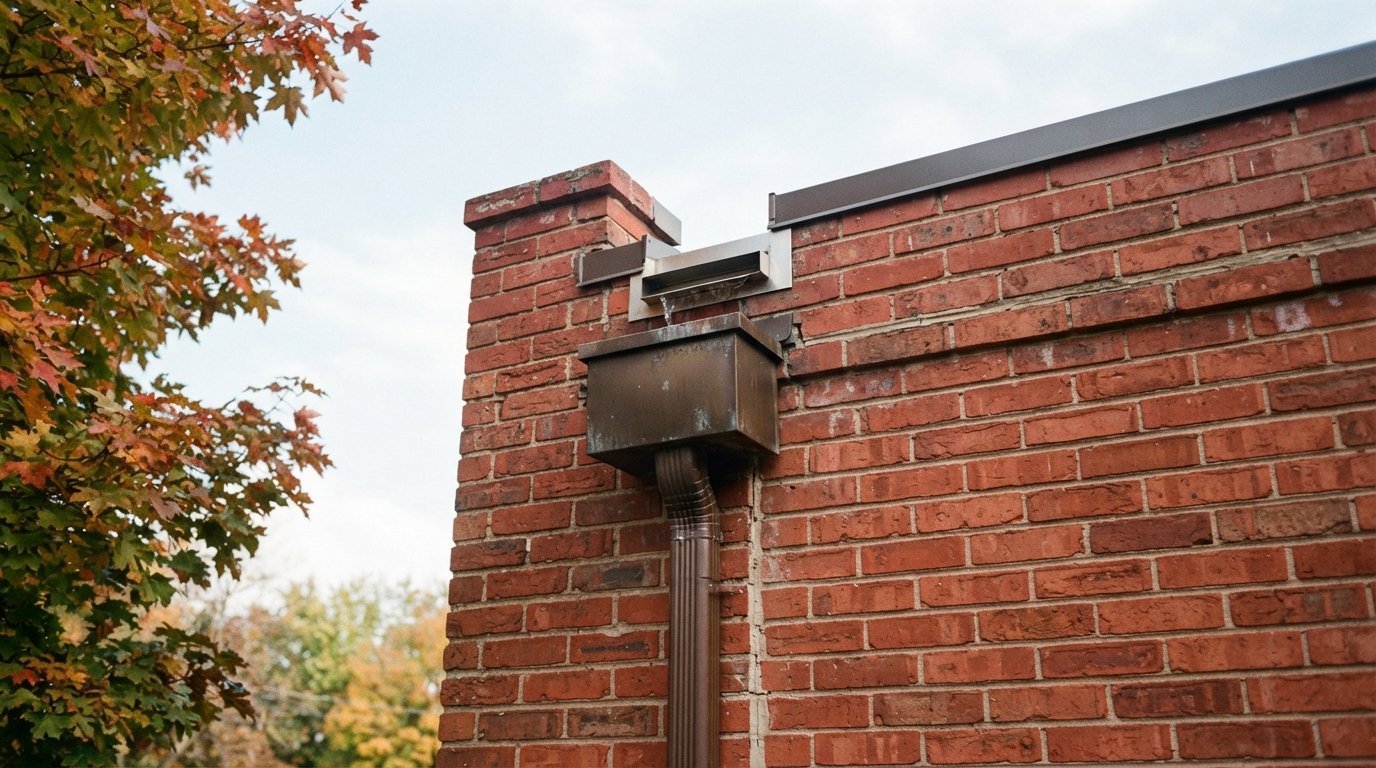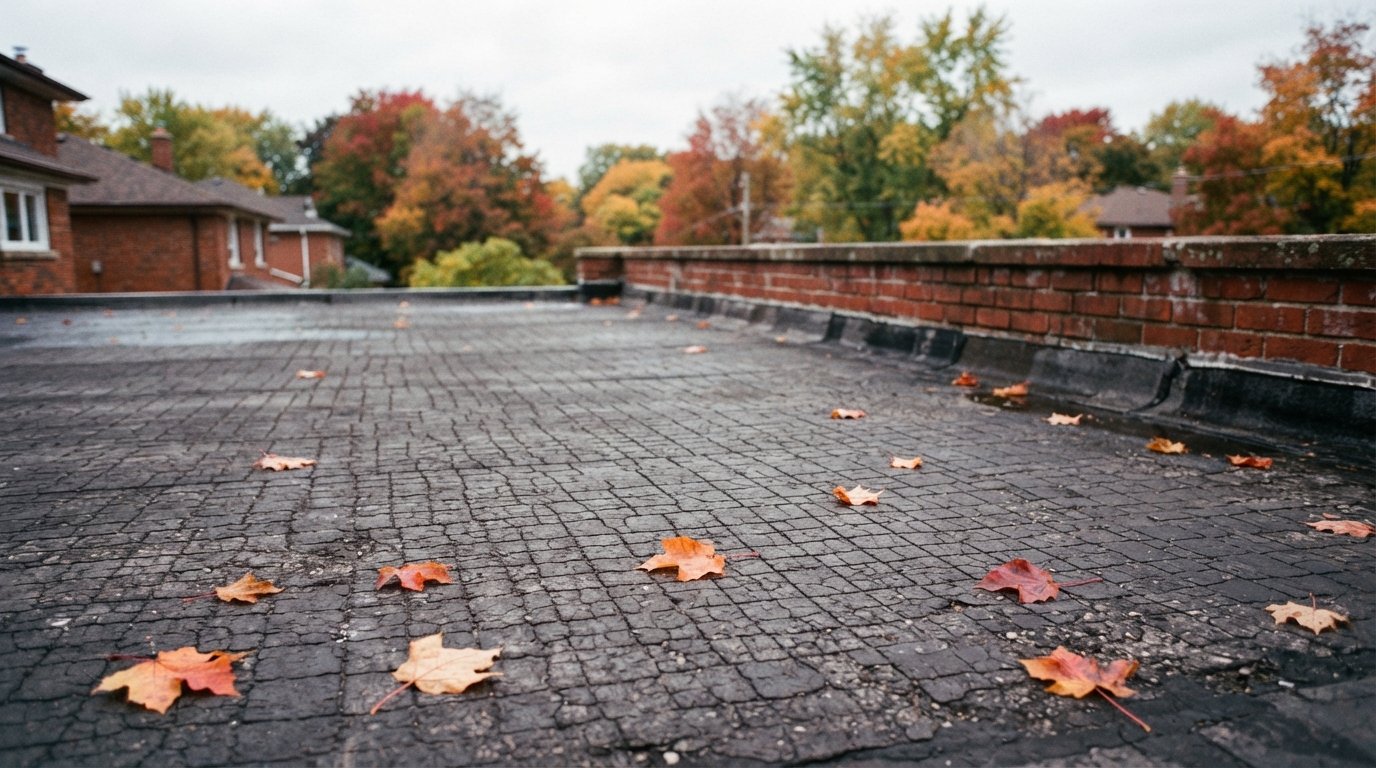

Autumn flat roof maintenance is the visit that decides how your roof gets through the colder months. A spring check looks back at what the winter did. An autumn visit looks ahead: it clears the leaves that are about to clog every drain, catches the small open seams and loose flashings before water gets into them and freezes, and leaves you with a written record of the roof’s condition going into the hardest part of the year.
This guide walks through what a professional autumn visit actually covers, in the order a roofer usually works, what can be fixed on the spot, what should be quoted separately, and how to judge whether the visit you paid for was thorough.
What Autumn Flat Roof Maintenance Is Really For
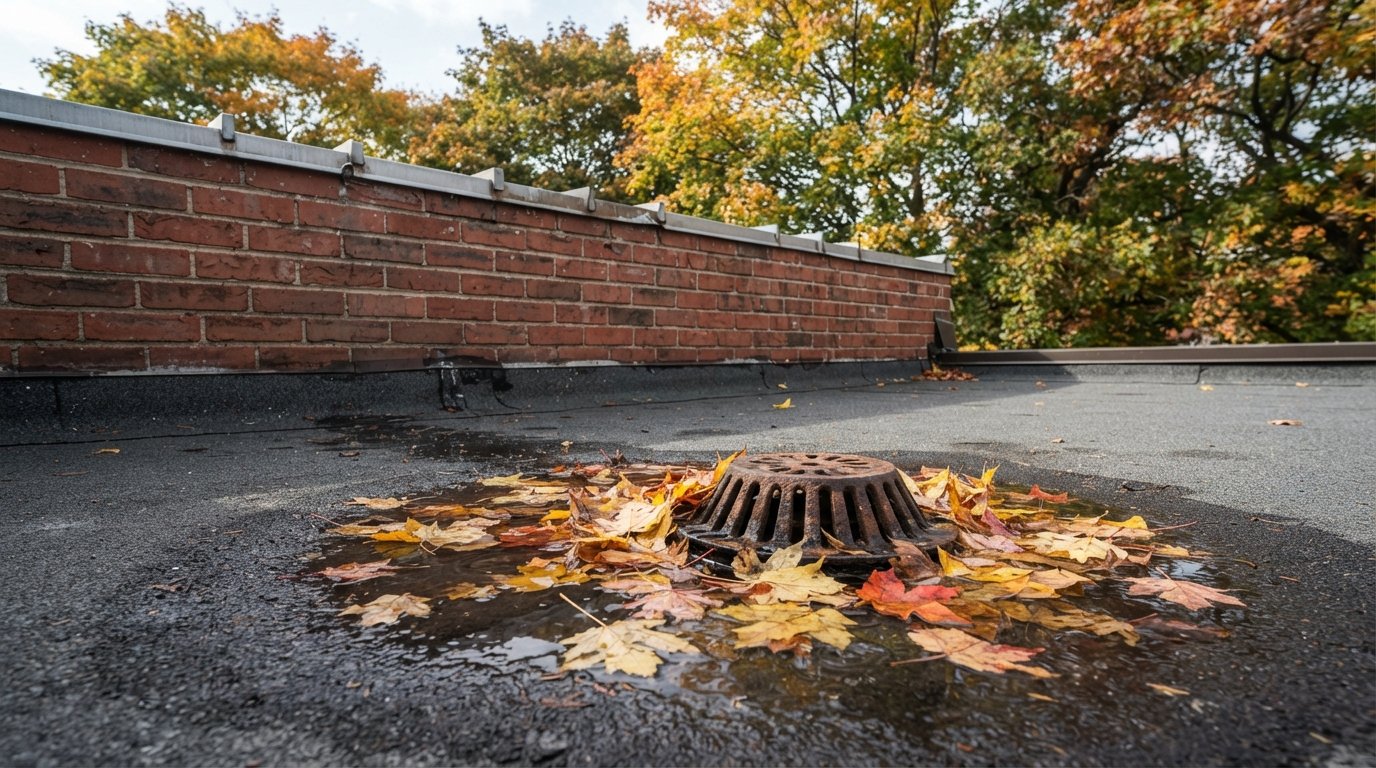
A flat roof relies on water leaving it quickly through a small number of drains or scuppers. It also relies on seams, flashings and edge details staying closed. Autumn puts pressure on both at once: trees drop their leaves, rainfall often gets heavier, and nights start dipping toward freezing. Water that sits in a clogged drain or seeps into an open lap now will be freezing and thawing repeatedly a few weeks from now, and every cycle opens the gap a little wider.
So the goals of autumn flat roof maintenance are simple:
- Make sure water can leave the roof through every drain, scupper and downspout.
- Find and close small openings before freeze and thaw cycles enlarge them.
- Secure anything that could be loosened by autumn and winter winds.
- Record the roof’s condition so you can plan repairs or replacement with real information.
When the visit finds something beyond routine upkeep, such as an active leak or a failed flashing, it moves into flat roof repair territory, and the goal becomes getting it sealed before the weather turns.
How a Professional Visit Runs, Step by Step
Every roofer has their own routine, but a thorough autumn visit usually covers the same ground. This is roughly the order we work in on a typical house or small building.
1. Ground check and interior questions
Before going up, we look at the roof edges, downspouts and walls from the ground and ask the owner about any stains, drips or musty smells inside. A ceiling stain under a particular room tells us where to spend extra time on the roof.
2. Drains, scuppers and downspouts
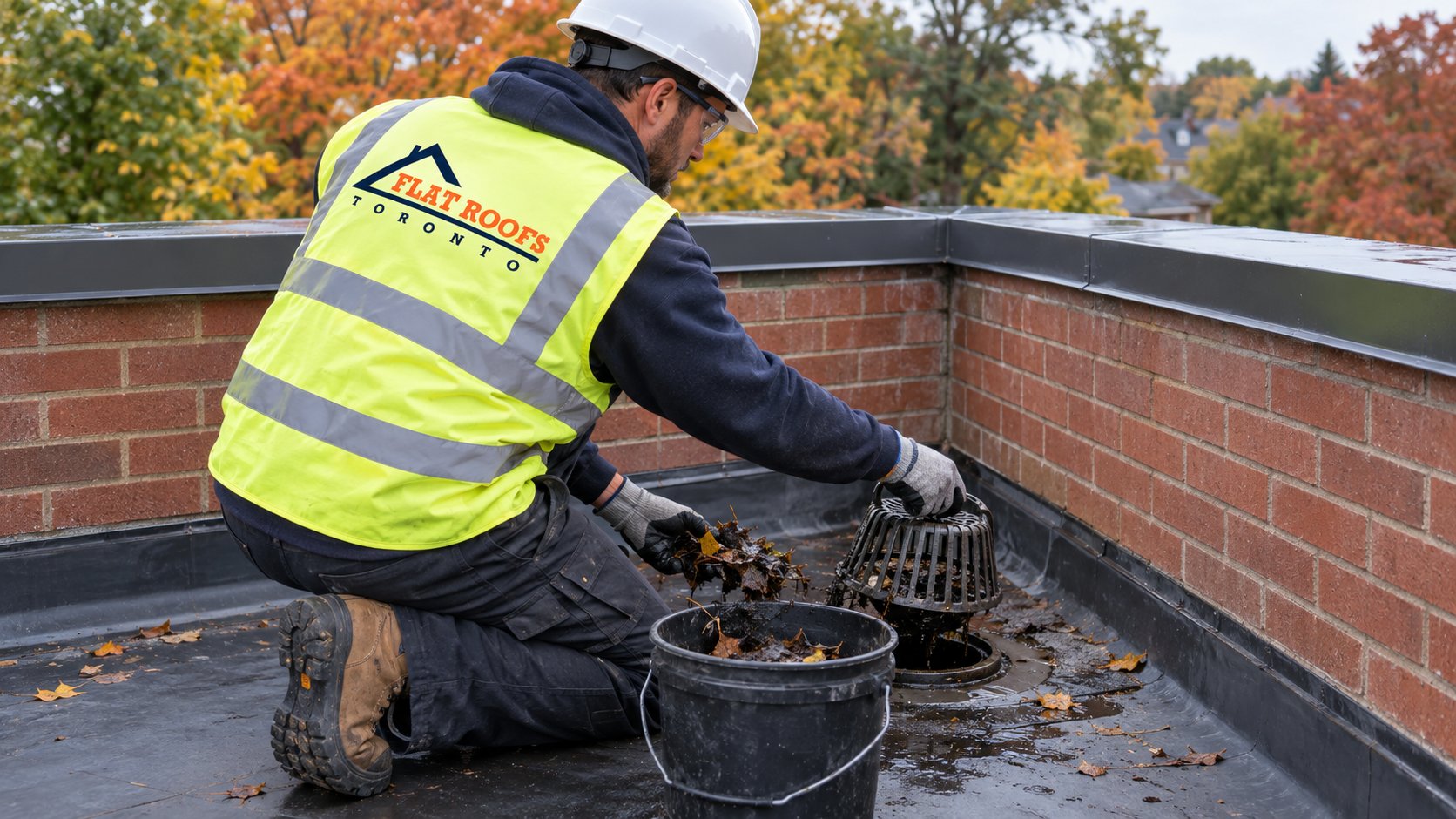
This is the heart of the autumn visit. Leaves, seeds, twigs, grit from granulated membranes and the occasional tennis ball collect at the outlets. We remove the debris, lift the strainer or dome, clear the drain body and check that water actually flows through. For scuppers, we clear the opening, the collector box and the downspout below. Where a drain has no strainer, or a broken one, that is noted and usually replaced on the spot.
3. The field of the roof
Next we walk the open areas looking for ponding marks, blisters, splits, bare spots where granules have worn away, and soft areas underfoot that could mean wet insulation. Stains from standing water show where the roof does not drain well, even when it is dry on the day of the visit.
4. Seams and laps
Every seam is a potential leak. On modified bitumen we look for lifted edges and open laps; on single-ply membranes we probe the seams for gaps; on older built-up roofs we check for cracks and alligatoring in the surface. Small openings found now are the ones most worth fixing before freeze and thaw.
5. Penetrations
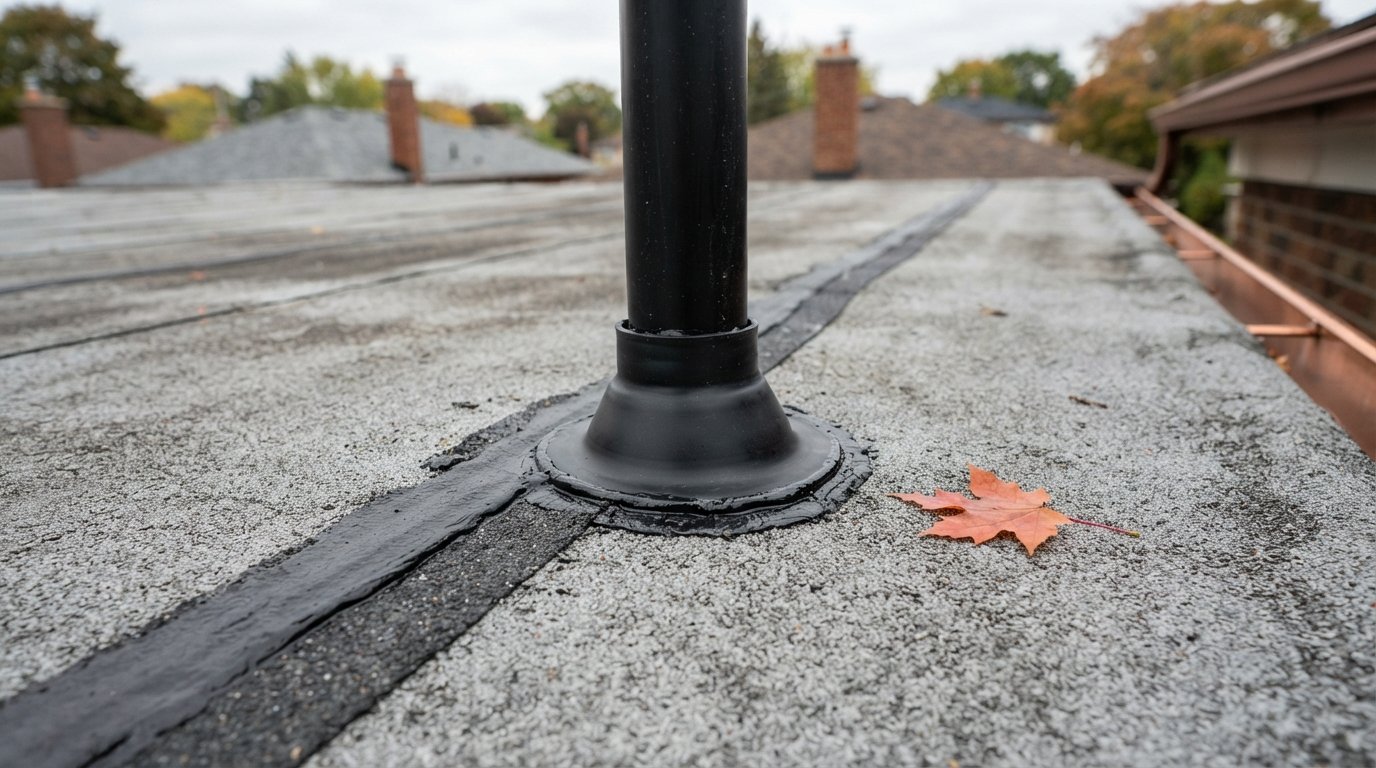
Plumbing vents, exhaust fans, gas lines, electrical conduits and mechanical supports all pass through the membrane. We check boots, collars and pitch pockets for cracks, shrinkage and sealant that has dried out and pulled away.
6. Edge metal, parapets and walls
Loose metal edge or cap flashing is both a leak risk and a wind risk. We look for lifted sections, missing fasteners, open joints, and base flashings that have slumped or pulled away from parapet walls. Masonry above the roof line gets a look too, since cracked mortar and loose caps let water into the wall.
7. Skylights and hatches
Curbs, flashings and the seals around the glazing are checked for gaps and cracking. Condensation between panes is noted, though that is a glazing issue rather than a roofing one.
8. Documentation
Finally, we photograph the roof overall and every item found, and note what was fixed on the spot and what needs a separate quote.
| Component | What gets checked | Common autumn finding |
|---|---|---|
| Roof drains | Strainer in place, drain body clear, water flows | Leaves and seeds packed around the strainer |
| Scuppers and downspouts | Opening clear, collector box and downspout flowing | Debris lodged in the elbow at the base of the downspout |
| Membrane field | Ponding marks, blisters, splits, granule loss | Summer blisters and worn spots in foot traffic areas |
| Seams and laps | Bonded edges, no fishmouths or lifted corners | Small open laps at end joints and corners |
| Penetrations | Boots, collars, sealant, pitch pockets | Dried or cracked sealant around vent stacks |
| Edge metal and caps | Fasteners, joints, lifting sections | Loose cap flashing on parapets after summer storms |
| Skylights | Curb flashing, perimeter seals | Gaps at the corners of older curbs |
Small Repairs Worth Doing Before Freeze and Thaw
A good maintenance visit is not just an inspection. Many small problems can be fixed while the roofer is already on the roof, and early autumn is the right time because most roofing sealants and adhesives need reasonable temperatures and a dry surface to bond properly. Always check the product’s data sheet for the manufacturer’s temperature limits; the useful window narrows as autumn goes on.
| Usually fixed during the visit | Usually quoted separately |
|---|---|
| Replacing a missing or broken drain strainer | Rebuilding a failed drain or adding a new outlet |
| Resealing small open laps and lifted seam edges | Replacing long lengths of failed seam |
| Fresh sealant around vent stacks and small penetrations | New flashing boots or rebuilt pitch pockets |
| Refastening loose edge metal and cap joints | Replacing corroded or damaged edge metal runs |
| Patching a small puncture or split | Cutting out and replacing blistered or wet areas |
| Clearing and flushing downspouts | Correcting ponding with tapered insulation or new drains |
The line between the two columns is not fixed; it depends on time, materials on hand and the size of the problem. What matters is that you know which items were closed on the day and which are still open.
How Autumn Flat Roof Maintenance Changes by Roof Type
The basic routine is the same on every roof, but the details a roofer pays most attention to depend on the membrane.
Modified bitumen
Most flat roofs on Toronto-area houses are two-ply modified bitumen. On these roofs, autumn flat roof maintenance focuses on lap edges, especially the T-joints where three sheets meet, and on base flashings at parapets that can slump after a hot summer. Areas of heavy granule loss are noted, because the exposed bitumen ages faster in sunlight.
Built-up gravel roofs
On older tar and gravel roofs, wind and water move the gravel, leaving bare patches of exposed bitumen. Gravel also drifts into drains and scuppers, so drain clearing on these roofs often means removing stones as well as leaves. Pitch pockets around penetrations need close attention, because the filler shrinks and cracks with age.
Single-ply membranes
On TPO, PVC and EPDM roofs, the seams are checked with a probe along their full length, and flashing at curbs and corners gets extra attention. Punctures from dropped tools or branches are easy to miss on these smooth membranes, so the field is walked carefully. Any repair uses materials approved by the membrane manufacturer, since the wrong sealant can damage some single-ply materials.
Whatever the membrane, an autumn flat roof maintenance visit on a roof that has had several past repairs should also check that older patches are still bonded, because patches are often the first thing to lift.
Timing Your Autumn Visit
Timing autumn flat roof maintenance is a balance. Go too early and the trees have not dropped their leaves yet, so the drains will clog again within weeks. Go too late and the weather can make repairs difficult, with short days, cold mornings and wet surfaces.
- Roofs with few or no trees nearby: a single visit from late September through October usually works well.
- Roofs under large trees: two visits often make sense, one in early autumn for repairs while the weather is still mild, and a quick drain clearing after most of the leaves have fallen.
- Roofs with known problems: book early, so any repair has time to be scheduled and completed before temperatures drop.
Maple keys, oak leaves and needles from nearby conifers are the main culprits around Toronto-area homes. Trimming branches that overhang the roof reduces the load, and it also keeps branches from scraping the membrane in wind.
What the Report Should Tell You
The documentation is what turns autumn flat roof maintenance from a chore into a planning tool. A useful report includes:
- Date of the visit and the weather conditions.
- Overall photos from several angles, so changes can be compared year to year.
- Photos of each issue found, with its location marked on a simple roof sketch.
- A clear list of what was repaired during the visit.
- A separate list of recommended repairs, ranked by urgency.
- An honest estimate of the remaining useful life of the membrane, if the roofer can judge it.
Over several years, these reports show trends: a seam that needs resealing every autumn, a drain that always holds water, a blister that keeps growing. Those trends tell you when repair has stopped being good value and a flat roof replacement should go on the budget.
What Autumn Flat Roof Maintenance Typically Costs
Pricing depends on roof size, access, how many drains and penetrations there are, and how much repair is needed. These are broad estimates only:
| Service | Typical scope | Estimated range |
|---|---|---|
| Drain and scupper clearing only | Clear outlets, check flow, basic visual check | Often $150 to $400 for a house roof |
| Full maintenance visit | Complete inspection, drain clearing, photo report | Commonly $250 to $700 depending on size and access |
| Visit with minor repairs | Inspection plus sealing, strainers and refastening | Frequently $400 to $1,200 depending on the number of items |
| Commercial or multi-unit roof | Larger area, more drains and equipment | Usually quoted on area and scope after a site review |
Some owners prefer a yearly maintenance arrangement with a spring and an autumn visit. Whatever the arrangement, ask for a written scope so you know exactly what is included. For larger buildings, our commercial flat roofing team can set up a maintenance schedule around your building’s operations.
What You Can Do Safely From the Ground
You do not need to go on the roof to help. In fact, we recommend owners stay off it; flat roofs can be slippery with wet leaves, and heavy foot traffic damages membranes. From the ground and from inside, you can:
- Watch how downspouts flow during a heavy rain. A downspout that barely trickles while rain is pouring usually means a clog above.
- Look for water spilling over roof edges or parapets, which points to a blocked drain or scupper.
- Check ceilings below the roof for new stains after storms.
- Keep an eye on trees that overhang the roof and plan trimming.
- Note the date of any problems so the roofer can connect them to weather events.
Common Mistakes With Autumn Roof Care
- Clearing the top of the drain only. Leaves removed from the strainer look tidy, but debris inside the drain body or downspout can still block flow.
- Smearing sealant over everything. Layers of caulk and roof cement hide problems and trap water. Proper repairs use compatible materials applied to clean, dry surfaces.
- Leaving the strainer off. A drain without a strainer will pull leaves and debris into the pipe, where they are much harder to clear.
- Skipping the report. Without photos and notes, next year’s visit starts from zero.
- Waiting too long. Repairs that are easy in early autumn become difficult once temperatures fall below what the materials can handle.
When should autumn flat roof maintenance be done?
How is autumn maintenance different from a spring inspection?
Can I clear my own roof drains?
Why do small open seams matter so much in autumn?
Can roof repairs be done in cold weather?
How often should a flat roof be maintained?
Book Autumn Flat Roof Maintenance Before the First Freeze
An hour or two on the roof now can prevent a leak in the middle of a cold snap, when repairs are harder and slower. Flat Roofs Toronto clears your drains and scuppers, checks every seam, penetration and edge, fixes the small items on the spot and leaves you with a photo report you can use for planning.
Call us today at (647) 333-3528 or request a free estimate.
Serving homeowners and property owners across Toronto and the GTA.