
When water starts running down a ceiling in the middle of a July thunderstorm, emergency roof repair in Scarborough stops being a maintenance item and becomes a damage-control problem measured in hours, not weeks. Scarborough sits on the eastern edge of Toronto, exposed to lake-driven wind and to the short, violent convective storms that move across the GTA between May and September. A flat or low-slope roof that has been quietly holding on for a decade will often choose exactly that moment to fail.
This guide explains what to do in the first hour, what a legitimate emergency crew will actually do when they arrive, what the work costs in 2026 Ontario dollars, and how to keep a temporary fix from turning into a permanent problem. It is written for homeowners and small commercial property owners who need emergency roof repair in Scarborough and want to make good decisions while the water is still coming in.
What Actually Counts as Emergency Roof Repair in Scarborough
Not every leak is an emergency, and treating every drip as one is an expensive habit. The practical test is simple: is water actively entering the building, and is the rate of entry going to cause structural, electrical or mould damage before a scheduled repair can be booked? If the answer is yes, you need emergency roof repair in Scarborough. If the answer is no, you need a prompt inspection and a properly scheduled repair, which will almost always cost less.
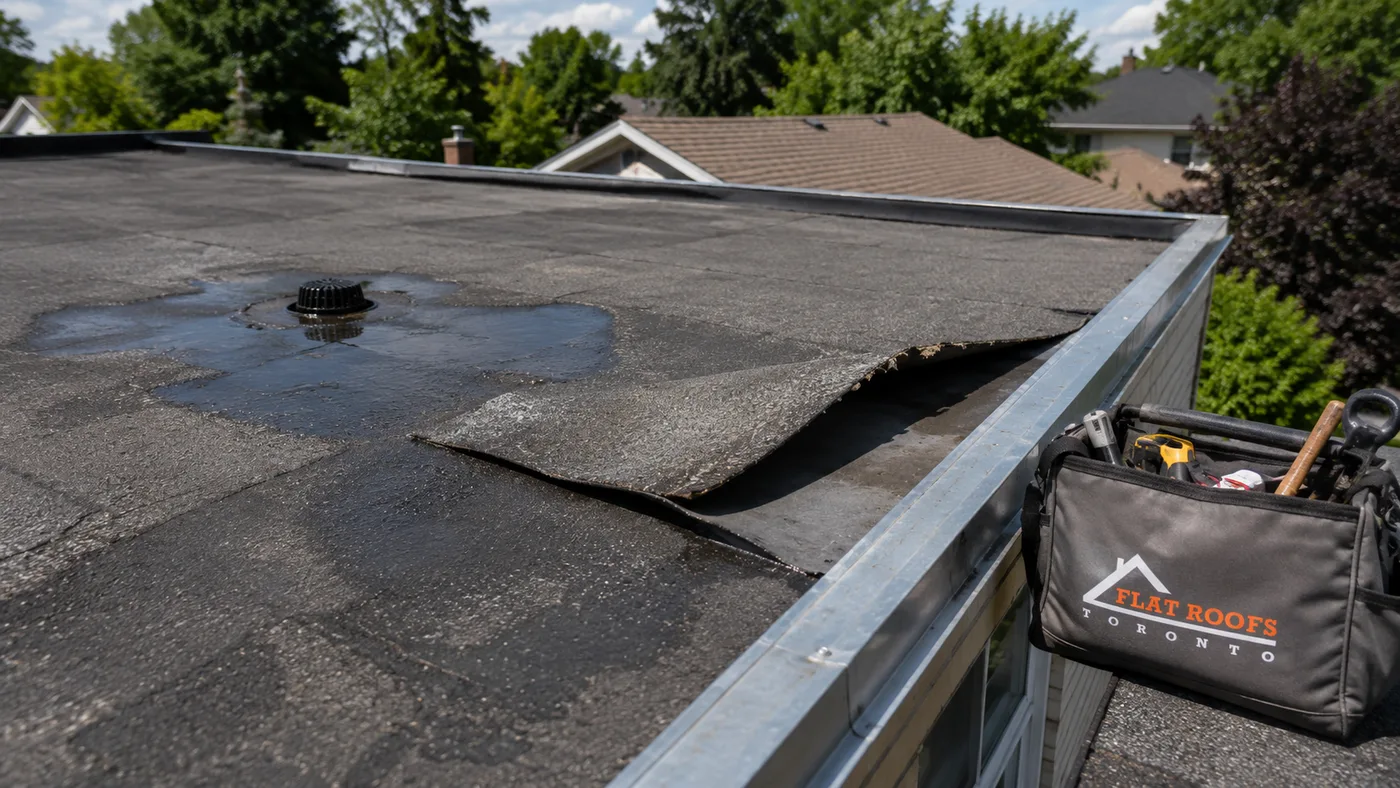
Situations that genuinely warrant an emergency call include active water entry through a ceiling or light fixture, a membrane seam that has opened and is admitting water directly into the roof assembly, wind that has lifted or peeled a section of flat roof membrane, a punctured roof from falling branches or wind-driven debris, a blocked or failed roof drain causing water to back up against a parapet, and any situation where water is reaching electrical panels, wiring or a service entrance.
Situations that usually do not require emergency roof repair in Scarborough include a small stain on a ceiling that has not grown in days, granule loss on a sloped section, a slightly ponding area that drains within 48 hours, and minor lifting at a membrane edge with no visible water entry. Those are real defects and they need attention, but they can be handled during a normal service window at a much lower cost. Knowing the difference is the first thing that separates a controlled repair from an expensive scramble.
One more distinction is worth making before you search for emergency roof repair Scarborough at two in the morning: the difference between the source of the leak and the place the water appears. On a low-slope roof, water can travel several metres along the deck or along a layer of saturated insulation before it finds a seam in the ceiling below. The wet spot in your hallway is rarely directly beneath the hole. This is why a competent crew inspects the roof rather than simply sealing whatever is above the stain, and it is the single biggest reason DIY patching so often fails to stop the water.
The First Hour: What to Do Before a Crew Arrives
What you do in the first sixty minutes has more effect on your total repair bill than almost anything else. The goal is not to fix the roof. The goal is to limit where the water goes and to preserve evidence for your insurer. Nearly every emergency roof repair in Scarborough that ends well starts with a homeowner who handled these five steps calmly.
Contain the water inside
Move furniture and electronics out of the affected area and put down buckets, bins or a tarp. If the ceiling is bulging, that is trapped water sitting on the drywall, and it will eventually let go all at once. Puncturing the low point of the bulge with a screwdriver, with a bucket underneath, is counterintuitive but it is the right call. A controlled release into a bucket costs far less than a ceiling collapsing across a room and taking insulation, wiring and flooring with it.
Kill the power to the affected area
If water is anywhere near a light fixture, a pot light, a ceiling fan or an outlet, shut off that circuit at the panel. Do not stand in standing water to do it. This single step is the reason many emergency roof repair in Scarborough calls end with a repair bill instead of an electrical rebuild. If the panel itself is wet or the main service entrance is affected, stay clear and call your utility.
Do not go on the roof
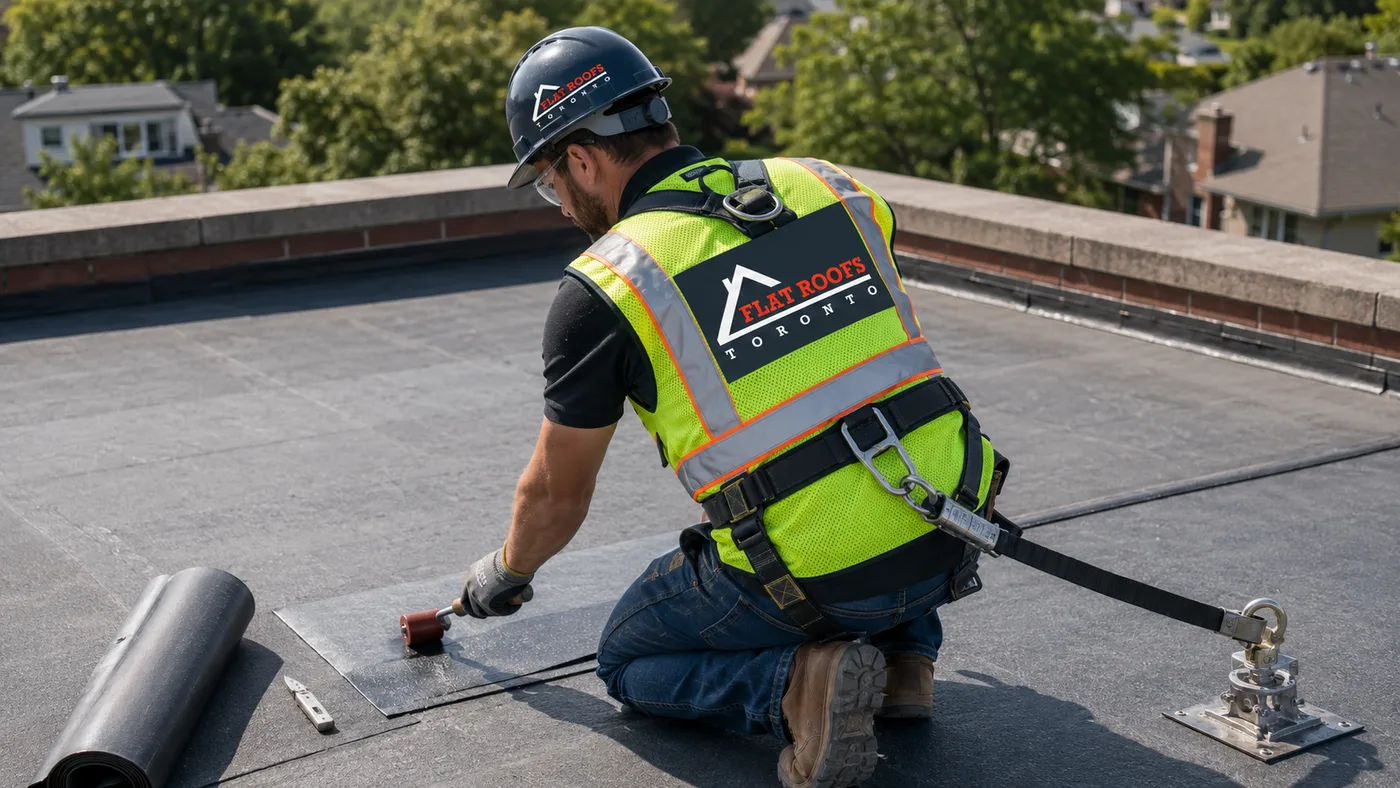
A wet membrane during or after a summer storm is genuinely dangerous, and a low-slope roof gives no visual warning before you slip. There is also a real risk of stepping through a section that has already been softened by long-term saturation. Every legitimate contractor providing emergency roof repair in Scarborough carries fall-protection equipment and knows how to load a roof safely. Wait for them.
Document everything
Photograph the interior damage, the water path, the date and time, and any visible exterior damage that can be safely seen from the ground. Insurers in Ontario routinely ask for evidence that the damage was sudden and accidental rather than the result of long-term neglect. Photographs taken during the event are worth far more than photographs taken after cleanup, because by then the adjuster is looking at a dry ceiling and a story.
Call, and describe the situation accurately
Tell the dispatcher whether water is actively entering, how large the affected ceiling area is, whether the roof is flat or sloped, roughly how old it is, and whether there is electrical involvement. That information determines whether a two-person crew is dispatched immediately or whether you are scheduled for the next morning, which is often the correct and cheaper answer.
How Scarborough’s Housing Stock Shapes Emergency Roof Repairs
Scarborough is not architecturally uniform, and the roof problems follow the housing. Understanding which category your property falls into tells you a great deal about what is likely failing and how urgent it is.
A large share of the area consists of postwar bungalows and side-splits built between the late 1940s and the 1970s. Many of these have had additions, rear extensions, garage conversions or sunroom builds attached over the decades, and those additions very frequently carry a flat or low-slope roof tied into the original sloped roof. That junction, where a low-slope membrane meets a sloped shingle field, is one of the single most common failure points behind emergency roof repair in Scarborough calls. It is a detail that depends entirely on correct flashing and correct overlap, and forty-year-old versions of that detail are usually at the end of their service life.
Newer subdivisions built from the 1980s onward tend to have more complex rooflines, more valleys, and more penetrations for bathroom fans, kitchen exhausts and HVAC equipment. Each penetration is a potential leak, and on low-slope sections each one needs a properly sealed curb or boot. The larger estate-style lots scattered through the area often carry substantial flat roof areas over attached garages and rear wings, which means more square footage of membrane, more drains to keep clear, and more edge metal that has to stay fastened through a wind event.
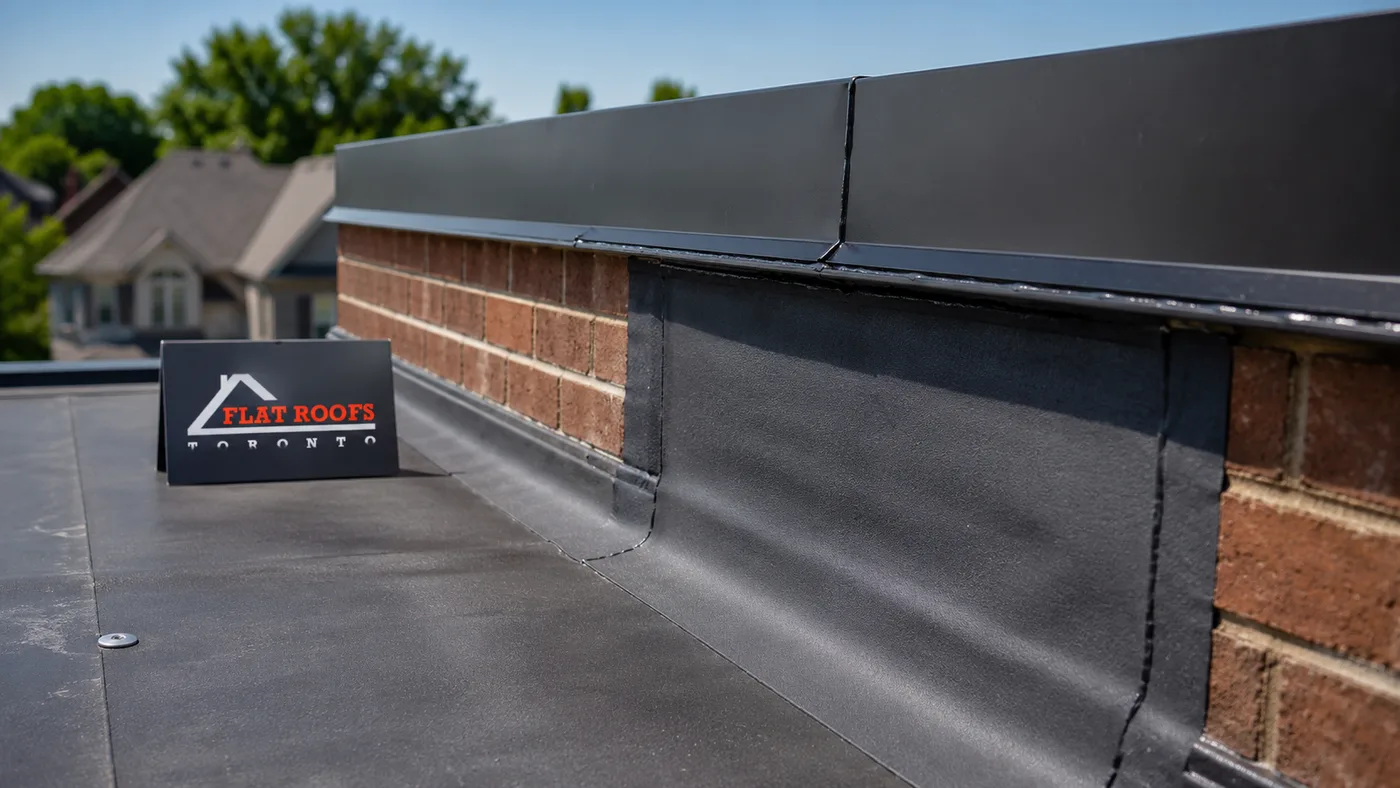
Older brick homes closer to the established parts of the district add another variable: parapet walls and masonry-to-roof transitions. Water that appears to be a roof leak on a brick building is quite often entering through deteriorated mortar or a failed parapet cap and travelling along the roof deck before it shows up inside. Diagnosing that correctly matters, because sealing the membrane will not stop a leak that is coming through the wall. Our full range of Scarborough flat roofing services covers both the membrane side and the transition details where these two systems meet.
What Emergency Roof Repair in Scarborough Costs in 2026
Emergency work costs more than scheduled work for three reasons: the crew is dispatched outside normal routing, the diagnosis has to happen under adverse conditions, and the first visit is usually stabilization rather than a permanent fix. The figures below reflect typical 2026 GTA pricing ranges for residential and small commercial low-slope roofs. Every roof is different, and a firm number only comes after someone has looked at the assembly in person.
| Emergency scenario | Temporary stabilization | Permanent repair | Typical timeline |
|---|---|---|---|
| Open membrane seam, active leak | $400 to $850 | $900 to $2,400 | Stabilize same day, permanent within 1 to 2 weeks |
| Wind-lifted or peeled membrane section | $600 to $1,400 | $2,000 to $6,500 | Stabilize same day, permanent within 2 to 4 weeks |
| Puncture from falling branch or debris | $350 to $800 | $700 to $2,200 | Often repaired permanently on the second visit |
| Blocked or failed roof drain, water backing up | $300 to $700 | $1,200 to $3,800 | Clear immediately, drain rebuild within 2 weeks |
| Skylight curb or flashing leak | $350 to $750 | $1,100 to $3,500 | Stabilize same day, curb rebuild within 2 to 3 weeks |
| Parapet cap or masonry transition failure | $500 to $1,100 | $2,500 to $8,000 | Stabilize same day, masonry work weather dependent |
After-hours and statutory holiday premiums are common across the industry and typically add 25 to 60 percent to the labour portion of a first visit. If a contractor quotes a flat emergency call-out fee, ask specifically what that fee includes: some include the first hour of labour and materials for a temporary patch, and some do not. Clarify before the truck is dispatched, not after the invoice arrives. Interior restoration, drywall, insulation replacement and paint are separate costs and are usually the part your insurer is most likely to cover.
Access affects the price of emergency roof repair in Scarborough more than most homeowners expect. A single-storey bungalow addition with a clear ladder set is quick. A three-storey property with a fenced side yard, overhead wires, or a roof reachable only through an interior hatch adds setup time and sometimes a second technician for safety. Mention access constraints when you call, because a crew that arrives without the right ladder or anchor equipment will lose an hour it will still bill you for.
Temporary Stabilization Versus Permanent Repair
Almost every emergency roof repair in Scarborough happens in two stages. The first visit stops the water. The second visit fixes the roof. Homeowners sometimes resist paying for two visits and push for a permanent repair on night one, but that is usually the wrong instinct. Most modern low-slope membrane systems, whether modified bitumen, TPO or EPDM, require a dry, clean and often warm substrate to bond correctly. Applying a permanent detail to a soaked deck in the middle of a storm produces a repair that fails again within a season, and the second failure usually costs more than the first. Anyone offering a same-night permanent guarantee during emergency roof repair in Scarborough is describing a product that does not exist.
A good contractor is explicit about which stage you are paying for. The table below outlines the common temporary measures, what each one realistically achieves, and how long you can rely on it.
| Temporary measure | What it does | Realistic service life | Typical cost |
|---|---|---|---|
| Mechanically fastened tarp over failed area | Sheds bulk water away from the opening | 2 to 8 weeks depending on wind exposure | $300 to $700 |
| Cold-applied mastic and reinforcing fabric | Bridges a seam or puncture, tolerates damp | 3 to 12 months | $250 to $650 |
| Self-adhered peel-and-stick patch | Seals a clean puncture on a dryable surface | 6 to 18 months | $300 to $800 |
| Temporary drain clearing and overflow relief | Removes ponding load, relieves parapet pressure | Until the next debris accumulation | $250 to $600 |
| Emergency flashing wrap at a curb or penetration | Diverts water around a failed detail | 1 to 6 months | $300 to $750 |
None of these are roofs. They are triage. If a contractor tells you a mastic patch is a permanent solution on a twenty-five-year-old membrane, treat that as a signal to get a second opinion. Dedicated emergency roof repair services should always come with a written plan for the permanent work, including a scope, a price range and a target date, before the crew leaves the property.
Insurance, Documentation and the Ontario Building Code
Most Ontario homeowner policies cover sudden and accidental water damage caused by a storm event, including damage to interior finishes and contents. What they generally do not cover is the roof repair itself when the failure is attributed to age, wear or deferred maintenance. This distinction is where most claims are won or lost, and it is why documentation during the event matters so much.
Practical guidance for a claim following emergency roof repair in Scarborough:
- Report the loss to your insurer promptly, usually within 24 to 72 hours, and note the storm date and time.
- Keep every invoice, including the emergency call-out. Reasonable mitigation costs are frequently reimbursable even when the roof repair itself is not, because you have a duty to prevent further damage.
- Ask your contractor for a written cause-of-loss description. “Wind-lifted membrane at the north parapet, consistent with the storm event of the stated date” carries far more weight with an adjuster than the words “roof leak”.
- Do not discard removed materials until the adjuster has seen them or released you in writing.
- Photograph the temporary repair as installed, so there is a dated record of what mitigation was done and when.
- Get a moisture reading of the affected ceiling and insulation before anything is closed up, since wet insulation left in place is a mould claim waiting to happen.
On the code side, a like-for-like repair of a small area of roofing generally does not require a building permit in Toronto. Once the work crosses into replacing the roof assembly, altering the structure, changing the insulation value or rebuilding a parapet, a permit and Ontario Building Code compliance come into play. Current code requirements for roof assemblies in this climate zone push insulation values well above what a 1960s bungalow addition was built to, so a full replacement often means adding insulation and, in turn, re-detailing curbs, drains and edge metal to accommodate the new thickness. That is a scheduled project, not an emergency one, but it is worth knowing early because it affects budget and timing. Homes with chronic condensation or ice damming should also have their attic insulation and ventilation assessed, since those problems very often present as roof leaks.
Response Times and What to Expect From a Contractor
Reasonable expectations help you tell a competent operation from an opportunistic one. During a major regional storm every roofing company in the GTA is triaging simultaneously, and a contractor who promises everyone a one-hour response is either overselling or is not busy. What matters is honest sequencing and clear communication about where you sit in the queue. The table below sets out what reasonable emergency roof repair in Scarborough response looks like by situation.
| Situation | Reasonable response window | What the crew does on arrival |
|---|---|---|
| Active water entry near electrical, occupied home | 2 to 6 hours, prioritized | Isolate area, tarp or patch, moisture reading, written scope |
| Active leak, no electrical involvement | Same day to next morning | Locate entry point, temporary seal, photo documentation |
| Storm damage visible, no active leak yet | 24 to 72 hours | Full inspection, secure loose material, quote permanent work |
| Commercial or multi-unit with tenant impact | 2 to 8 hours, prioritized | Stabilize, drain relief, incident report for property manager |
| Slow ceiling stain, no active entry | Scheduled inspection within a week | Diagnostic inspection, moisture mapping, repair proposal |
When the crew arrives, expect them to walk the roof before touching anything, take photographs of the failure point, explain what they are about to do and roughly what it will cost, and leave you with a written record of the visit. Expect them to be wearing fall-protection equipment. A crew that arrives without harnesses and starts working on a wet low-slope roof is telling you something about how they run the rest of the job, and about what their insurance situation probably looks like.
Be cautious of anyone who appears unsolicited after a storm, pressures you to sign immediately, asks for a large cash deposit, or cannot produce proof of WSIB coverage and liability insurance. Storm chasing is a real pattern across the GTA and it peaks in the weeks after every significant wind event. Ask for the company address, verify it, and check that they have a documented service history in the area. A contractor that serves Scarborough from a Toronto-area base is entirely normal and expected; a contractor with no verifiable address at all is not.
Reducing the Odds of the Next Emergency
Most of the emergency roof repair in Scarborough work that gets called in was preventable, and usually by a wide margin. Low-slope roofs fail at details, not in the middle of the field, and details are inspectable long before they let water through.
Twice-yearly inspections, in spring after the freeze-thaw cycle and in autumn before the leaf load, catch the overwhelming majority of developing problems. Keep drains and scuppers clear, especially on properties with mature trees, because a blocked drain on a flat roof converts an ordinary rainstorm into a structural load. Watch for ponding that persists beyond 48 hours after rain, which usually indicates a drainage or deck deflection issue rather than a membrane issue. Check flashing at every curb, vent, skylight and wall transition, since that is where the failures start.
Pay attention to the age of the assembly. A modified bitumen roof in this climate typically runs 15 to 25 years, EPDM 20 to 30 years, and TPO 20 to 30 years with correct installation. Once a roof passes roughly 80 percent of its expected life, the economics shift: money spent on repeated emergency repairs is money that would be better applied to a planned flat roof installation done on your own schedule, in good weather, at a scheduled rate rather than an emergency one. Reviewing a contractor’s completed project gallery is a reasonable way to judge whether their detail work matches the standard you want on your own building.
Finally, keep a simple record: the year the roof was installed, the material, any repairs and their dates, and the contact details of the contractor who did the work. When something fails at eleven at night, having that information at hand shortens the diagnosis considerably and can meaningfully reduce what the first visit costs. Owners who keep that record almost never need emergency roof repair in Scarborough twice for the same detail.
How fast can someone get to my property for emergency roof repair in Scarborough?
What does emergency roof repair in Scarborough typically cost?
Will my insurance pay for the repair?
Should I climb up and put a tarp on the roof myself?
Do I need a building permit for an emergency repair?
Why does the permanent repair need a second visit?
Get Emergency Roof Repair in Scarborough Handled Properly
A roof failure is stressful, but it is manageable when the sequence is right: contain the water, cut the power to the affected area, document everything, and get a properly equipped crew on site to stabilize the failure before it spreads. Flat Roofs Toronto works on low-slope and flat roof systems across the Greater Toronto Area, including the bungalows, additions, subdivision homes and older brick properties that make up Scarborough’s housing stock, and every emergency roof repair in Scarborough comes with a written scope for the permanent work rather than a patch and a handshake.
Call us today at (647) 333-3528 or request a free consultation to have your roof assessed, stabilized and permanently repaired.
Flat Roofs Toronto serves Scarborough and communities across the Greater Toronto Area with residential and commercial flat roofing, emergency repairs and full roof replacements.